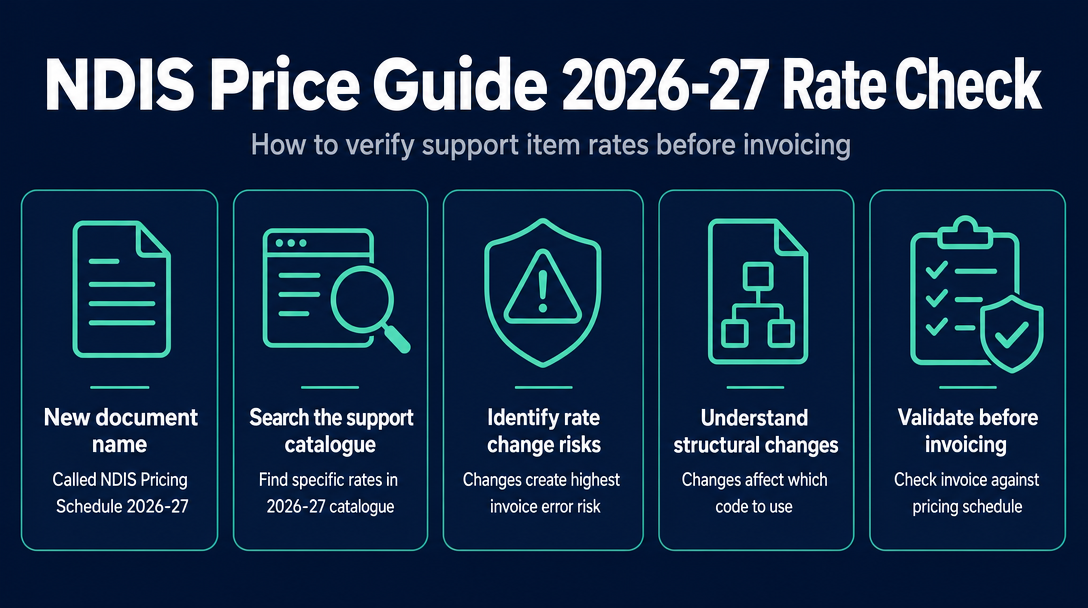
NDIS Price Guide 2026-27: How to Check Support Item Rates Before Invoicing
If you are searching for the "NDIS price guide 2026-27," the document you need is now officially called the NDIS Pricing Schedule 2026-27, effective from
NDIS Price Guide 2026-27: How to Check Support Item Rates Before Invoicing
If you are searching for the "NDIS price guide 2026-27," the document you need is now officially called the NDIS Pricing Schedule 2026-27, effective from 1 July 2026. The old Pricing Arrangements and Price Limits (PAPL) has been renamed, rates have moved in both directions across support categories, and carrying an unchanged invoice template into the new financial year creates two distinct types of error - over-cap billing (non-compliant) or under-cap billing (lost revenue). This article explains what changed, which changes carry the highest invoice risk, and how to validate a line item against the live document before you send a claim.
The Pricing Schedule Has a New Name - and That's Causing Search Confusion
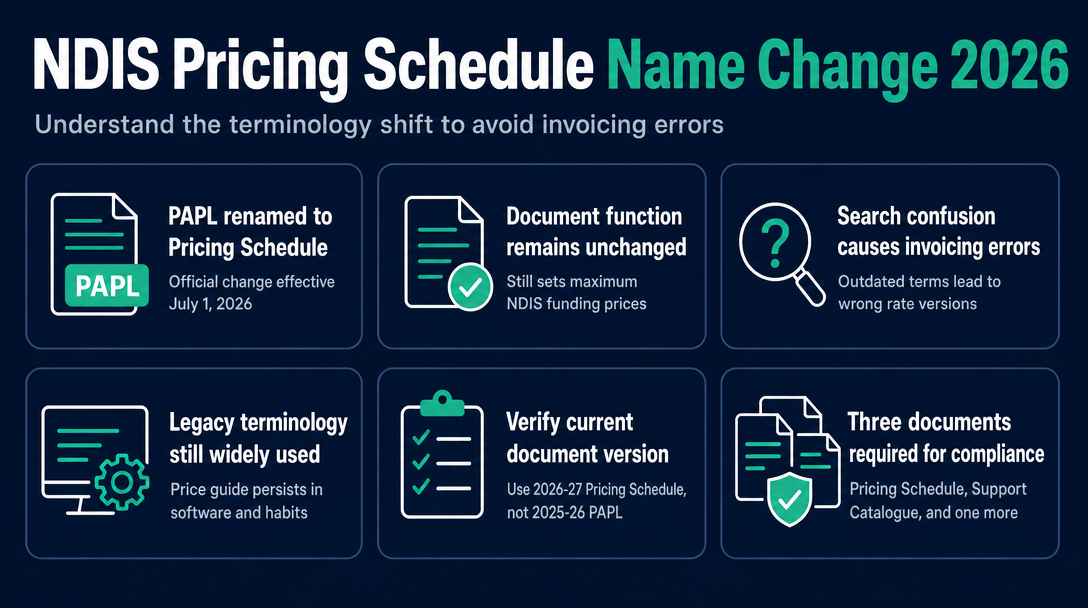
From 1 July 2026, the NDIA officially retired the name "Pricing Arrangements and Price Limits (PAPL)" and replaced it with the simpler title NDIS Pricing Schedule. The function of the document is unchanged - it sets the maximum prices the NDIS will fund for every support type - but the rename has created real search friction. Providers typing "NDIS price guide 2026-27" or "PAPL July 2026" are often landing on cached 2025-26 files or outdated bookmarks, then invoicing against last year's rates.
The phrase "NDIS price guide" is not an official 2026-27 term. It is legacy language that persists in practice management software, provider handbooks, and search habits. If your system still uses it, you are referencing the right concept - just make sure the document you are actually working from is the current Pricing Schedule, not a saved copy of the 2025-26 PAPL.
Three companion documents must be used together for invoice compliance:
- NDIS Pricing Schedule 2026-27 (PDF or DOCX) - the rules and maximum price limits
- NDIS Support Catalogue 2026-27 (XLSX) - the searchable list of every support item code with its current price
- Pricing addenda - supplements for specific support circumstances
The Annual Pricing Review (APR) is the NDIA process that produces these documents each year. The 2026-27 review was informed by the Fair Work Commission's Annual Wage Review, which flows into SCHADS Award adjustments and drives the support worker and nursing rate increases described below.
Where to download the official 2026-27 Pricing Schedule and Support Catalogue
Both documents are available at no cost directly from the NDIA:
- Pricing Schedule and Support Catalogue: ndis.gov.au - Pricing arrangements
- Latest pricing updates and addenda: ndis.gov.au - Pricing updates
Do not download from third-party sites. Only the ndis.gov.au versions are authoritative and up to date.
How to Search the 2026-27 NDIS Support Catalogue for a Specific Rate
The NDIS Pricing Schedule (PDF/DOCX) contains the rules. The NDIS Support Catalogue (XLSX) is the practical search tool for finding a specific line item's current price limit. It is the document you should have open when building or checking an invoice. The NDIS Support Catalogue contains hundreds of current line items across all support categories.
To find a rate in the XLSX:
- Open the file in Excel or Google Sheets.
- Press Ctrl+F (or Cmd+F on Mac) and type the support item number (for example,
01_011_0107_1_1for a standard weekday support worker) - or type a keyword from the support name if you do not have the code yet. - Alternatively, use the column filter on column A (support item number) or column B (support item name) to narrow by category.
What each column in the Support Catalogue means
Once you locate a row, the columns you need for invoice compliance are:
| Column | What it tells you |
|---|---|
| Support item number | The code that must appear on your invoice |
| Support item name | Human-readable description - use this to confirm you have the right code |
| Unit | How the support is measured (e.g., H = hour, EA = each) |
| National price | The price cap for standard locations |
| Remote / Very remote price | Higher caps where geographic loading applies |
| Claim type | Whether the item is claimable under agency-managed, plan-managed, and/or self-managed plans |
Matching the correct column to your participant's location is important. Invoicing at the remote rate for a metro participant will place the claim above the applicable cap.
Which Rate Changes in 2026-27 Create the Highest Invoice Error Risk
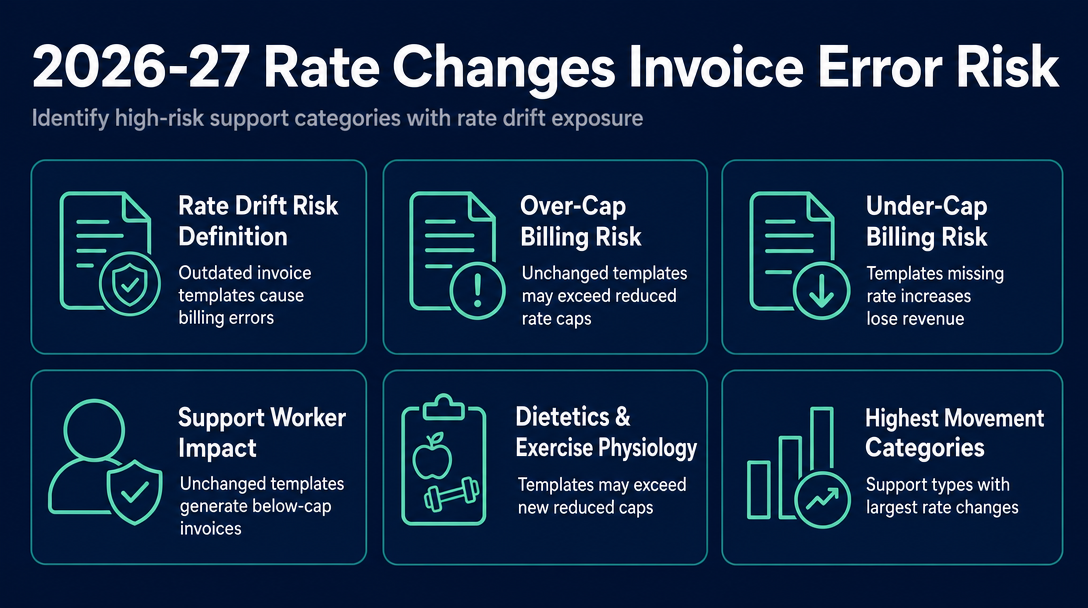
This is where the concept of Rate Drift Risk becomes useful. Rate Drift Risk is the exposure created when a provider's invoice template carries forward a rate from the previous financial year's pricing schedule without being updated to the current year's caps - resulting in either over-cap billing (non-compliant) or under-cap billing (lost revenue), depending on whether that support category's rate increased or decreased.
Rate Drift Risk runs in both directions. A support worker template unchanged since June 2026 will generate invoices below the new cap - legally fine, but leaving revenue on the table on every shift. A dietetics or exercise physiology template unchanged since June 2026 may now sit above the reduced 2026-27 cap, making every invoice in that category non-compliant.
The table below shows the categories with the highest rate movement - the items where an unchanged template will produce an error:
| Support type | 2025-26 national rate | 2026-27 national rate | Direction | Invoice error risk |
|---|---|---|---|---|
| Support worker - standard weekday daytime (01_011_0107_1_1) | $70.23/hr | $73.58/hr | + approx. 4.8% | Under-charging if template not updated |
| Psychology - capacity building | approx. $232/hr | $252.99/hr | + approx. 8.6% | Under-charging if template not updated |
| Dietetics / Exercise physiology | Higher | Reduced | Cut | Over-charging if template not updated = non-compliant |
| Support Coordination Level 2 and 3 | Unchanged | Unchanged | Frozen | No rate error risk; note: service agreement review still recommended |
| Plan management (monthly) | Unchanged | Unchanged | Frozen | No rate error risk |
Rates increased for support workers and nursing in line with SCHADS Award adjustments. Psychology rose 8.6% to $252.99 per hour nationally from 1 July 2026, making it one of the largest single-category movements this cycle. Dietetics, exercise physiology, and the "Other Professional" rate were cut - these are the categories where failing to update a template carries compliance exposure, not just revenue impact.
Short Term Accommodation (STA) has a restructured pricing approach for 2026-27. If you deliver STA, check the Support Catalogue for the specific item codes now applicable to your service model, as the structure has changed rather than simply the rate.
Three Structural Changes That Affect Which Code You Use (Not Just the Rate)
Some 2026-27 changes are not about the dollar amount at all. They involve the code itself - meaning a provider can be invoicing at a compliant rate and still have a non-compliant claim because the item number is no longer correct.
Therapy unbundling and new suffix codes: From 1 July 2026, a range of allied health items now use suffix codes that distinguish the type of service delivered - direct (face-to-face) service, telehealth, non-face-to-face time, report writing, and provider travel. Previously, a single code covered the whole item. Using the old unsuffixed code when a suffixed version now applies means the claim type may not match the service actually delivered. Allied health providers and therapy assistants should review every item code they use against the updated Support Catalogue.
SIL new code 0138: For Supported Independent Living supports delivered from 1 July 2026, a new support item code was introduced - specifically for "Assistance with Supported Independent Living." Using the previous SIL code on invoices for services delivered after 1 July 2026 will cause claiming problems. This change primarily affects registered SIL providers rather than sole traders; if you do not deliver SIL, this does not affect your invoices. Confirm the current code from the NDIS pricing updates page before billing.
Short-notice cancellation period - now 2 clear business days: The cancellation period for non-Disability Support Worker-related supports has changed to 2 clear business days under the 2026-27 rules. Providers who bill short-notice cancellation fees based on the previous cancellation window may be applying an incorrect claiming basis. Check your cancellation fee line items and service agreement terms against the updated rules.
SCCP deferred: Social, Community and Civic Participation (SCCP) pricing changes are not live yet - those changes take effect from January 2027. You do not need to update SCCP invoice lines now.
For sole traders: The SIL code change and therapy suffix changes are unlikely to affect your typical invoice if you deliver individual support work. The changes that do apply to you are the support worker rate increase (from $70.23 to $73.58/hr for standard weekday daytime), the updated cancellation rules if you bill short-notice cancellation fees, and any allied health items if you hold a relevant registration.
How to Validate an Invoice Against the 2026-27 Pricing Schedule Before Sending
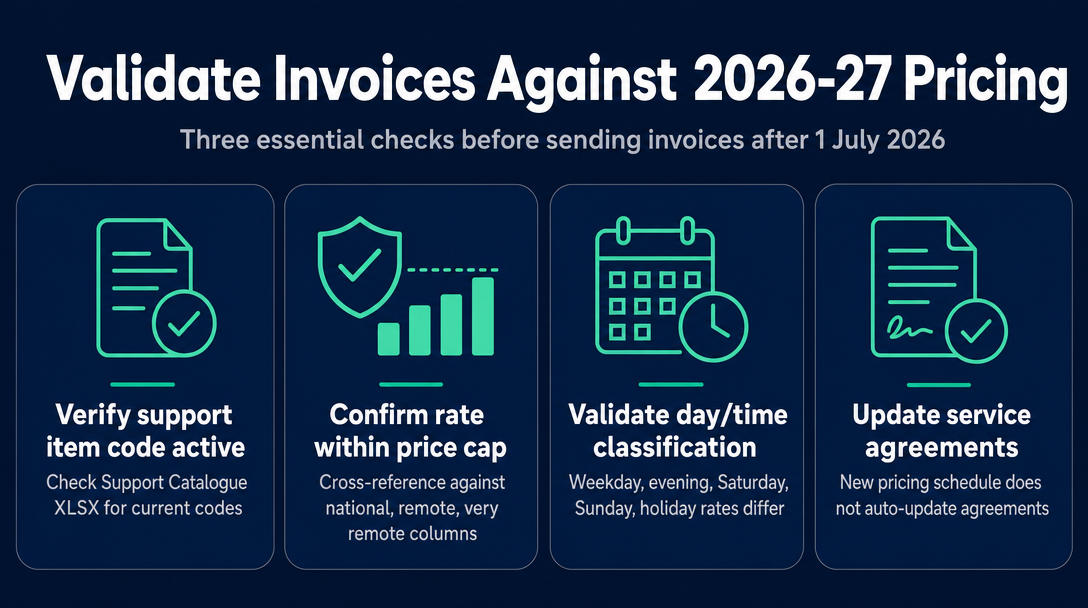
Before any invoice goes out after 1 July 2026, three checks on each line item will catch the most common 2026-27 errors:
Is the support item code still active? The Support Catalogue XLSX lists only current codes. If your code does not appear, it may have been retired or replaced (as with the SIL code above). An inactive code will cause a claim rejection.
Is the rate at or below the current price cap? Cross-reference your invoiced amount against the national, remote, or very remote column depending on where the support was delivered. This is the direct Rate Drift Risk check.
Is the day/time classification correct? Weekday daytime, weekday evening, Saturday, Sunday, and public holiday rates carry different price caps. Misclassifying a Saturday shift as a weekday, or a public holiday as a Sunday, is one of the most frequent support worker invoice errors - and it runs in both directions.
One important procedural point: the new pricing schedule does not automatically update your existing service agreements. The NDIA requires that providers discuss proposed changes to prices with participants before applying new rates. Your service agreement and your invoice both need to reflect the same pricing basis - and the participant needs to have agreed to any change before you apply the higher rate. Note also that NDIS participant plans are indexed (from 13 July 2026) to accommodate the pricing changes, so participants' budgets do reflect the new caps - but the service agreement conversation is still a required step.
For agency-managed participants, invoices that exceed the price cap will be rejected by PRODA. For plan-managed participants, the plan manager is required to reject non-compliant invoices. Neither is a quick fix.
Tools that run all three checks automatically - like NDIS Invoice - validate every line item against the current pricing schedule in your browser, with nothing leaving your device.
NDIS Pricing Schedule 2026-27 - Frequently Asked Questions
Is the NDIS Price Guide the same as the NDIS Pricing Schedule 2026-27?
"NDIS Price Guide" is informal, legacy terminology that many providers and search engines still use. The current official document is the NDIS Pricing Schedule 2026-27, which replaced the Pricing Arrangements and Price Limits (PAPL) from 1 July 2026. Both terms refer to the same function - setting maximum prices for NDIS supports - but only the Pricing Schedule is the authoritative 2026-27 document.
Where do I download the official 2026-27 Pricing Schedule?
Download the Pricing Schedule (PDF or DOCX) and the companion Support Catalogue (XLSX) from the NDIA's official site: ndis.gov.au - Pricing arrangements. Both documents are free. The Schedule sets the rules and price limits; the Catalogue lists every support item code with its current price and is the document to use when checking a specific rate.
Do I need to update my service agreements after the July 2026 pricing changes?
The new price caps take effect from 1 July 2026 but do not automatically change your existing service agreements. The NDIA requires providers to discuss any proposed changes to prices with participants before applying new rates. You should review and, where necessary, update service agreements to reflect the 2026-27 rates before invoicing at the new amounts.
What is the new support worker rate under the NDIS Pricing Schedule 2026-27?
The standard weekday daytime price limit for a Level 1 disability support worker rose to $73.58 per hour nationally from 1 July 2026, up from $70.23 per hour in 2025-26 - an increase of approximately 4.8%. Evening, weekend, and public holiday rates carry higher caps; check the Support Catalogue for the code that matches the actual time of service.
What happens if I invoice above the 2026-27 price cap?
Invoicing above the maximum price limit is non-compliant under NDIS pricing rules. For agency-managed participants, PRODA will reject the claim. For plan-managed participants, the plan manager is required to reject invoices that exceed the cap. In either case, the invoice must be corrected and resubmitted - there is no automatic adjustment.
Check your 2026-27 rates before your next invoice goes out. NDIS Invoice validates every line item against the current pricing schedule directly in your browser - catching outdated codes, over-cap rates, and wrong day/time classifications before a claim is submitted. Nothing leaves your device. No subscription required. Validate your invoice free at ndisinvoice.com.au
More articles
- How to Send Your NDIS Invoice After Creating It: A Step-by-Step Guide for Sole Traders
- Cloud-Based NDIS Invoicing vs. Local Processing: Why Privacy Matters for Participant Data
- NDIS Invoice Builder vs. Static Template: Why a Live Price-Guide Check Changes Everything
- NDISInvoice.com.au vs. Earni: Free Browser Tool vs. App Subscription for NDIS Support Workers
- NDISInvoice.com.au vs. Billability: Which Free-Tier NDIS Invoicing Tool Fits Your Needs?