GST on NDIS Invoices: What Support Workers Need to Know Before Adding (or Skipping) Tax
Written by Cory Nathan, founder of NDIS Invoice · Last reviewed
Most NDIS services are GST-free under section 38-38 of the A New Tax System (Goods and Services Tax) Act 1999 - but "GST-free" does not mean "ignore GST
12 min read
GST on NDIS Invoices: What Support Workers Need to Know Before Adding (or Skipping) Tax
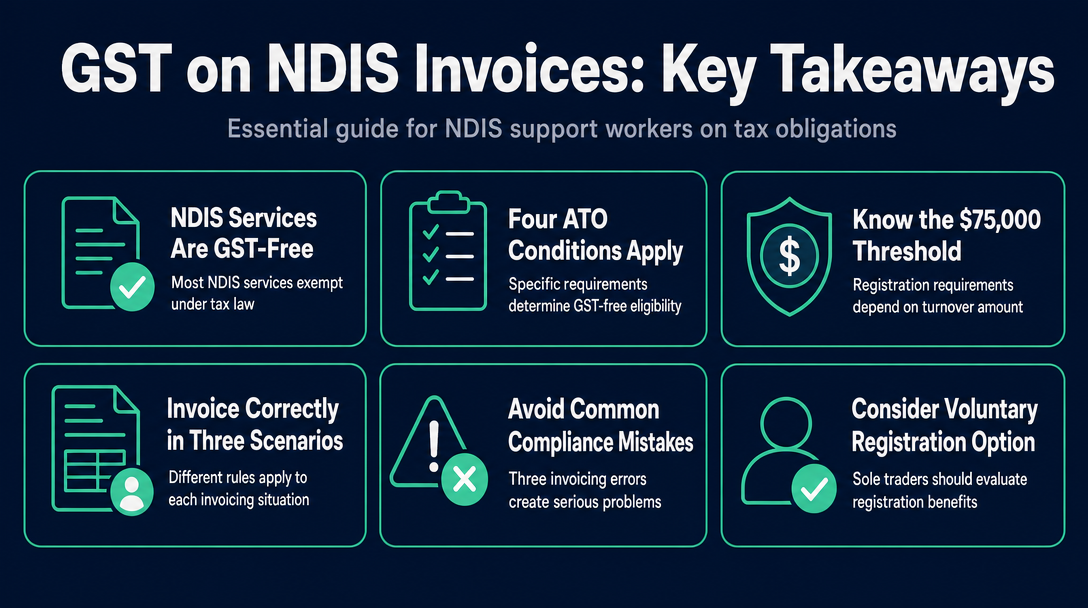
Most NDIS services are GST-free under section 38-38 of the A New Tax System (Goods and Services Tax) Act 1999 - but "GST-free" does not mean "ignore GST entirely." The rules still govern what you write on the invoice, what you call the document, and whether you need to register at all. Getting any of these wrong is one of the most common reasons an NDIS invoice triggers a query from a plan manager or the ATO.
This article covers the exact mechanics: the four qualifying conditions, the $75,000 registration threshold twist that catches many sole traders off guard, and precisely what to write on each line of your invoice across three different scenarios.
Does GST Apply to NDIS Invoices?
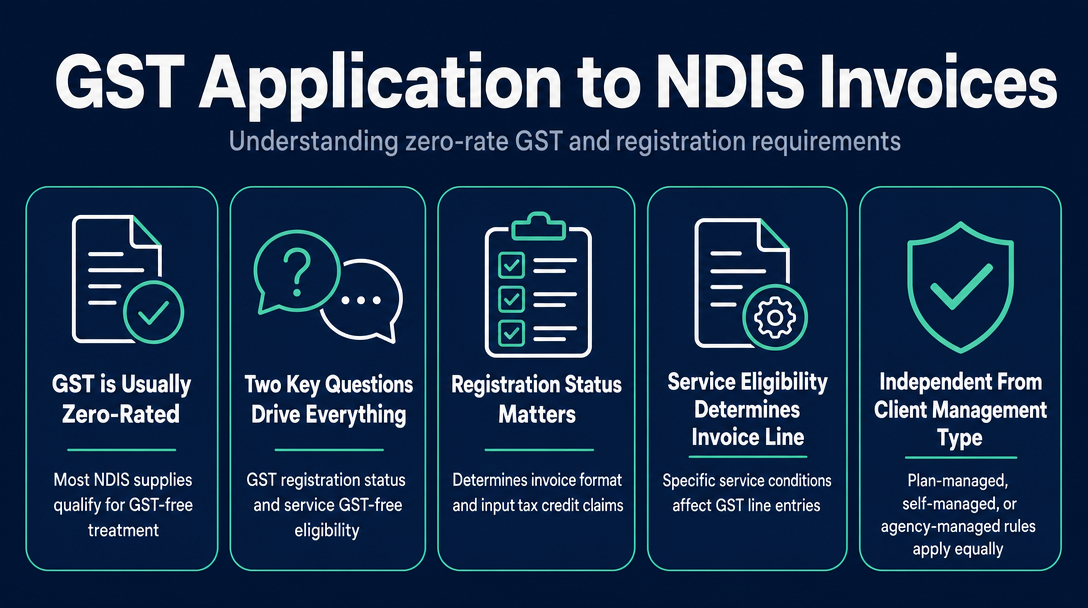
Yes - but in most cases the GST rate that applies is zero, because the supply is GST-free. That is not the same as GST being irrelevant. You still need to determine whether your service qualifies for GST-free treatment, whether you are required to register for GST at all, and how to reflect both of those decisions correctly on the invoice you send.
Two separate questions drive everything:
- Am I required (or choosing) to be registered for GST? - This determines the document title and whether you can claim input tax credits (ITCs) on your own expenses.
- Does this specific service meet the conditions for GST-free treatment? - This determines what goes on the GST line of the invoice.
These are independent. A sole trader can be GST-registered and still charge $0 GST - because the service is GST-free. A sole trader can be unregistered and also charge $0 GST - but for a different reason and with different invoice wording.
One other point worth clarifying: it does not matter whether your client is plan-managed, self-managed, or agency-managed. The ATO's GST rules apply regardless of how the NDIS funding flows. The National Disability Insurance Agency (NDIA) processes claims, but it is the ATO that sets the GST treatment.
The Four ATO Conditions: When Your Service Is GST-Free
Under section 38-38 of the GST Act, a supply to an NDIS participant is GST-free only when all four of the following conditions are met simultaneously. Missing even one condition means that particular supply is taxable at the standard 10% rate.
| # | Condition | What it means for your invoice |
|---|---|---|
| 1 | The person is an NDIS participant with a plan currently in effect | If the plan has expired or the person is not yet an approved participant, the supply is taxable |
| 2 | The support is a reasonable and necessary support specified in the participant's NDIS plan | Supports you deliver beyond the scope of the plan are taxable, even to a current participant |
| 3 | There is a written agreement between you and the participant (or their representative) identifying the participant and stating the support is part of their NDIS plan | A signed service agreement is the safest way to satisfy this. Written correspondence or invoices can satisfy it in limited circumstances, but a formal service agreement removes doubt |
| 4 | The type of support is listed in the NDIS (Supports for Participants) (List of Supports) Determination 2021 | Common inclusions: personal care, community participation, support coordination, plan management, home help, therapeutic supports. Common exclusions: room and board, transport in some configurations, items not on the approved list |
The fourth condition is the one most often overlooked. A support worker who provides a service that is not on the Determination 2021 list - even to a genuine NDIS participant under a valid plan - is supplying a taxable service. Treating it as GST-free is an invoicing error.
Do You Need to Register for GST? The $75,000 Threshold - and the Twist
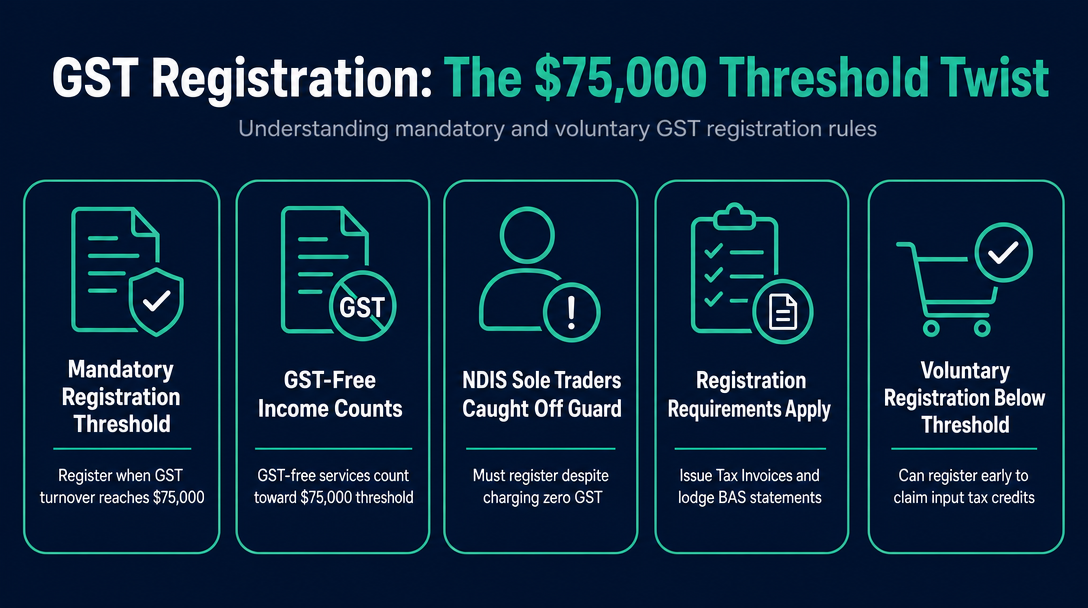
The general rule is straightforward: register for GST if your GST turnover reaches or is projected to reach $75,000 in any 12-month period ($150,000 for not-for-profits).
Here is the twist that catches many NDIS sole traders off guard: GST-free income counts toward your $75,000 threshold. A sole trader earning $80,000 entirely from GST-free NDIS services is still required to register for GST - even though they will never charge a participant a single dollar of GST. Registration is triggered by turnover, not by how much GST you actually collect.
The practical consequence: you may be legally required to register, issue Tax Invoices, and lodge a Business Activity Statement (BAS) - all while charging $0 GST on every line.
Voluntary registration below $75,000: You can choose to register even if your turnover is below the threshold. The main benefit is claiming input tax credits (ITCs) - the GST you pay on your own business expenses (vehicle running costs, mobile phone, professional development, software, equipment) can be claimed back via your BAS. The trade-off is the compliance obligation: quarterly or annual BAS lodgment, additional record-keeping, and correctly classifying every supply. Whether the ITC saving justifies the compliance overhead depends on your specific expense profile - a registered tax agent can run the numbers for your situation.
| Turnover | Registration | Document title | Can claim ITCs? |
|---|---|---|---|
| $75,000 or above | Must register | "Tax Invoice" | Yes |
| Below $75,000 | Optional | "Invoice" (unless registered) | Only if registered |
What to Actually Write on the Invoice: Three Scenarios
This is where most guidance stops at the abstract rule and leaves you to guess the practical wording. The "GST Invoice Scenario Test" cuts through that with three questions you ask at invoice time - not at registration time, not at BAS time:
- Am I GST-registered? - Determines document title and ITC eligibility.
- Does this specific service meet all four s 38-38 conditions? - Determines the GST line treatment.
- Does this invoice include any mixed lines (some GST-free, some taxable)? - Determines whether you need separate line items.
Run through the three scenarios below to find yours.
Scenario A: You Are NOT Registered for GST
| Invoice field | What to write |
|---|---|
| Document title | Invoice (never "Tax Invoice") |
| Your name / trading name | Your registered business name or personal name |
| ABN | Your ABN - required. Without it, your client must withhold 47% of payment under the ATO's no-ABN withholding rule |
| Date | Invoice date |
| Description | Support type, hours/units delivered |
| Rate | Hourly or unit rate |
| Total | Full amount (no GST added) |
| GST note | "This business is not registered for GST - no GST has been charged." |
The ATO is explicit: only GST-registered entities may issue a document called a "Tax Invoice." Calling your document "Tax Invoice" when you are not registered is a compliance error - it misleads the recipient into thinking a GST credit exists when it does not.
Do not add a "$0.00 GST" line. That line implies GST was assessed and found to be zero - a different concept. A plain explanatory note is the correct approach.
Scenario B: You ARE Registered for GST - Service Meets All Four Conditions (GST-Free)
| Invoice field | What to write |
|---|---|
| Document title | Tax Invoice (required for all GST-registered entities) |
| ABN | Your ABN |
| Date | Invoice date |
| Description | Support type, hours/units |
| Rate | Hourly or unit rate |
| GST line | $0.00 - GST-free supply (s 38-38, A New Tax System (Goods and Services Tax) Act 1999) |
| Total | Full amount with no GST added |
Showing the GST line explicitly as $0.00 with the legislative reference gives the plan manager or participant the information they need to process the invoice correctly and confirms you have assessed the GST treatment - not simply forgotten to add it. The NDIS record-keeping requirements and ATO tax invoice rules both point in this direction.
Scenario C: You ARE Registered for GST - Mixed Invoice (One Line GST-Free, One Line Taxable)
This scenario is the most commonly mishandled. A sole trader delivers 3 hours of personal care (GST-free under s 38-38) and also sells the participant an assistive device that is not on the Determination 2021 list (taxable at 10%). The invoice must itemise each supply separately with its own GST treatment.
| Line | Description | Amount | GST | Line total |
|---|---|---|---|---|
| 1 | Personal care - 3 hrs x $65.00 | $195.00 | $0.00 (GST-free, s 38-38) | $195.00 |
| 2 | Assistive device | $100.00 | $10.00 (10% GST) | $110.00 |
| Total | $305.00 |
Treating the entire invoice as GST-free because the participant has an NDIS plan is a compliance error. Each line must be assessed against the four conditions independently. Your BAS must also correctly split the two portions - GST-free sales on one label, taxable sales on another.
Ready to apply this to a real invoice? NDIS Invoice is a free, browser-based tool that validates every line item against the current NDIS Pricing Schedule before you send - catching errors like wrong support codes, rates above the price cap, and incorrect day/time classifications. Build your compliant invoice now at ndisinvoice.com.au.
Voluntary GST Registration: Is It Worth It for a Sole Trader?
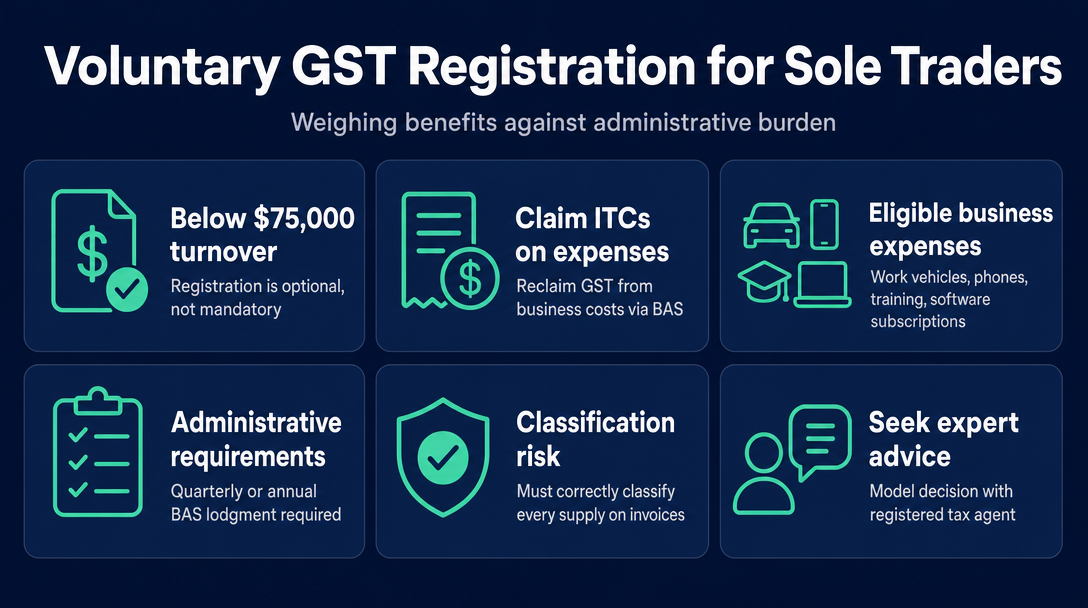
If your turnover is below $75,000, registration is a choice, not an obligation. The case for registering rests on one thing: claiming ITCs on your business expenses. If you run a car for work, use a phone, pay for professional development, or subscribe to software, the GST embedded in those costs is reclaimable via your BAS - but only if you are registered.
The case against is equally real. You take on quarterly or annual BAS lodgment, must correctly classify every supply on every invoice, and carry the risk of mis-classifying a line. If your business expenses are modest and your services are overwhelmingly GST-free personal care or community support, the ITC saving may not justify the administrative load.
This is a decision worth modelling with a registered tax agent before you commit either way.
Three GST Invoicing Mistakes That Create Compliance Problems
These are the errors most likely to result in a query, a rejected claim, or an ATO audit flag.
Mistake 1: Calling the document "Tax Invoice" when not GST-registered. This misleads the plan manager or participant into believing they can claim a GST credit that does not exist. Fix it before you send - or issue a corrected document immediately if you have already sent it.
Mistake 2: Adding 10% GST to a service that meets all four s 38-38 conditions. The participant's NDIS budget pays the invoice. An inflated invoice consumes more of their funding than the NDIS Pricing Arrangements allow - which can simultaneously breach the price cap rules. The fix: issue a corrected invoice (credit note or adjustment note), return any overpayment, and ensure your BAS does not treat the incorrectly collected amount as output tax. Seek advice from a registered tax agent promptly.
Mistake 3: Treating an entire invoice as GST-free because the client has an NDIS plan. Each line must be assessed against all four conditions independently. If any support on that invoice falls outside the Determination 2021 list, or was delivered beyond the scope of the plan, that line is taxable. Applying a blanket "NDIS = GST-free" label to every line is a recognised compliance risk.
For a broader view of invoice errors that lead to rejection, see the pillar article Why NDIS Invoices Get Rejected: The 7 Most Common Errors (and How to Check Yours Before Sending) - GST treatment sits alongside support code errors, price cap breaches, and date mismatches as the most frequent problems.
Frequently Asked Questions
Does GST-free income count toward my $75,000 registration threshold?
Yes. GST-free NDIS income counts toward your GST turnover for registration purposes. A sole trader earning $80,000 entirely from GST-free personal care or community supports is still required to register for GST - even though no GST will appear on any invoice they send.
Do I need a written service agreement just for GST purposes?
A written agreement is one of the four mandatory conditions under section 38-38. Without it, the supply does not meet the statutory requirements for GST-free treatment, regardless of whether the other three conditions are satisfied. A signed service agreement is the most reliable way to satisfy this condition. Written correspondence can satisfy it in limited circumstances, but a formal agreement is the safer approach.
Can I claim back GST on my phone and car if my NDIS work is all GST-free?
Only if you are registered for GST. If you are registered, yes - you can claim ITCs on your business expenses regardless of whether your supplies are GST-free. If you are not registered for GST, no ITCs are available to you.
My plan manager said my invoice needs to say "Tax Invoice" - is that right?
Only if you are GST-registered. If you are not registered, your document must say "Invoice." Let the plan manager know your GST registration status and reissue the document with the correct title if necessary. Issuing a "Tax Invoice" as an unregistered entity is a compliance error.
What if I have already sent an invoice with GST I should not have charged?
Issue a corrected invoice or adjustment note, return any overpayment to the participant or their plan manager, and ensure your BAS does not include the incorrectly collected amount as an output tax liability. Seek advice from a registered tax agent promptly - the correction process has specific requirements and the sooner it is addressed, the simpler it is to resolve.
Check your invoice before it goes out. NDIS Invoice is a free, private, browser-based tool built for sole trader support workers and NDIS providers. It validates every support item code and rate against the current Pricing Schedule and flags common compliance errors - all without sending your data anywhere. Start at ndisinvoice.com.au.
More articles
- How to Create Your First NDIS Invoice in Under 5 Minutes (Step-by-Step Video Companion)
- NDIS Plan Manager Turnaround Times: How Long Should You Wait to Be Paid After Submitting an Invoice?
- NDIS Invoice Numbering: Do You Need a Sequential System? (And What Happens If You Don't Have One)
- How to Handle a Rejected NDIS Invoice: Diagnosis, Correction, and Resubmission Step by Step
- NDIS Allied Health Invoicing: How Physiotherapy, Speech Therapy, and OT Codes Work in the Price Guide