How to Invoice NDIS Provider Travel: Rules, Codes, and Caps for Support Workers in 2026-27
Written by Cory Nathan, founder of NDIS Invoice · Last reviewed
Travel invoicing is one of the most rejected claim types in the NDIS system - not because providers are dishonest, but because the structure is genuinely
15 min read
How to Invoice NDIS Provider Travel: Rules, Codes, and Caps for Support Workers in 2026-27
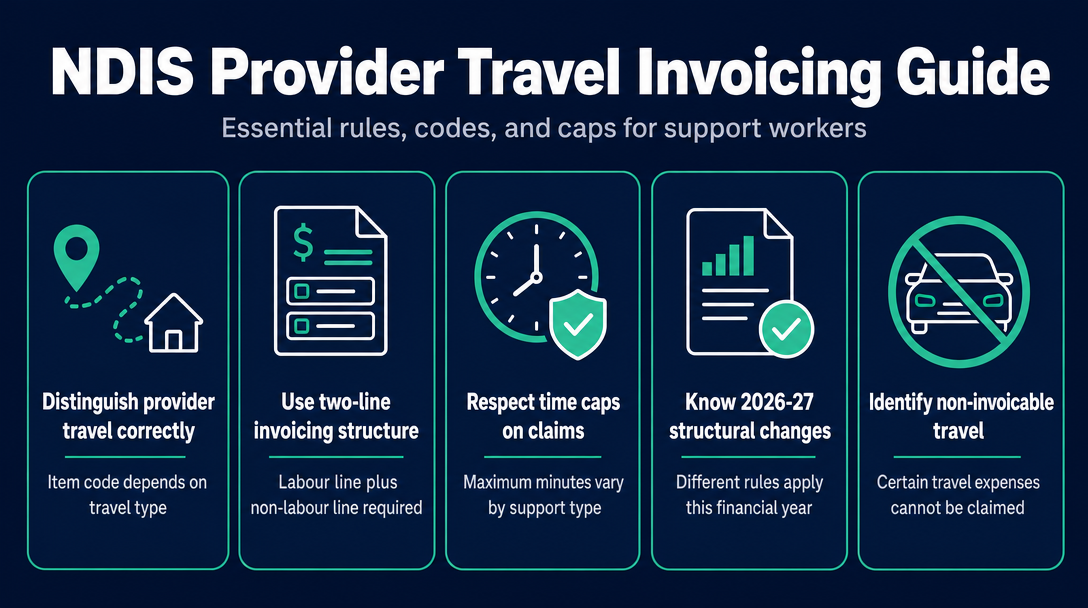
Travel invoicing is one of the most rejected claim types in the NDIS system - not because providers are dishonest, but because the structure is genuinely confusing. There are two separate line items to write, zone-based time caps to check, a pre-condition in your service agreement to satisfy, and a 2026-27 structural change that affects allied health providers entirely. This guide walks through every rule, then shows you exactly what a compliant travel invoice looks like, line by line.
Provider Travel vs. Participant Transport: The Distinction That Changes Your Item Code
These are two fundamentally different claims. Confusing them is the fastest route to a plan manager rejection.
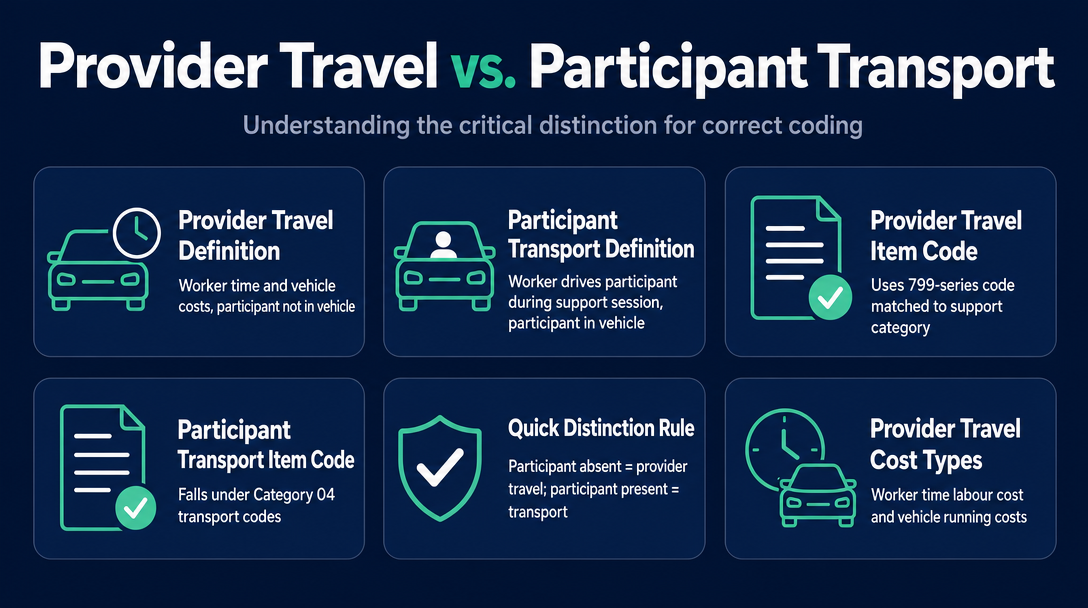
Provider travel is the worker's time and vehicle costs getting to a participant, or moving between participants. The participant is not in the vehicle. This claim uses a 799-series item code matched to the category of the primary support delivered.
Participant transport is when the worker drives the participant somewhere during a support session - the participant is in the vehicle, moving as part of their community participation or daily life. This falls under Category 04 transport item codes, draws from a different budget line, and operates under completely different rules.
One practical rule: if the participant is not in the vehicle, it is almost certainly provider travel (799-series). If the participant is in the vehicle, it is likely participant transport (Category 04).
What "provider travel" actually covers
Provider travel covers two distinct cost types: the worker's time while travelling (a labour cost) and the vehicle running costs per kilometre (a non-labour cost). Both are claimable. Both appear on the invoice - but they must appear as separate line items. This is the structural principle the rest of this article builds on.
What "participant transport" covers and why it belongs elsewhere
Participant transport covers the cost of moving a participant to community activities, appointments, or other destinations as part of an active support session. It has its own item codes, its own rules, and its own documentation requirements. That is a separate topic. This article covers provider travel only.
The Two-Line Rule: Every Travel Claim Has a Labour Line and a Non-Labour Line
Every NDIS provider travel claim consists of exactly two distinct line items: a labour line for travel time and a non-labour line for vehicle kilometre costs. Combining them into a single line - or omitting one - is the structural error that causes most plan manager rejections.
Line 1 - Labour (travel time): The time you spent travelling, billed at the same hourly rate as the primary support item, using the 799-series code that matches your support category prefix. If you delivered Assistance with Daily Living (Category 01), your travel time line uses 01_799_XXXX_X_X.
Line 2 - Non-Labour (km costs): The per-kilometre vehicle cost, billed at the schedule rate. For the 2026-27 financial year, the NDIS Pricing Schedule sets this at $0.99 per kilometre for a standard vehicle and $2.76 per kilometre for a modified vehicle. This line uses its own 799 non-labour cost item code. The quantity field carries the kilometres; the unit price is the per-km rate.
These are not double-dipping. Time and kilometres are different cost types - labour versus vehicle running costs. What counts as double-dipping is claiming travel time twice, or building a hidden time component into an inflated per-km rate.
Which 799 code matches your support category
The 799 code prefix mirrors the category of the primary support you delivered in the same session:
| Primary Support Category | Category Number | 799 Code Prefix |
|---|---|---|
| Assistance with Daily Living | 01 | 01_799... |
| Assistance with Social, Economic and Community Participation | 04 | 04_799... |
| Improved Living Arrangements | 05 | 05_799... |
| Increased Social and Community Participation | 09 | 09_799... |
| Improved Daily Living (Capacity Building) | 15 | 15_799... |
| Support Coordination | 07 | 07_799... |
Check the NDIS Support Catalogue for the exact item identifier in your category - the full code includes additional digits after the prefix. A missing SIL travel item (01_799_0138_1_1) was added to the 2026-27 catalogue in mid-July 2026, so confirm you are working from the current version of the catalogue rather than a copy downloaded at the start of the financial year.
How to write the line item description
Use plain, specific language. A good travel line item description reads: "Provider travel - travel time to [Participant Name/NDIS number] - [date] - [minutes] min" for the labour line, and "Provider travel - vehicle km cost - [date] - [km] km @ $0.99/km" for the non-labour line. Vague descriptions like "travel" or "other" invite scrutiny.
What to do with parking and tolls
Parking fees and tolls are claimable as actual costs with receipts. They do not have a specific 799 item code - include them as a separately described line with the amount and a note: "Parking - [location] - [date] - receipt held." Never bundle them into the km rate or the time line.
Note: travel time is billed at the NDIS price limit for the support category, which sets the ceiling. The SCHADS Award (MA000100) sets a separate minimum floor for employed workers - the two are not the same figure, and it is the NDIS price limit that determines what you can charge the participant's plan.
The Time Caps: How Many Minutes of Travel You Can Invoice
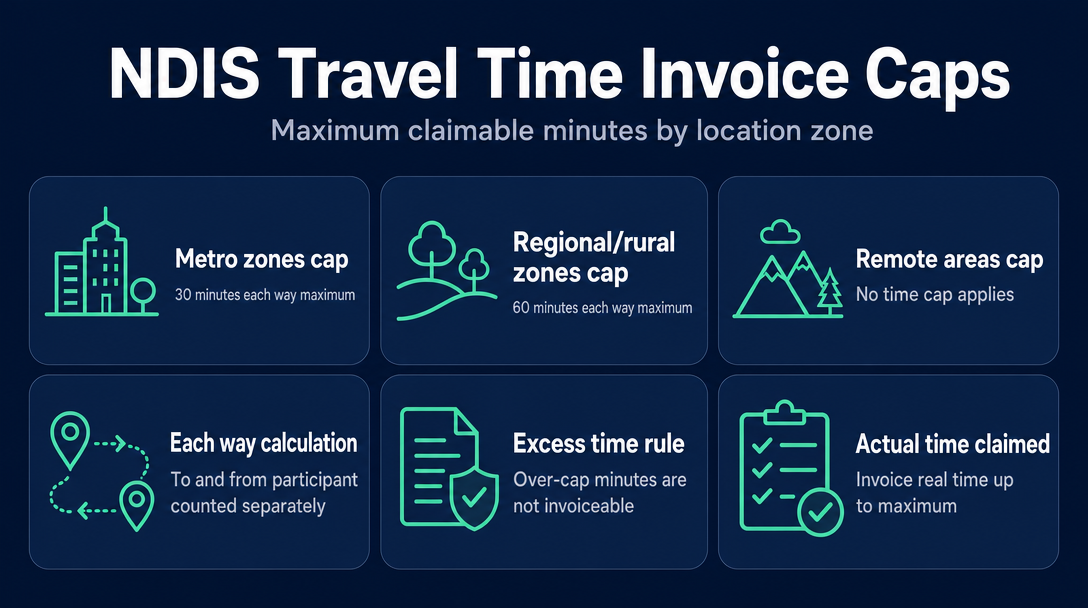
The NDIS sets hard maximum claimable travel times based on the participant's Modified Monash Model (MMM) location zone. According to NDIA guidance, the caps are:
| MMM Zone | Area Type | Maximum Claimable Travel Time |
|---|---|---|
| MMM 1-3 | Metropolitan to large regional towns | 30 minutes each way |
| MMM 4-5 | Regional and rural | 60 minutes each way |
| MMM 6-7 | Remote and Very Remote | No time cap |
"Each way" matters: in a metro area, you can potentially invoice up to 30 minutes travelling to a participant AND up to 30 minutes returning from them - 60 minutes total for a single visit. But "up to" is the ceiling, not a guaranteed entitlement. You claim the actual time, capped at the maximum.
Time over the cap cannot be invoiced. If you drive 40 minutes to a metro participant, you invoice 30 minutes. The extra 10 minutes is absorbed as a business operating cost. This applies even when the longer travel was genuinely necessary.
For Remote and Very Remote (MMM 6-7) providers, there is no time limit - but costs still need to be agreed in the service agreement, and they must be reasonable.
How to find your MMM zone
Use the Health Workforce Locator on the Australian Government Department of Health and Aged Care website to check the MMM classification for a participant's address. The zone is based on the participant's location, not the worker's.
What "usual place of business" means for sole traders
This is a commonly misunderstood rule. Provider travel is claimable from your usual place of business to the participant - not from your personal home unless your home address is also your registered business address.
If your registered business address and your home are the same (common for sole traders), then travel from home to your first participant is claimable provider travel (subject to the time caps). If your home is different from your registered business address, travel from home to your first participant is a personal commute and cannot be invoiced. Travel between participants is always claimable regardless of where you started.
The 2026-27 Structural Change: What Is Different This Financial Year
From 1 July 2026, the NDIA separated what was previously a single document - the NDIS Pricing Arrangements and Price Limits (PAPL) - into two distinct documents:
- The NDIS Pricing Schedule: maximum prices only
- The NDIS Support Catalogue: item codes and claim types
This matters for travel invoicing because the narrative rules governing travel (time caps, what can and cannot be claimed, the two-line structure) are not fully reproduced in either new document. When discussing travel rules with a plan manager or responding to an audit query, reference the NDIS Pricing Schedule 2026-27 as the operative document - and be aware that the substantive rules carry over from the prior PAPL framework while the full consolidated rules document is finalised.
Allied health: what the _PT item looks like on an invoice
This is the biggest practical change in 2026-27 for therapy providers. Before 1 July 2026, allied health providers (occupational therapists, physiotherapists, speech pathologists, psychologists, and others) selected provider travel via a "claim type" field in the NDIS portal when submitting their primary therapy item.
From 1 July 2026, that claim type field is no longer used for travel. Instead, provider travel for allied health is now its own separate support item, identified by a _PT suffix in the item code. Therapy providers now invoice travel as a distinct line item with its own code - not as a modifier on the main therapy item. The claim type field should be left as "Standard Service Charges" - the _PT suffix in the item code now carries the travel identifier.
The rate for allied health provider travel is typically 50% of the provider's applicable therapy hourly rate. Confirm the specific _PT item code for your therapy discipline in the current NDIS Support Catalogue.
Core supports: the 799-series structure is unchanged
For core support workers (Assistance with Daily Living, Community Participation, and similar categories), the 799-series coding structure is unchanged in 2026-27. The Two-Line Rule applies exactly as before: a labour 799 line for travel time, and a non-labour 799 line for km costs.
What You Cannot Invoice for Travel
Knowing what is off-limits is as important as knowing what is allowed.
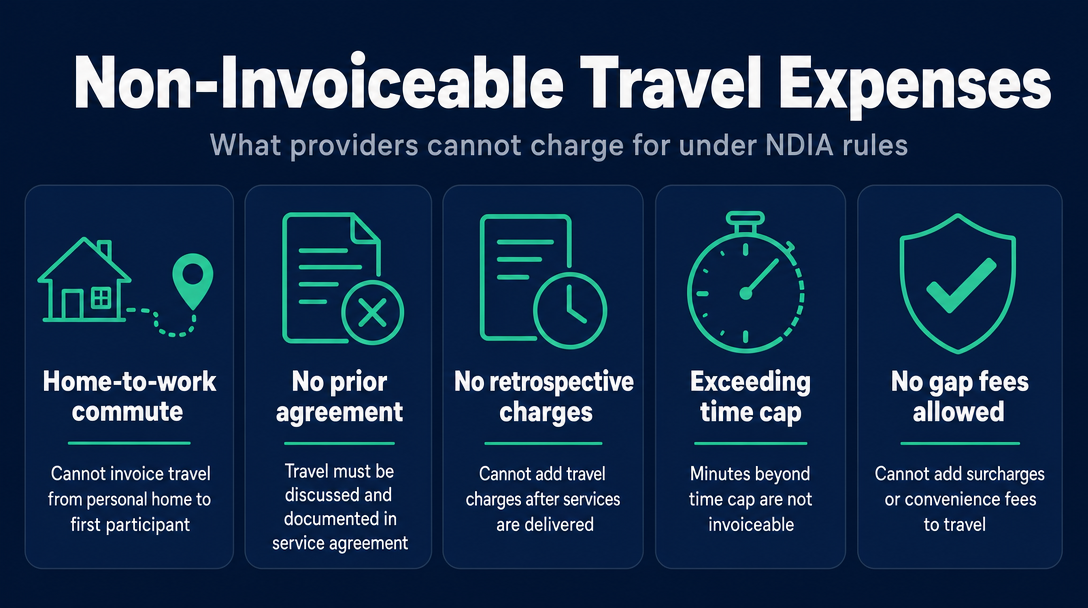
Home-to-work commute. A sole trader cannot invoice for travel from a personal home (that is not the registered business address) to their first participant of the day. That is a commute. Provider travel starts from the registered business address or from the previous participant's location.
No prior participant agreement, no travel claim. Travel cannot be invoiced unless it was discussed and documented in the service agreement before services were delivered. The NDIA is explicit that providers cannot retrospectively add travel charges that were not pre-agreed. If it is not in the service agreement, it cannot appear on the invoice.
Exceeding the time cap. Any minutes beyond the 30 or 60-minute cap are simply not invoiceable. There is no exception for genuinely long journeys within a capped zone.
Gap fees and surcharges on travel. No additional loading, card surcharge, inconvenience fee, or gap fee can be added to a travel line item. This applies to all registered providers.
Travel for cancelled appointments. If a support session is cancelled, specific short-notice cancellation rules govern what can be claimed - and they do not automatically extend to the travel you made before the cancellation. That is governed by the NDIS short-notice cancellation framework, which is outside the scope of this article.
A Worked Invoice Scenario: Provider Travel for a Core Support Worker
Scenario: Tasha is a sole trader delivering Assistance with Daily Living (Category 01) to two participants in a regional town (MMM 4). Her home is also her registered business address. She drives 45 minutes to Participant A, delivers 2 hours of support, then drives 20 minutes to Participant B and delivers 1.5 hours of support, then drives 30 minutes home.
| Line | Description | Item Code | Qty / Unit | Rate | Claimable? |
|---|---|---|---|---|---|
| 1 | Support - Assistance with Daily Living - Participant A - 2 hrs | 01_XXX_XXXX_X_X | 2 hrs | Applicable support rate | Yes |
| 2 | Provider travel (time) - to Participant A - 45 min | 01_799 labour | 45 min | Same as support rate | Yes - within 60-min regional cap |
| 3 | Provider travel (km) - to Participant A - [X] km | 01_799 non-labour | X km | $0.99/km | Yes |
| 4 | Support - Assistance with Daily Living - Participant B - 1.5 hrs | 01_XXX_XXXX_X_X | 1.5 hrs | Applicable support rate | Yes |
| 5 | Provider travel (time) - between participants - 20 min | 01_799 labour | 20 min | Same as support rate | Yes - between clients |
| 6 | Provider travel (km) - between participants - [X] km | 01_799 non-labour | X km | $0.99/km | Yes |
| 7 | Provider travel (time) - return home - 30 min | 01_799 labour | 30 min | Same as support rate | Yes - home is registered business address; within 60-min cap |
| 8 | Provider travel (km) - return home - [X] km | 01_799 non-labour | X km | $0.99/km | Yes |
Note: If Tasha's home were not her registered business address, Line 7 and Line 8 would not be claimable. The return travel cap applies to each leg independently.
Before you send your next travel invoice, validate every code and rate against the current NDIS Pricing Schedule at NDIS Invoice - free in your browser. Paste in your travel line items and catch errors before the claim reaches your plan manager.
What Plan Managers and NDIS Auditors Look For on a Travel Claim
Plan managers processing a travel claim - and auditors reviewing it later - are checking for a specific set of signals. An invoice that supplies these signals gets processed faster and challenged less.
What they check:
- The 799-series code (or _PT code for allied health) matches the primary support category in the same claim
- Labour and non-labour costs appear as separate lines, not bundled
- The time invoiced does not exceed the applicable MMM zone cap
- The rate does not exceed the price limit in the NDIS Pricing Schedule for that support category
- The service agreement pre-dates the travel claim and explicitly permits travel charges
For agency-managed participants, the provider claims directly in the NDIS portal. From 2026-27, the claim type should be left as "Standard Service Charges" - the travel is identified by the item code itself, not a separate claim type selection (for allied health, this is the _PT suffix; for core supports, it is the 799 code).
Documentation you should hold (not always submitted, but required if asked):
- Date of travel and the participant's name and NDIS number
- Actual kilometres travelled or time spent (route and/or odometer/GPS record)
- Which support item the travel related to
- Reference to the service agreement clause permitting travel charges
If your invoicing is under scrutiny, the travel-related errors covered here - wrong codes, missing lines, cap breaches, absent service agreement consent - are among the most common reasons NDIS invoices get rejected. For a broader look at invoice rejection causes, see the article "Why NDIS Invoices Get Rejected: The 7 Most Common Errors" on the NDIS Invoice site.
Frequently Asked Questions
Can I charge for travel to every participant I visit?
No. Two conditions must both be met: the specific support item you delivered must permit provider travel (check the item's description in the NDIS Support Catalogue), and travel must have been agreed in your service agreement before services were delivered. If either condition is absent, travel cannot be invoiced.
What item code do I use for provider travel?
Use the 799-series code with the category prefix that matches the primary support you delivered in that session. For example, Category 01 (Assistance with Daily Living) uses a code beginning 01_799. Allied health providers from 1 July 2026 use the specific _PT-suffixed item for their discipline rather than the old claim type selection.
Can I claim travel time AND kilometres, or is that double-dipping?
You can claim both - they are different cost types (labour and non-labour respectively) and both appear as separate lines on the same invoice. Double-dipping means claiming the same cost type twice, such as adding a time component into an inflated per-km rate while also billing a separate travel time line.
What if my actual travel took longer than the cap?
Invoice only up to the applicable cap: 30 minutes each way in MMM 1-3 areas, or 60 minutes each way in MMM 4-5 areas. Time beyond the cap is not claimable and must not appear on the invoice, regardless of how long the journey actually took.
Do I need participant sign-off before invoicing for travel?
The participant must have agreed to travel charges in the service agreement before service delivery began. An agreement reached after the fact does not satisfy this requirement. If the service agreement is silent on travel, the charge cannot be invoiced - update the agreement before the next session.
Check Your Travel Invoice Before It Leaves Your Hands
Travel invoicing errors are structural - wrong code prefix, a missing non-labour line, a time that exceeds the zone cap - and they are exactly the kind of errors a quick validation catches before a plan manager sees them.
NDIS Invoice is a free, browser-based tool that lets you build NDIS-compliant invoices and validate every line item against the current 2026-27 Pricing Schedule before you send. Open it, enter your travel lines, and know immediately whether the codes, rates, and caps are correct.
More articles
- How to Create Your First NDIS Invoice in Under 5 Minutes (Step-by-Step Video Companion)
- NDIS Plan Manager Turnaround Times: How Long Should You Wait to Be Paid After Submitting an Invoice?
- NDIS Invoice Numbering: Do You Need a Sequential System? (And What Happens If You Don't Have One)
- How to Handle a Rejected NDIS Invoice: Diagnosis, Correction, and Resubmission Step by Step
- NDIS Allied Health Invoicing: How Physiotherapy, Speech Therapy, and OT Codes Work in the Price Guide