NDIS Invoice Requirements: Every Mandatory Field Explained
Written by Cory Nathan, founder of NDIS Invoice · Last reviewed
Every NDIS invoice must satisfy two separate sets of rules at once: the ATO's tax invoice requirements and the NDIA's own field-level requirements. Miss a
13 min read
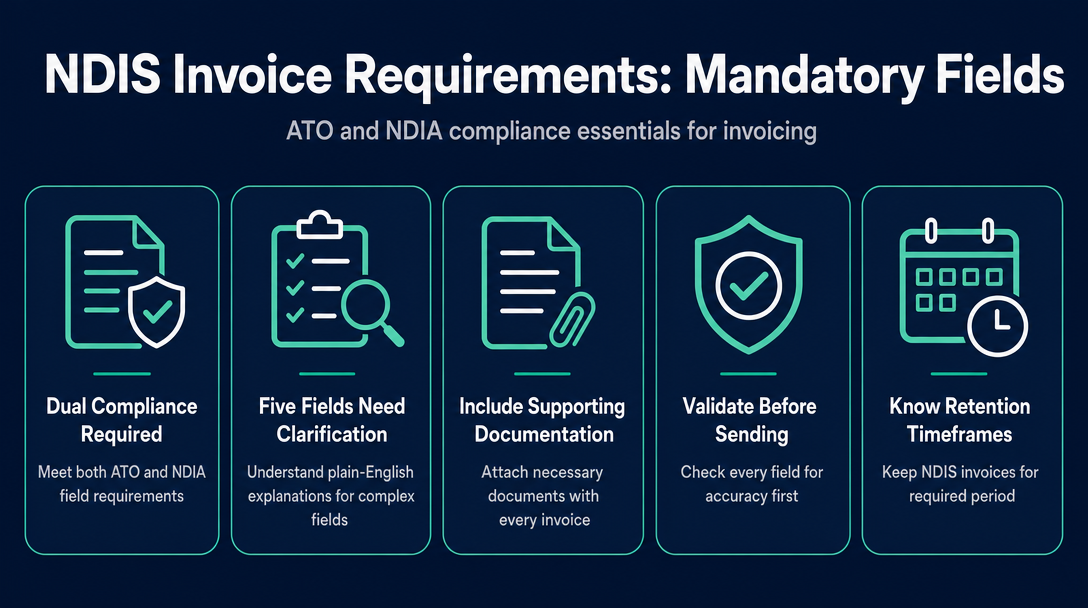
NDIS Invoice Requirements: Every Mandatory Field Explained
Every NDIS invoice must satisfy two separate sets of rules at once: the ATO's tax invoice requirements and the NDIA's own field-level requirements. Miss a field from either layer - or enter the wrong value - and your invoice will be returned, your payment delayed, or your claim rejected outright.
A useful way to think about this is the Three-Layer Invoice Test. Before any NDIS invoice is processed, it passes through three distinct reviewers, each checking for different things:
- The ATO Layer - Does the invoice meet Australia's tax invoice rules? (ABN, business name, date, total amount, GST treatment)
- The NDIA Layer - Does it meet NDIS-specific requirements? (participant NDIS number, support item code, unit type, quantity, rate within the price cap)
- The Plan Manager / Evidence Layer - Can the claim be verified against the service agreement, service log, and current pricing schedule?
This article works through every mandatory field, explains what value it requires, and notes what happens if it is missing or wrong. It is designed as a permanent reference - bookmark it and return to it before each billing cycle.
The Mandatory Fields at a Glance
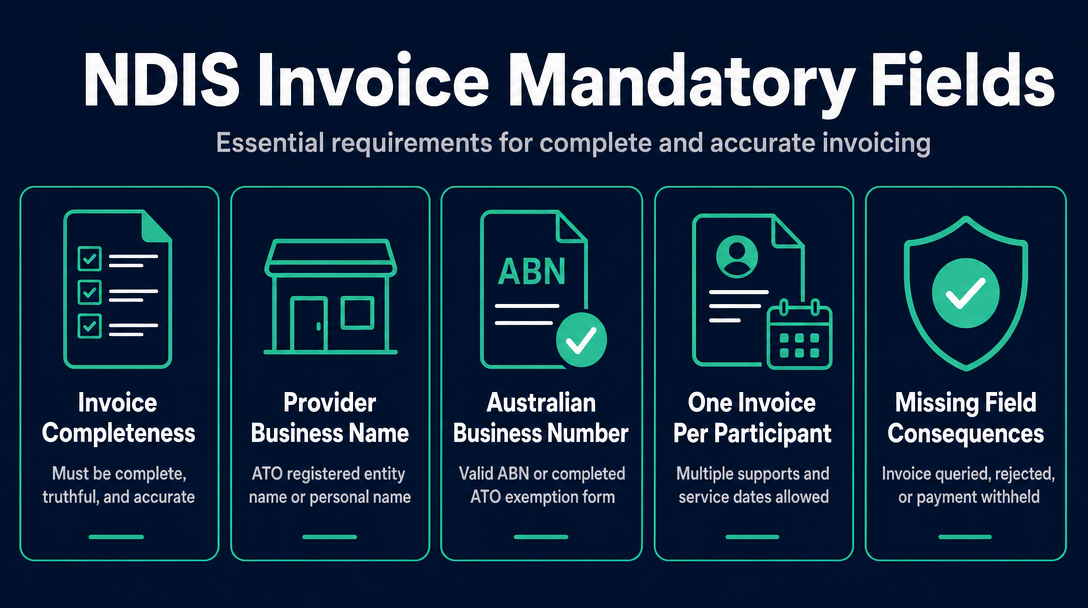
According to the NDIA's own guidance, your invoice must be complete, truthful, and accurate. The table below maps every required field to what it must contain and what goes wrong when it does not.
| Field | Required Value | Applies To | Consequence if Missing or Wrong |
|---|---|---|---|
| Provider business name or trading name | The entity name registered with the ATO for your ABN. Sole traders use their personal name if that is the ABN entity name. | All providers | Invoice queried or rejected; payment may be withheld until corrected |
| ABN (Australian Business Number) | Your valid ABN. If exempt, attach a completed Statement by a Supplier (ATO form) instead. | All providers (or ATO exemption form) | Plan managers are legally prevented from processing the payment; NDIA portal will reject the claim |
| Invoice number | A unique identifier that has never been used before - for any participant. Sequential numbering recommended. | All providers | Duplicate invoice numbers trigger automatic duplicate-payment checks; the NDIA system may reject or hold the claim |
| Invoice date | The date the invoice was issued (dd/mm/yyyy) | All providers | Affects payment terms; a missing date makes the invoice an incomplete tax invoice under ATO rules |
| Participant's full name | The participant's legal name as recorded in their NDIS plan | All providers | Cannot be matched to the correct plan; risk of misdirected payment |
| Participant's NDIS number | Their unique 9-digit NDIS participant number | All providers. Critical for NDIA-managed; highly recommended for plan-managed; best practice for self-managed. | NDIA-managed claims cannot be submitted without it; plan managers cannot locate the correct plan |
| Date(s) of service delivery | The exact calendar date on which each support was delivered | All providers | A date range is not sufficient; each support date must be individually identifiable |
| Description of each support | A clear plain-English description of the support delivered (e.g. "Assistance with Daily Activities - personal hygiene and meal preparation") | All providers | Without a description, plan managers or participants cannot verify the service was delivered |
| Support Item Number | The exact alphanumeric code from the current NDIS Pricing Arrangements and Price Limits support catalogue (e.g. 01_011_0107_1_1) | All providers | Wrong code draws funding from the wrong budget category; rejected by plan manager or NDIA portal; price cap may not match the service delivered |
| Unit type | The unit of measurement for the support as listed in the pricing schedule: H (hour), E (each), D (day), WK (week), MO (month), or KM (kilometre for some transport items) | All providers | Mismatch between unit type and quantity creates arithmetic errors that plan managers must query before paying |
| Quantity | The number of units delivered as a plain number (e.g. 2.5 for two hours thirty minutes - not "2.5 hrs") | All providers | Without quantity, the line-item total cannot be verified |
| Unit price (rate) | The price per unit charged. Must not exceed the maximum in the NDIS Pricing Arrangements and Price Limits for that support item in the relevant geography (standard, remote, or very remote) | All providers | Overcharging above the price cap: claim rejected or funds clawed back. Undercharging: accepted but cannot be corrected without issuing a new invoice |
| GST status / GST amount | State whether GST applies. Most NDIS supports are GST-free: show $0.00 GST or "GST-free" per line. Where GST applies, show the amount as a separate line. Do not leave this field blank. | All providers | Incorrect GST treatment creates ATO compliance risk; a blank field is not the same as $0.00 and will trigger a query |
| Total amount payable | The sum of all line items | All providers | Absence creates ambiguity; plan managers will return the invoice for correction before processing |
| Payment details | Bank account BSB and account number (or other nominated payment method) | Plan-managed and self-managed. NDIA-managed payments go to the bank account on file in the myplace provider portal - not required on the invoice itself. | Without payment details, plan managers cannot remit funds; payment is indefinitely delayed |
Five Fields That Need Plain-English Explanation
The table above tells you what goes in each field. The fields below are the ones most likely to trip providers up - either because the rule is less obvious, or because the consequences of getting it wrong are severe.
Your ABN - and the One Exception
An ABN is mandatory on every NDIS invoice. As the NDIA states, the invoice must include a valid ABN - unless you are exempt from providing one.
The exception is narrow: if you are legally exempt under ATO rules (for example, because you earn below the GST registration threshold and meet other ATO criteria), you must attach a completed Statement by a Supplier form, available directly from ato.gov.au. The plan manager or NDIA cannot process your claim without one or the other - there is no middle ground. Sole traders who operate under their own name and personal ABN do not need a separate business ABN; their personal ABN satisfies this requirement.
The Support Item Number - Which Budget It Draws From
The Support Item Number is not a label - it determines which of the participant's budget categories is drawn on and which price cap applies. The code must come from the current NDIS Pricing Arrangements and Price Limits support catalogue, published on ndis.gov.au. An outdated code - even one that was valid last financial year - is among the most common reasons plan managers return invoices for correction.
For a full step-by-step guide to finding and confirming the right code, see How to Find Your NDIS Support Item Code: A Step-by-Step Guide for Australian Support Workers.
Unit Type - the Field the Pricing Schedule Sets, Not You
This is the most misunderstood field on an NDIS invoice. The unit type is not your choice - it is defined by the NDIS Pricing Arrangements and Price Limits for each support item. You cannot invoice per session if the schedule specifies per hour.
The standard unit types are:
- H - hour (the most common for direct support)
- E - each (for fixed-price, one-off items)
- D - day (for day programs and some accommodation supports)
- WK - week
- MO - month
- KM - kilometre (for some transport items)
Enter the quantity as a plain number only. For two hours and thirty minutes at an hourly rate, write "2.5" in the quantity field - not "2.5 hrs" or "2 hrs 30 min". The unit column is what tells the reader that 2.5 means hours. Mixing the unit into the quantity field creates a text string, not a calculable number, and plan managers will query it.
GST - Show Zero, Not a Blank
Most supports delivered directly to NDIS participants under their plan are GST-free under ATO rules. On your invoice, this means showing $0.00 or the label "GST-free" against each applicable line - not leaving the GST field empty. A blank GST field is ambiguous: it does not confirm GST-free status, it just looks incomplete.
A small number of items - some consumables and certain transport reimbursements - may attract GST. If GST applies to a line item, show the GST amount as a separate line and include it in the total. Check the current GST treatment for your specific support types directly at ato.gov.au before invoicing, as the ATO's determinations are the authoritative source.
Invoice Numbers - Unique Across Every Participant, Not Just Per Client
Most providers understand that invoice numbers must be unique - but the rule extends further than many realise. An invoice number must be unique across your entire invoicing system, not just sequential per participant. Using "Invoice 001" for participant A and again for participant B is a duplicate, even though each participant has only received one invoice with that number from you.
Plan managers and the NDIA system run duplicate-payment checks by invoice number. If a number has been used before, the claim may be automatically held for review. A simple sequential system with a year prefix - for example, INV-2026-001, INV-2026-002 - prevents this problem entirely and makes your records easy to audit.
What Goes WITH the Invoice - Supporting Documentation
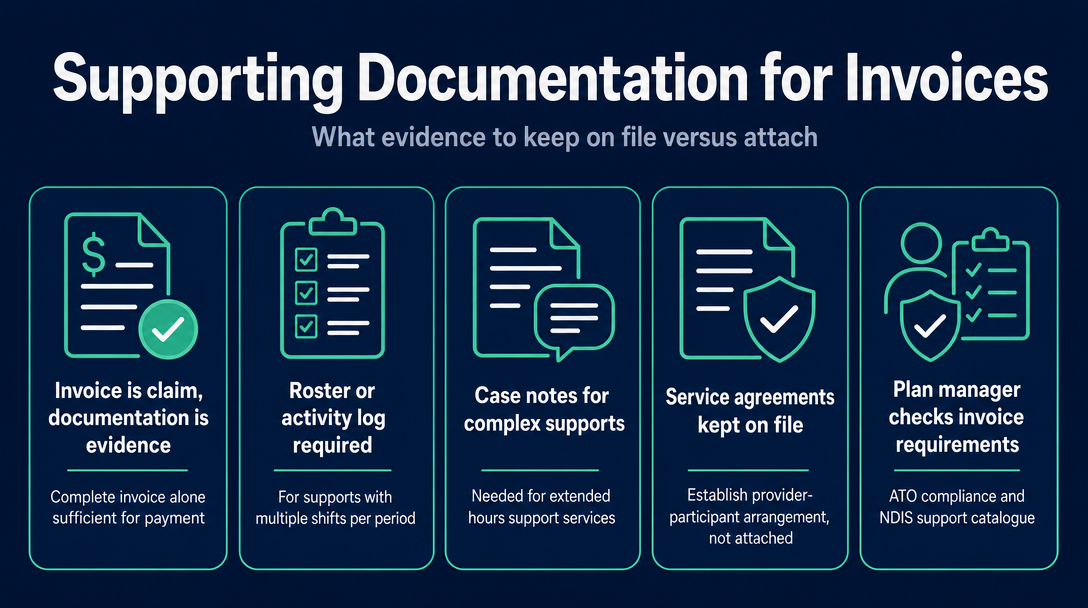
There is an important distinction that most provider guides overlook: the invoice is the claim; supporting documentation is the evidence.
For the majority of standard supports, the invoice alone - provided all mandatory fields are complete and correct - is sufficient to submit for payment. You do not need to attach timesheets or case notes to every invoice.
However, certain situations require additional records to be kept on file and available on request:
- Roster of care or activity log - for supports involving multiple shifts across a billing period
- Case notes or progress reports - for some complex core supports, particularly where the support extends across extended hours (such as Supported Independent Living)
- Service agreements - these establish the arrangement between provider and participant and must be held on file, but they are NOT attached to individual invoices
When a plan manager reviews your invoice before paying, they are checking: that it meets ATO requirements, that the support item number appears in the current NDIS support catalogue, that the unit price does not exceed the price cap, and that the claim aligns with the participant's available plan budget and approved supports.
The Provider Payment Assurance Program (PPAP) means the NDIA can request verification of any payment claim at any time. If your invoice and supporting records do not match - for example, your invoice shows four hours of support but your activity log shows two - funds may need to be repaid. The NDIA is clear that it is your responsibility to ensure claims are complete, truthful, and accurate.
How Long Must You Keep NDIS Invoices?
This question is absent from most provider guides, but the obligation is real.
Registered NDIS providers are required by the NDIS Quality and Safeguards Commission to keep records for a minimum of 5 years from the date of creation. The ATO independently requires business records - including invoices - to be kept for at least 5 years from the date you lodge the relevant tax return. In practice, these two obligations point to the same minimum: keep everything for at least 5 years.
Plan managers must keep all invoices and records for claims they submit, which means if you are a provider sending invoices to a plan manager, you still need your own copies - do not rely on the plan manager's records as your archive.
For sole traders and unregistered support workers, the ATO's 5-year business records rule applies in the same way.
Practical advice: Store invoices as PDFs or printed copies in a format you control. If you use invoicing software or a browser-based tool, export copies regularly. Software platforms get discontinued; your compliance obligation does not.
Keep every invoice and its supporting records for at least 5 years. The PPAP can request them at any time.
Validate Every Field Before You Send
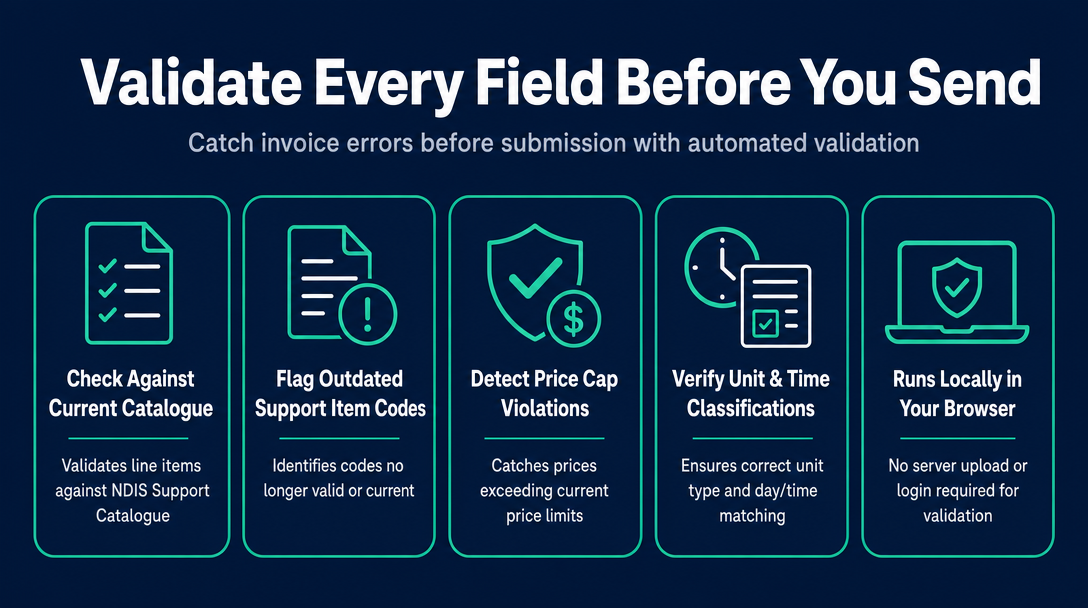
Now that you know what each field must contain, the next step is confirming your invoice gets each one right before it leaves your hands.
NDISInvoice.com.au is a free, browser-based tool that validates every line item against the current NDIS Support Catalogue before you submit. It flags outdated support item codes, prices above the current price cap, and unit type or day/time classification mismatches - the errors that most commonly cause invoices to be returned.
For a full walk-through of the tool itself, see The Complete Guide to Creating a Free NDIS-Compliant Invoice with NDISInvoice.com.au.
Open NDISInvoice.com.au and check your invoice now
Frequently Asked Questions
What fields are mandatory on every NDIS invoice?
Every NDIS invoice must include: provider name and ABN (or Statement by a Supplier), a unique invoice number, invoice date, participant's full name and NDIS number, date(s) of service, a description of each support, the support item number from the current NDIS support catalogue, unit type, quantity, unit price (within the price cap), GST status, total amount payable, and payment details. NDIA-managed providers do not include bank details on the invoice itself - those are held in the myplace portal.
Does an NDIS invoice need to include GST?
Most NDIS supports are GST-free, so you should show $0.00 or "GST-free" against each applicable line on the invoice. Do not leave the GST field blank - a blank is not the same as confirming GST-free status and will trigger a query. Some items, such as certain consumables, may attract GST; in those cases, show the GST amount as a separate line. Check the current treatment for your support types at ato.gov.au.
Can one invoice cover multiple supports or service dates?
Yes. A single NDIS invoice can include multiple support items and multiple service dates. However, each invoice must relate to only one participant - you cannot combine supports for two different participants on the same invoice.
Do I need an ABN to send an NDIS invoice?
Yes, an ABN is required on every NDIS invoice. The only exception is if you are legally exempt under ATO rules - in that case, you must attach a completed Statement by a Supplier form (available from ato.gov.au) to your invoice. Without either an ABN or this form, plan managers and the NDIA cannot legally process your payment.
What is the unit type field on an NDIS invoice?
The unit type tells the reader what your quantity number represents. It is set by the NDIS Pricing Arrangements and Price Limits - not chosen by the provider. Common values are H (hour), E (each), D (day), WK (week), MO (month), and KM (kilometre for some transport items). Enter quantity as a plain number only (e.g. 2.5, not "2.5 hrs").
How long must I keep NDIS invoices?
A minimum of 5 years from the date of creation, under both NDIS Commission requirements for registered providers and ATO business records rules. Plan managers are also required to keep all invoices and records for claims they submit. Store copies in a format you control - such as PDF - rather than relying solely on software that may be discontinued.
More articles
- How to Create Your First NDIS Invoice in Under 5 Minutes (Step-by-Step Video Companion)
- NDIS Plan Manager Turnaround Times: How Long Should You Wait to Be Paid After Submitting an Invoice?
- NDIS Invoice Numbering: Do You Need a Sequential System? (And What Happens If You Don't Have One)
- How to Handle a Rejected NDIS Invoice: Diagnosis, Correction, and Resubmission Step by Step
- NDIS Allied Health Invoicing: How Physiotherapy, Speech Therapy, and OT Codes Work in the Price Guide