NDIS Sleepover and Overnight Support Invoicing: Which Codes to Use and How to Calculate the Rate
Written by Cory Nathan, founder of NDIS Invoice · Last reviewed
A sleepover shift uses a flat rate billed per event - not per hour. There are two possible NDIS support item codes depending on the funding context, and
13 min read
NDIS Sleepover and Overnight Support Invoicing: Which Codes to Use and How to Calculate the Rate
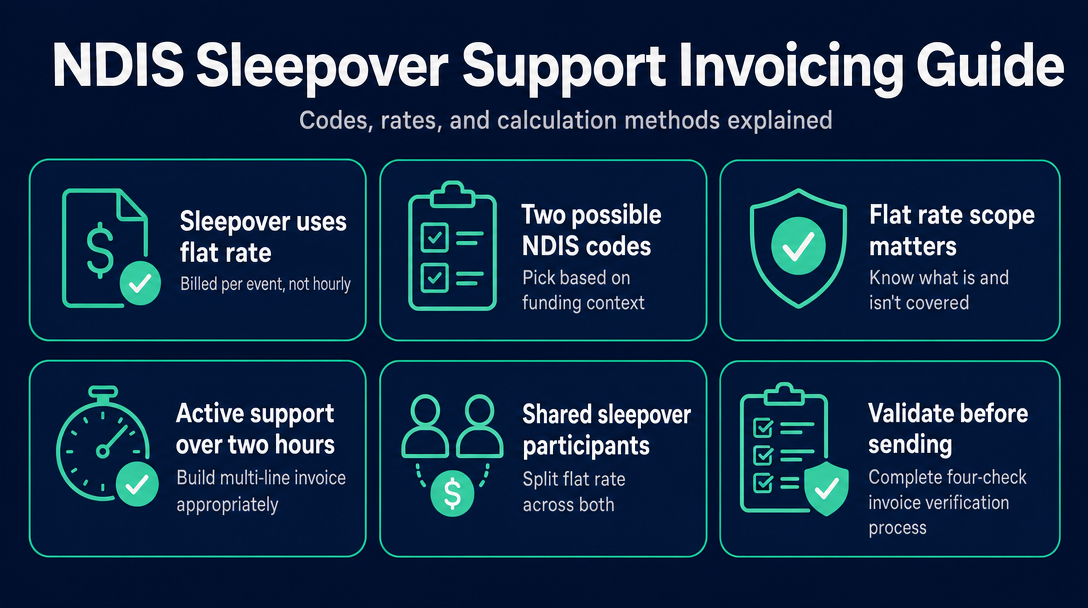
A sleepover shift uses a flat rate billed per event - not per hour. There are two possible NDIS support item codes depending on the funding context, and using the wrong one draws from the wrong plan budget. If active support during the night exceeds two hours, a second line item is required. This article explains which code to use, how to build the invoice correctly, and what to do when the night runs long.
The Two NDIS Sleepover Codes - and How to Pick the Right One
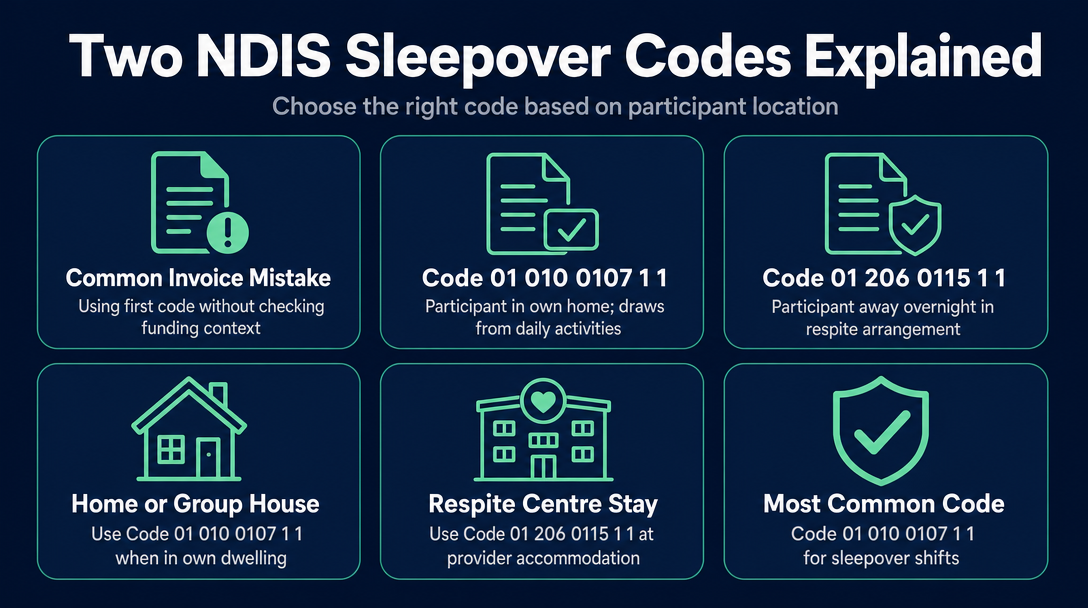
Most sleepover invoice errors start with the same mistake: using whichever code comes to mind first without checking whether it matches the funding context. There are two distinct codes that can apply to a sleepover shift, and they draw from different parts of the participant's plan.
| Scenario | Correct Code |
|---|---|
| Participant sleeping in their own home or usual residence; worker comes to them | 01_010_0107_1_1 |
| Participant is away from home overnight in a short-term/respite arrangement | 01_206_0115_1_1 |
| In-home group house or SIL setting; worker supports participant in their own dwelling | 01_010_0107_1_1 |
| Participant stays at a respite centre or provider-run accommodation | 01_206_0115_1_1 |
Code A - 01_010_0107_1_1 "Assistance With Self-Care Activities - Night-Time Sleepover": this is the most common sleepover code. It sits in Support Category 01 (Assistance with Daily Life) and draws from the participant's daily activities funding. It is used when a support worker stays overnight while the participant remains in their own home or usual dwelling.
Code B - 01_206_0115_1_1 "Short Term Accommodation - Sleepover": this code is for short term accommodation (STA) or respite arrangements - that is, when the participant is staying away from their usual home. It draws from the participant's STA funding, not their Daily Activities budget. Billing 01_010_0107_1_1 for a respite stay pulls from the wrong bucket and will create plan balance discrepancies.
Both codes carry a 2026-27 national price limit of $311.79 per each, effective from 1 July 2026.
What "Each (E)" Means on a Sleepover Invoice
Both sleepover codes use the unit type Each (E), not Hour (H). This is the single most common sleepover invoicing error: entering "Hour" as the unit type and then multiplying by shift hours. That produces an amount that is almost certainly above the price cap and will either be rejected or flagged by the plan manager.
The correct invoice entry for the base sleepover line is:
- Quantity: 1
- Unit: Each
- Unit Price: $311.79 (or the applicable remote/very remote rate)
- Line Total: $311.79
Because the sleepover is billed as a flat rate per event, the day-of-week hourly rate system - weekday, evening, weekend, public holiday - does not apply to the base sleepover line. A sleepover on a Saturday night and a sleepover on a Tuesday night are both $311.79 (national rate). The day of the week becomes relevant only if additional active-support time is billed separately, which is covered in the next section.
What the Flat Rate Includes - and What It Does Not Cover
The $311.79 flat rate includes up to two hours of active support across the sleepover period. A standard sleepover window is typically eight hours (for example, 10 pm to 6 am), though the exact hours are set in the service agreement between the provider and participant.
"Active support" within those two hours means hands-on assistance - repositioning, toileting, medication administration, helping the participant after a disturbance. Between these interruptions, the worker may sleep or rest. That on-call time is already factored into the flat rate; it is not billed additionally.
What the flat rate does not cover as additional line items:
- Travel to and from the shift (claimed separately under NDIS provider travel rules - see the published guide on provider travel invoicing for the applicable codes)
- Non-face-to-face admin time
Sole trader eligibility: Sole traders can claim 01_010_0107_1_1 for self-care sleepover support - the code is not restricted to registered providers. However, this applies only where the participant is plan-managed or self-managed. If the participant is NDIA-managed, they must use a registered provider. This is a non-negotiable eligibility constraint that affects which participants a sole trader can invoice for a sleepover shift.
Remote and very remote rates: Location-based price tiers apply. Remote and Very Remote multipliers increase the flat rate above the $311.79 national figure. Check the current NDIS Pricing Schedule for the exact rate that applies to your location tier - do not use the national rate if your service location is classified as Remote or Very Remote.
A brief note on worker obligations: sleepover shifts must also comply with the SCHADS Award, which has specific provisions for sleepover allowances and call-outs - but that is a pay instrument, not an invoicing instrument. The NDIS billing rules and the SCHADS Award obligations are separate, and getting the invoice right does not automatically satisfy the Award requirements.
When Active Support Exceeds Two Hours - Building the Multi-Line Invoice
This is where most sleepover invoices fall apart - and where no standard guide goes deep enough.
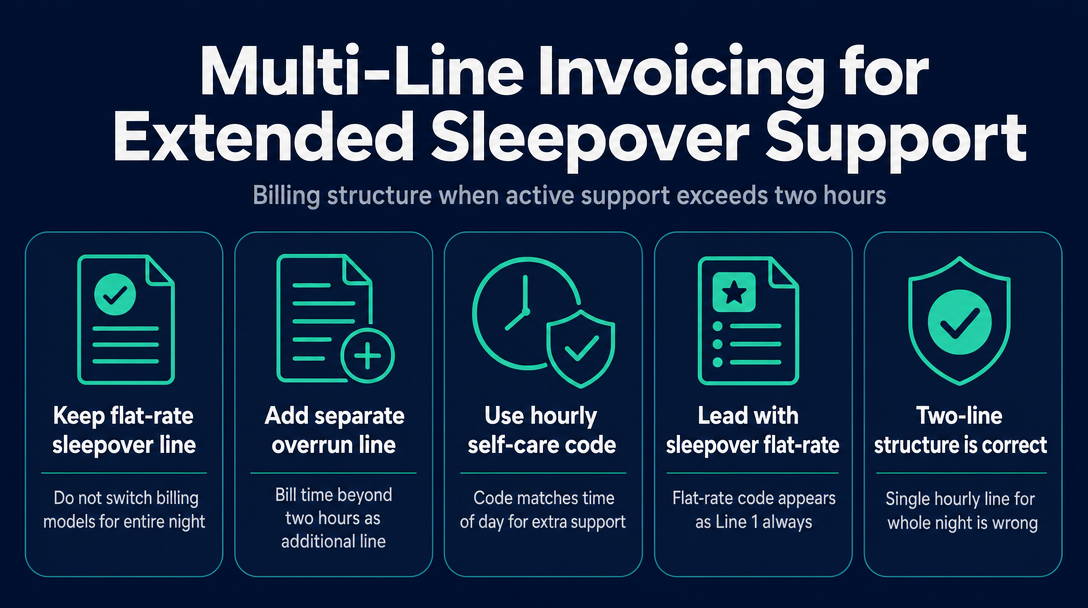
If a worker provides more than two hours of active, hands-on support during the sleepover period, the time beyond the two-hour inclusion is billed as a separate additional line item on the same invoice. You do not switch to a different billing model for the whole night; you keep the sleepover flat-rate line and add an overrun line beneath it.
The Two-Line Sleepover Invoice Rule: A correctly structured sleepover invoice always leads with the flat-rate sleepover code (01_010_0107_1_1 or 01_206_0115_1_1) as Line 1. If active support exceeded two hours, a second line is added - a separate hourly self-care code for the overrun time only. If an invoice has only one line and that line is hourly, or if it charges the full night's hours at an hourly rate, it is wrong. This rule is the fastest way to audit a sleepover claim before it hits the plan manager.
The additional line item uses the relevant hourly self-care support item code for the time of day at which the extra support occurred, billed in hours (H) - not as another sleepover item. For example, if the overrun occurred at 3 am on a weeknight, you would use the applicable night-time or early-morning self-care hourly code for that period. For the correct hourly code to use, check the NDIS Pricing Schedule for the time classification that applies.
Worked Invoice Example - Sleepover With 30 Minutes of Additional Active Support
Participant: Jane Smith - NDIS Number: 430 XXX XXXX Provider: [Support Worker Name] - ABN: XX XXX XXX XXX Support period: 22 August 2026, 10:00 pm - 23 August 2026, 6:00 am Claim type: Service
| Line | Support Item Code | Description | Qty | Unit | Unit Price | Line Total |
|---|---|---|---|---|---|---|
| 1 | 01_010_0107_1_1 | Assistance With Self-Care Activities - Night-Time Sleepover | 1 | Each | $311.79 | $311.79 |
| 2 | [applicable night self-care code] | Additional Active Support - 30 min beyond 2-hr inclusion, 3:00-3:30 am | 0.5 | Hour | At the applicable hourly rate per 2026-27 NDIS Pricing Schedule | [calculated] |
Invoice Total: $311.79 + (0.5 x applicable hourly rate)
This structure means the plan manager can see immediately: a flat sleepover rate has been charged, and an additional 30 minutes of active support is claimed separately. It is transparent, auditable, and consistent with the NDIS pricing rules.
Common error to avoid: Billing the entire night (e.g., 8 hours) at the hourly self-care rate instead of using the sleepover code. Eight hours at a standard self-care hourly rate will almost certainly produce an amount above the price cap for the period. The claim will be rejected or require correction.
Rounding Active Support Minutes Correctly
Hourly NDIS support items are generally billed in 15-minute increments. If the additional active support beyond the two-hour inclusion was 45 minutes, the quantity on Line 2 is 0.75 - not 1.00. Rounding up to the nearest full hour is overbilling and constitutes a billing error. Use the actual time in quarter-hour increments: 15 min = 0.25, 30 min = 0.50, 45 min = 0.75.
Shared Sleepover - Splitting the Flat Rate Across Two Participants
When one worker conducts a sleepover for two participants simultaneously - for example, in a group home or shared SIL house - the flat rate is divided between them. Each participant is invoiced for their share of the base sleepover charge, not the full flat rate.
The standard approach is a 50/50 split: each participant's invoice includes a sleepover line at half the applicable flat rate ($155.90 each at the national rate, based on the $311.79 national price limit). Two separate invoices or invoice line items are created - one per participant.
If one participant required additional active support beyond two hours during the night, that overrun line item is billed only to that participant. It is not shared, because the extra support was directed at one person.
A situation where a provider has two separate workers each conducting a separate sleepover shift for two participants in the same house is different: those are two full flat-rate claims, one per worker-participant pair.
What to Write in the Description Field for a Shared Sleepover
The invoice description field carries more weight in a shared sleepover than in a standard one. Auditors and plan managers need to understand why a participant is being billed for half a sleepover rate. Best practice is to write something like:
"Shared sleepover - 50% allocation - [Worker Name] - 22 Aug 2026, 10:00 pm to 23 Aug 2026, 6:00 am"
This makes the claim transparent and protects both the provider and the participant if the invoice is ever reviewed.
Validating Your Sleepover Invoice Before You Send It - The Four Checks
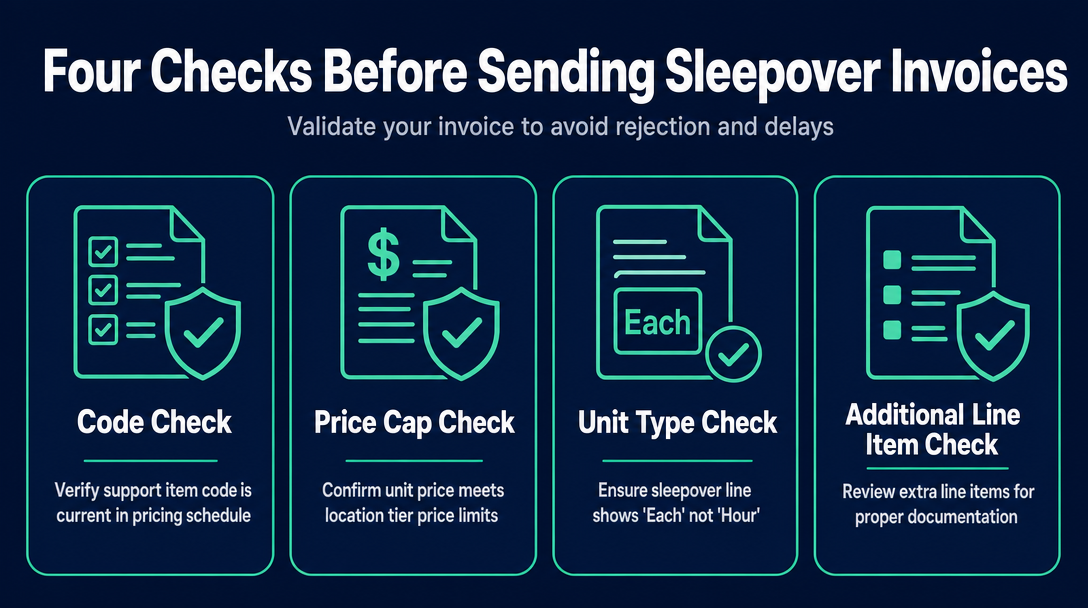
Sleepover invoices have more moving parts than a standard hourly shift, and each part is a potential rejection point. Before submitting - to a plan manager or directly to the NDIA portal - run through these four checks:
Code check - Is 01_010_0107_1_1 (or 01_206_0115_1_1) still active in the current 2026-27 NDIS Pricing Schedule? Support item codes can be retired or modified between financial years. For the process of checking whether a code is still current, see the published guide on outdated NDIS support item codes.
Price cap check - Is your unit price at or below the 2026-27 price limit for your location tier? The national limit is $311.79 per each. If your service location is Remote or Very Remote, the applicable rate is higher - but you cannot charge above it.
Unit type check - Does the sleepover line show "Each" as the unit type, not "Hour"? If it shows "Hour" and the participant's plan manager or the NDIA portal runs a validation, the claim will likely fail.
Additional line item check - If you provided more than two hours of active support, is that extra time on a separate line with a different hourly code, billed in 15-minute increments? A single sleepover line covering an unusually long active night is a flag.
Running through these four checks manually takes a few minutes. NDIS Invoice - a free, browser-based tool - validates your support item codes against the 2026-27 NDIS Pricing Schedule, checks unit types, and flags prices above the cap before the invoice leaves your hands. It is particularly useful for sleepover invoices because it will catch the "Hour instead of Each" error that plan managers see regularly.
Sleepover invoice errors are also among the billing issues covered in the broader compliance guide, "Why NDIS Invoices Get Rejected: The 7 Most Common Errors (and How to Check Yours Before Sending)" - worth reading alongside this article if you want a full picture of what triggers a rejection.
Frequently Asked Questions
Does a sleepover attract a higher rate on a public holiday?
The base sleepover flat rate does not change on public holidays. It is the same $311.79 each (national rate) regardless of which night of the week the shift falls on. However, if additional active-support hours are billed as a separate line item on top, those additional minutes do use the applicable hourly code for the time of day - and if that time occurs on a public holiday, the public holiday hourly rate for that support item applies to the additional line only. Do not apply a public holiday multiplier to the flat sleepover line itself.
Can I claim a sleepover and a full active overnight shift for the same worker, participant, and time window?
No. A sleepover and an active overnight are mutually exclusive for the same worker, participant, and period. If the participant requires active support throughout the entire night - meaning the worker cannot reasonably sleep - the correct billing model is the active overnight approach using hourly support item codes for the full period. The sleepover model applies only when the worker is expected to sleep and be available for limited interruptions.
Can a sole trader invoice for a sleepover using 01_010_0107_1_1?
Yes, but only for plan-managed or self-managed participants. Sole traders who are not registered NDIS providers cannot deliver supports to NDIA-managed participants. If the participant is NDIA-managed, a registered provider must be used, regardless of the support item code.
What happens if the sleepover runs longer than the agreed window - for example, the worker stays for morning routines?
The time beyond the agreed sleepover window is billed separately using the appropriate hourly daytime self-care or community access code for that period. It is not an additional sleepover item. Two sleepover codes cannot be claimed for a continuous overnight period.
What if a plan manager queries the shared sleepover 50% charge?
Include a clear description in the invoice description field noting the shared arrangement and the percentage allocation (see the description field example above). If queried, you should be able to reference the service agreement and shift notes that confirm both participants were present and supported by the one worker during the same shift window.
Ready to validate your sleepover invoice before it goes out?
NDIS Invoice is a free, browser-based tool that checks your support item codes against the current 2026-27 NDIS Pricing Schedule, flags unit-type errors (like "Hour" where "Each" should be), and confirms your price is within the cap for your location tier. It takes less than a minute and catches the errors that cause plan managers to send invoices back.
Validate my sleepover invoice at ndisinvoice.com.au
More articles
- How to Create Your First NDIS Invoice in Under 5 Minutes (Step-by-Step Video Companion)
- NDIS Plan Manager Turnaround Times: How Long Should You Wait to Be Paid After Submitting an Invoice?
- NDIS Invoice Numbering: Do You Need a Sequential System? (And What Happens If You Don't Have One)
- How to Handle a Rejected NDIS Invoice: Diagnosis, Correction, and Resubmission Step by Step
- NDIS Allied Health Invoicing: How Physiotherapy, Speech Therapy, and OT Codes Work in the Price Guide