Agency-Managed (NDIA-Managed) NDIS Invoicing: Why These Participants Can't Use Unregistered Providers
Written by Cory Nathan, founder of NDIS Invoice · Last reviewed
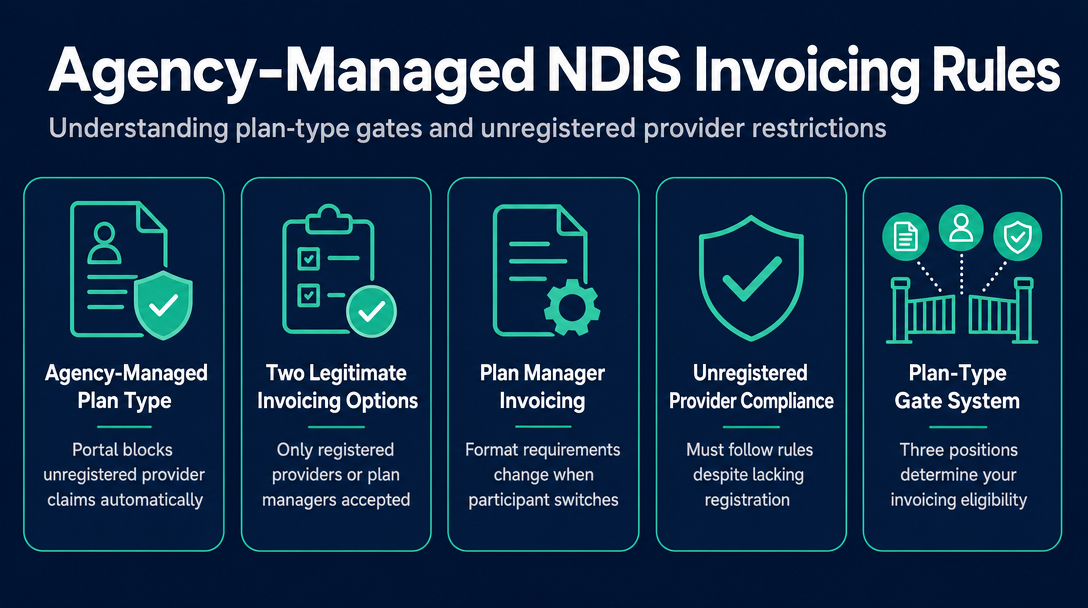
Think of your eligibility to invoice any NDIS participant as a "Plan-Type Gate" with three positions: agency-managed (closed to unregistered providers)
12 min read
Agency-Managed (NDIA-Managed) NDIS Invoicing: Why These Participants Can't Use Unregistered Providers
Think of your eligibility to invoice any NDIS participant as a "Plan-Type Gate" with three positions: agency-managed (closed to unregistered providers), plan-managed (open, via a plan manager), and self-managed (open, directly with the participant). As an unregistered provider, the gate position determines whether you can legally invoice at all - not your qualifications, your rates, or your willingness to comply. If a participant's plan is agency-managed, the gate is structurally closed to you. There is no workaround.
This article explains exactly why that closure exists, what options you and the participant have, and how to invoice correctly once the gate is open.
What "Agency-Managed" Actually Means for Your Invoice
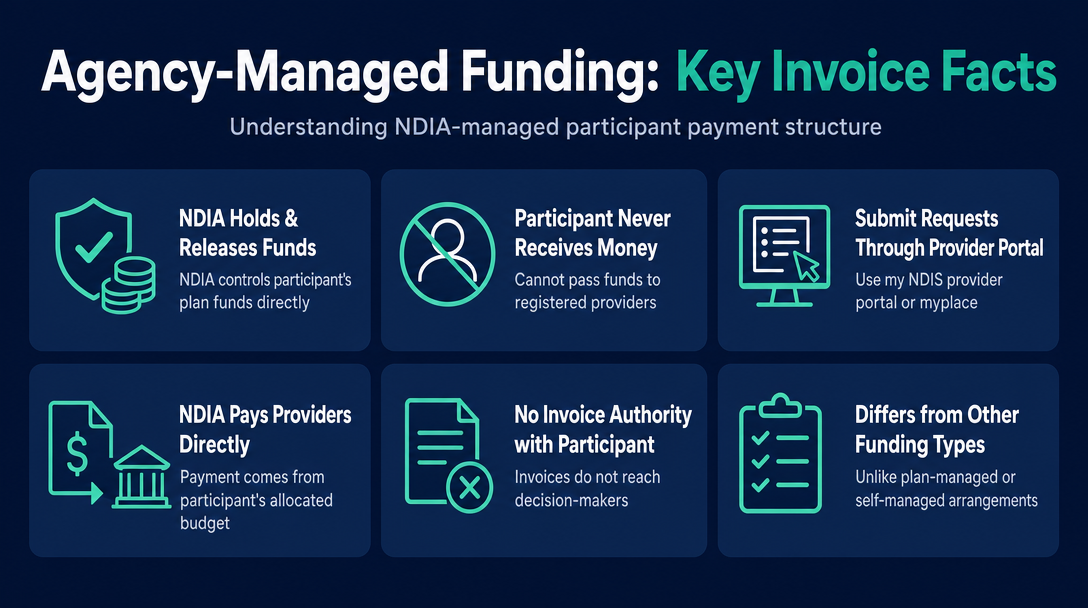
Agency-managed funding - officially called NDIA-managed funding - means the NDIA holds and releases the participant's plan funds directly. The participant does not receive money they can pass on to you. Instead, registered providers submit payment requests through the my NDIS provider portal (or the legacy myplace provider portal), and the NDIA pays them directly from the participant's allocated budget.
The participant never touches the money, and no invoice from you reaches anyone with authority to pay it.
This is the key structural difference from plan-managed funding (where a registered plan manager receives and pays your invoice) and self-managed funding (where the participant pays you and claims reimbursement). Those two arrangements are covered in detail in our existing articles on invoicing plan-managed participants and self-managed invoicing rules - this article focuses entirely on the agency-managed hard stop and what comes after it.
The rule is straightforward. As the NDIA states directly: "You can't use unregistered providers for NDIS supports you have NDIA-managed funding for."
Why the Portal Physically Blocks Unregistered Claims
The my NDIS provider portal (part of the PACE system, which replaced the original SAP-based CRM and myplace portal) is the only mechanism for submitting a payment request against an agency-managed participant's plan. To access it, a provider must be registered with the NDIS Quality and Safeguards Commission and have valid provider credentials within the NDIS system.
Unregistered providers have no login, no credentials, and no submission pathway. This is not a bureaucratic preference - it is a structural access control.
If you try to invoice an agency-managed participant directly, nothing happens. Agency-managed participants do not hold discretionary funds. Sending them an invoice is like sending a bill to someone who has a store credit they cannot transfer. The participant cannot pay you from their NDIS budget, regardless of how willing they are to do so.
The NDIA's own guidance on getting paid confirms that payment requests for NDIA-managed participants must go through the portal, and that plan managers (not unregistered providers) are the entities with portal access for plan-managed participants. The correct channel for unregistered providers - as the NDIA's troubleshooting guidance confirms - is the plan manager or the self-managed participant directly. There is no equivalent channel for agency-managed plans.
The NDIS Quality and Safeguards Commission is the registration authority. Without registration through the Commission, a provider has no standing in the portal system. The Commission can also receive complaints about unregistered providers who breach the NDIS Code of Conduct - a point covered in the compliance section below.
The Two Legitimate Options When a Participant Is Agency-Managed
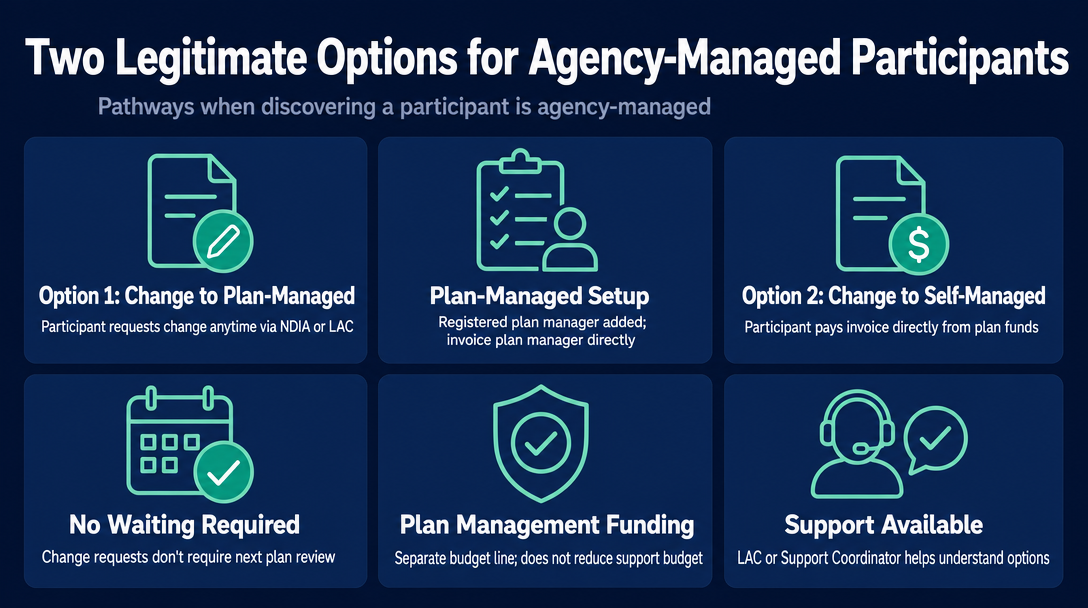
When a participant enquires about your services and you discover they are agency-managed, you have two legitimate paths forward. There is no third option.
Option 1: The Participant Requests a Change to Plan-Managed or Self-Managed
A participant can request a change to their plan management type at any time - they do not have to wait until their next plan review. They do this by contacting the NDIA directly, or by working through their Local Area Coordinator (LAC) or Support Coordinator if they have one. The LAC or Support Coordinator can help them understand the options and submit the change request.
When a participant moves to plan-managed funding, a registered plan manager is added to their plan. You then invoice the plan manager, not the participant and not the NDIA. When a participant moves to self-managed, they pay your invoice directly from their plan funds.
One common misconception is that adding plan management "uses up" the participant's support budget. It does not. Plan management is funded through a separate line in the participant's plan - typically under Improved Life Choices - so the move to plan-managed does not reduce the dollars available for the supports you deliver.
Your role in this process is informational only. You can explain the difference between plan types and let the participant know that you are only able to deliver NDIS-funded supports if they have plan-managed or self-managed funding. What you should not do is pressure a participant to switch - the plan management decision belongs to them.
Once a participant has plan management in place, refer to the plan-managed invoicing article for the full breakdown of who receives the invoice and what it must contain.
Option 2: Decline the Enquiry Professionally
If the participant cannot or does not wish to change their plan management type, you cannot deliver NDIS-funded supports to them as an unregistered provider. The professional response is a clear, non-judgmental explanation:
"Because my services are provided as an unregistered NDIS provider, I'm only able to work with participants who have plan-managed or self-managed funding. Unfortunately, I'm not able to access payment through an agency-managed plan. I'd encourage you to speak with your LAC about whether plan management might suit you - it doesn't reduce your support budget and would open up more provider choices."
One edge case worth noting: you may offer supports to an agency-managed participant on a purely private-pay basis, entirely outside of NDIS funding. This is a different arrangement - no NDIS price caps apply, the participant pays from their own pocket, and no claim is ever made against their plan. This is uncommon in practice, but it is a legitimate option where the participant and provider both understand no NDIS funds are involved.
Proceeding as though agency-managed funding can be accessed without registration - delivering supports and then attempting to claim payment - is a compliance breach. If funds are incorrectly obtained as a result, this can constitute a serious matter under the National Disability Insurance Scheme Act 2013. State this clearly in your own practice policies, and treat the Plan-Type Gate as a non-negotiable checkpoint before you begin any service.
If the Participant Switches: How Your Invoice to a Plan Manager Must Look
Once a participant has plan management in place, the Plan-Type Gate is open. You now invoice the plan manager - a registered entity who receives your invoice, verifies it against the participant's plan, and then submits a claim to the NDIA on the participant's behalf.
Plan managers have real commercial processes and internal checklists. A vague or incomplete invoice will be queried or returned. Here is what a compliant invoice to a plan manager must include:
- Your legal business name and ABN
- Participant's full name and NDIS number
- Date(s) of service delivery
- Description of supports delivered - use NDIS Support Catalogue terminology, not generic descriptions like "support session"
- NDIS support item code from the Support Catalogue (formatted as a structured code, for example
01_011_0107_1_1) - Unit of measure (hours, sessions, each)
- Quantity and unit rate
- Total amount payable
- GST status - most NDIS supports are GST-free; state "GST-free" or show "$0.00 GST" explicitly
- Your bank account details (BSB and account number)
- Invoice number and invoice date
Before submitting, confirm with the plan manager how they prefer to receive invoices - some use email, others have supplier portals. Establishing this before your first invoice avoids a delay that can affect your cash flow.
Support Codes and Why Getting Them Wrong Kills the Payment
The NDIS Support Catalogue "gives information on what we consider to be an appropriate maximum price for each NDIS support item. It also shows which claim type applies to each support item." Plan managers use these codes to verify that the support is funded in the participant's plan and to determine how and when they can claim reimbursement from the NDIA.
A missing or generic item code is one of the most common reasons plan managers bounce an invoice back to a provider. But an incorrect code is even more damaging - and the most frequent source of incorrect codes is misclassifying the time of day or day of week.
For example, assistance with daily living delivered on a weekday morning carries a different item code - and a different maximum rate - than the same support delivered on a Saturday or a public holiday. Using the weekday code for a Saturday shift means the rate on your invoice does not match the code's price cap in the Support Catalogue. The plan manager will query or reject it.
Even without the NDIA portal enforcing rates on your submission, plan managers are required to check invoices against the NDIS Pricing Arrangements and Price Limits before paying. You cannot charge above the current price cap, and the plan manager cannot pay above it - regardless of any private agreement between you.
This is where pre-send validation matters. NDIS Invoice cross-checks every support item code and rate against the current 2026-27 NDIS Pricing Schedule before you generate the invoice, catching time-of-day misclassifications, outdated codes, and above-cap rates before the plan manager ever sees the document.
What Unregistered Providers Must Comply With - Even Without Registration
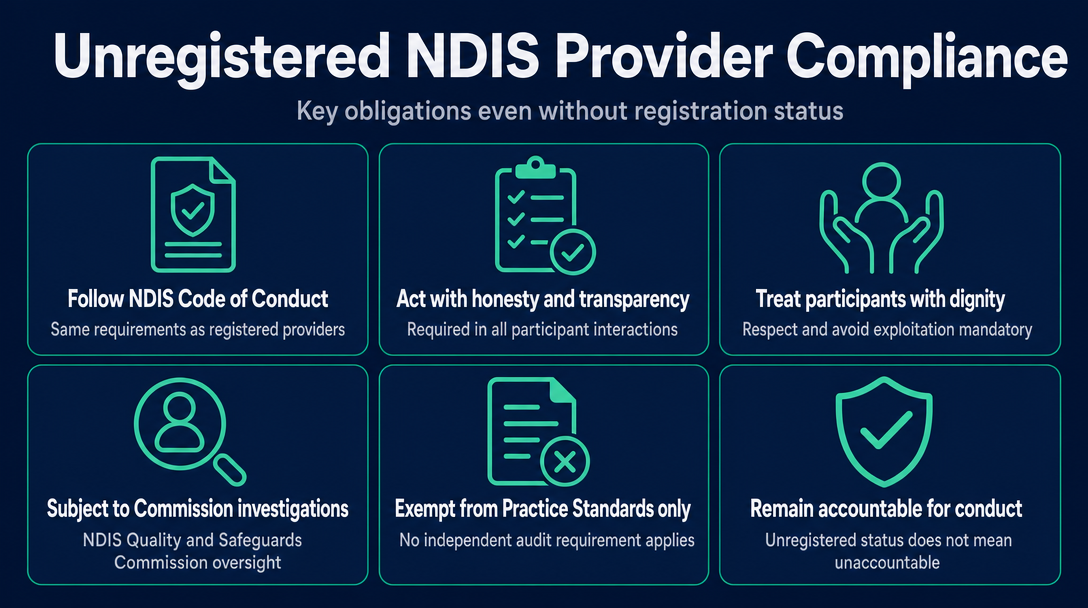
"Unregistered" does not mean "unaccountable." This is one of the most common misconceptions new sole traders carry into the NDIS space.
Unregistered providers are bound by the NDIS Code of Conduct - the same code that applies to registered providers. This means acting with honesty and transparency, treating participants with dignity and respect, and not engaging in conduct that exploits or harms a participant. The NDIS Quality and Safeguards Commission can investigate unregistered providers for Code of Conduct breaches if a complaint is received.
What unregistered providers are not required to comply with is the NDIS Practice Standards. The Practice Standards are an additional layer of requirements, verified through an independent audit, and they apply only to registered providers. The absence of a Practice Standards obligation is the principal regulatory distinction between registered and unregistered status - it is not a blanket exemption from accountability.
On pricing: without a portal actively rejecting above-cap claims, some unregistered providers assume they can set their own rates. They cannot. The NDIS Pricing Arrangements and Price Limits sets the maximum price for every supported item. Plan managers are required to check invoices against it before paying. An above-cap invoice will be rejected, and a pattern of above-cap invoicing could attract Commission attention under the Code.
Record-keeping obligations also apply. As the NDIA states, "It's your responsibility to make sure your claims for payment are complete, truthful and accurate." The prior article on NDIS record-keeping for sole traders covers what to retain and for how long - this article does not repeat that material.
Frequently Asked Questions
Can I invoice an agency-managed participant directly and have them pay me from their NDIS plan?
No. Agency-managed participants do not control their NDIS funds - the NDIA releases payments only to registered providers via the portal. There is no mechanism for the participant to pay you from their NDIS plan budget, regardless of their willingness to do so. You would need to either work with them as a private-pay client (no NDIS funding involved) or wait until their plan management type changes.
What if only part of the participant's plan is agency-managed?
Some participants have split funding - certain supports agency-managed, others plan-managed or self-managed. In this case, you can deliver and invoice for supports that fall under the plan-managed or self-managed portion, provided those supports are within your agreed scope. You cannot deliver the agency-managed supports as an unregistered provider, even if the rest of the plan is accessible to you.
Do I need to include NDIS support item codes on my invoice if I am unregistered?
Yes - when invoicing a plan manager, support item codes are essential. Plan managers use them to verify that the support is covered under the participant's plan and to submit their own claim to the NDIA. An invoice without codes, or with a generic description in place of a code, will almost always be queried or rejected.
Can I charge above the NDIS price cap if the plan manager agrees to pay it?
No. Plan managers are bound by the NDIS Pricing Arrangements and Price Limits and are not permitted to pay above the maximum price for any support item, regardless of any private agreement between you and the plan manager. Submitting above-cap invoices is a compliance risk for both parties.
If my participant's plan was just switched to agency-managed, what should I do immediately?
Stop delivering NDIS-funded supports to that participant until their plan management type changes. Contact them to explain the situation clearly and without pressure, and encourage them to speak with their LAC or Support Coordinator about switching to plan-managed or self-managed funding. Do not continue delivering supports in the hope that payment can be arranged later - it cannot be through NDIS funding under agency management.
Does the NDIS Code of Conduct apply to me as an unregistered provider?
Yes. The Code of Conduct applies to all NDIS providers and workers, registered or not. The NDIS Quality and Safeguards Commission can investigate complaints about unregistered providers and take action for Code of Conduct breaches.
Build Your Plan-Manager Invoice Correctly - Before You Send It
Once your participant has plan management in place, the Plan-Type Gate is open and your next step is generating a compliant invoice that a plan manager will approve on first review.
NDIS Invoice is a free, browser-based tool built specifically for unregistered sole traders and support workers. It validates every support item code and rate against the current 2026-27 NDIS Pricing Schedule as you build the invoice - catching time-of-day misclassifications, outdated codes, and above-cap rates before the plan manager ever sees the document.
Build your compliant NDIS invoice now - free, at ndisinvoice.com.au
More articles
- How to Create Your First NDIS Invoice in Under 5 Minutes (Step-by-Step Video Companion)
- NDIS Plan Manager Turnaround Times: How Long Should You Wait to Be Paid After Submitting an Invoice?
- NDIS Invoice Numbering: Do You Need a Sequential System? (And What Happens If You Don't Have One)
- How to Handle a Rejected NDIS Invoice: Diagnosis, Correction, and Resubmission Step by Step
- NDIS Allied Health Invoicing: How Physiotherapy, Speech Therapy, and OT Codes Work in the Price Guide