NDIS Allied Health Invoicing: How Physiotherapy, Speech Therapy, and OT Codes Work in the Price Guide
Written by Cory Nathan, founder of NDIS Invoice · Last reviewed
Using the wrong support item number on an NDIS allied health invoice does not just delay payment - it can trigger a claim rejection, a plan manager query
15 min read
NDIS Allied Health Invoicing: How Physiotherapy, Speech Therapy, and OT Codes Work in the Price Guide
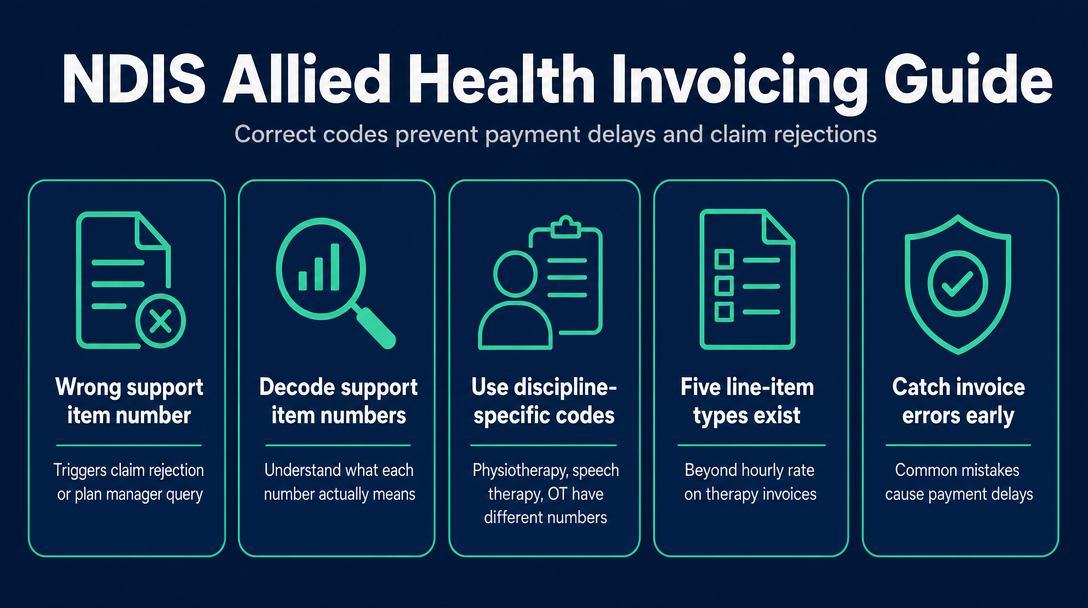
Using the wrong support item number on an NDIS allied health invoice does not just delay payment - it can trigger a claim rejection, a plan manager query, or an audit flag from the NDIS Quality and Safeguards Commission. This guide covers the exact support item codes for physiotherapy, occupational therapy, and speech pathology, how to decode any item number you encounter, and the five distinct line-item types that can legitimately appear on a single therapy invoice under the NDIS Pricing Arrangements 2026-27.
For a broader orientation to the NDIS Pricing Schedule and how to find any support item code, see the pillar guide: NDIS Price Guide 2026-27: How to Find the Right Support Item Code for Any Service You Deliver.
At a Glance: 2026-27 National Rates and Primary Item Numbers by Discipline
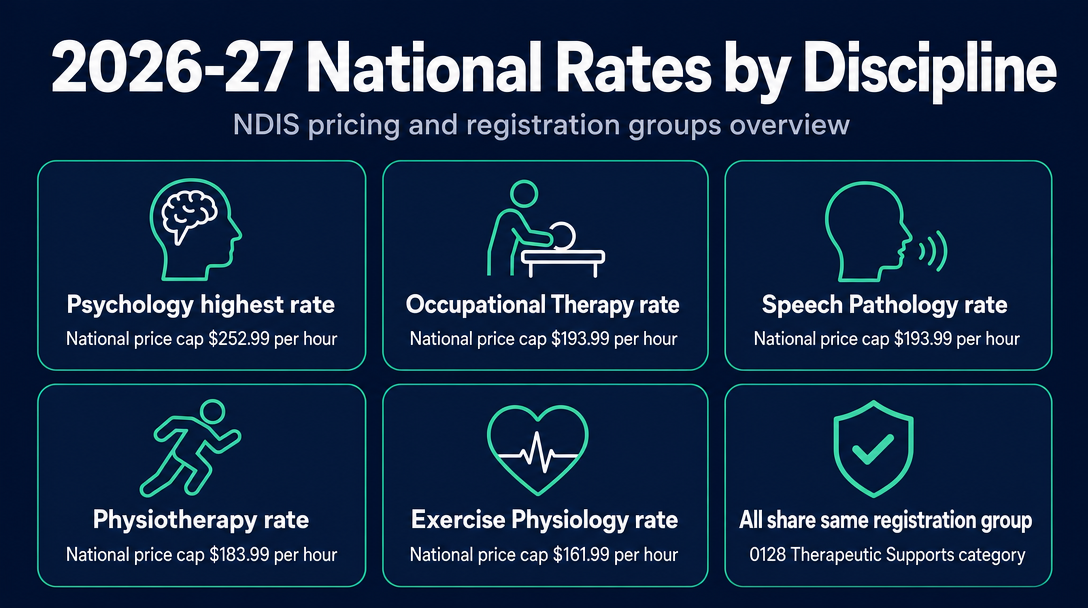
| Discipline | National Price Cap (per hour) | Primary Registration Group | Budget Category |
|---|---|---|---|
| Occupational Therapy | $193.99 | 0128 - Therapeutic Supports | Category 15 - Improved Daily Living |
| Speech Pathology | $193.99 | 0128 - Therapeutic Supports | Category 15 - Improved Daily Living |
| Physiotherapy | $183.99 | 0128 - Therapeutic Supports | Category 15 - Improved Daily Living |
| Exercise Physiology | $161.99 | 0128 - Therapeutic Supports | Category 15 - Improved Daily Living |
| Psychology | $252.99 | 0128 - Therapeutic Supports | Category 15 - Improved Daily Living |
All three disciplines draw from the participant's Capacity Building budget - specifically Category 15, Improved Daily Living. Attempting to claim from Core Supports for qualified therapy services will result in payment rejection. These rates have applied nationally since 1 July 2026, when state and territory pricing differentials were removed.
The exact item number for each line on your invoice comes from the NDIS Support Catalogue - a separate document from the Pricing Arrangements that lists all 976 support item codes with their claiming rules. You need both documents: the Pricing Arrangements for the rate cap, and the Support Catalogue for the correct code and delivery-mode rules.
What That Number Actually Means: Decoding an NDIS Support Item Number
Every item number in the Support Catalogue follows the same anatomy. Using the real OT code as a worked example:
15  _  617  _  0128  _  1  _  3
|      |       |         |    |
|      |       |         |    Price control indicator
|      |       |         Support purpose (1 = Capacity Building)
|      |       Registration group (0128 = Therapeutic Supports)
|      Item number (unique to this specific service)
Support category (15 = Improved Daily Living)
15_617_0128_1_3 - "Occupational Therapist - Assessment Recommendation Therapy or Training"
Segment 1 - Support Category (the "15")
Every allied health therapy item starts with 15. This tells the NDIA and the plan manager that the claim draws from Category 15 - Improved Daily Living - within the Capacity Building budget. If you see a 01 here, you are looking at a Core Supports item, which is the wrong bucket for professional therapy.
Segment 2 - The Item Number
The three-digit middle segment identifies the specific service within Category 15. Different services - direct therapy, non-face-to-face time, group delivery, cancellations - each have their own item number. This is where most invoicing errors occur: providers assume the same middle digits apply across all delivery modes.
Segment 3 - Registration Group (0128, 0136, or 0118)
This segment identifies which registration group the item falls under. For most physio, OT, and speech pathology services, this is 0128 - Therapeutic Supports. Using the wrong registration group causes claim rejection for agency-managed participants and raises a mismatch flag with plan managers.
Segment 4 - Support Purpose and Price Control Digits
The final two digits (1_3 in this example) indicate the support purpose (1 = Capacity Building) and the price control type. Most clinicians do not need to construct these from scratch - they appear exactly as listed in the Support Catalogue - but knowing what they mean helps you spot a copied-from-last-year code that no longer matches the current catalogue.
Discipline-by-Discipline: Which Support Item Numbers to Use
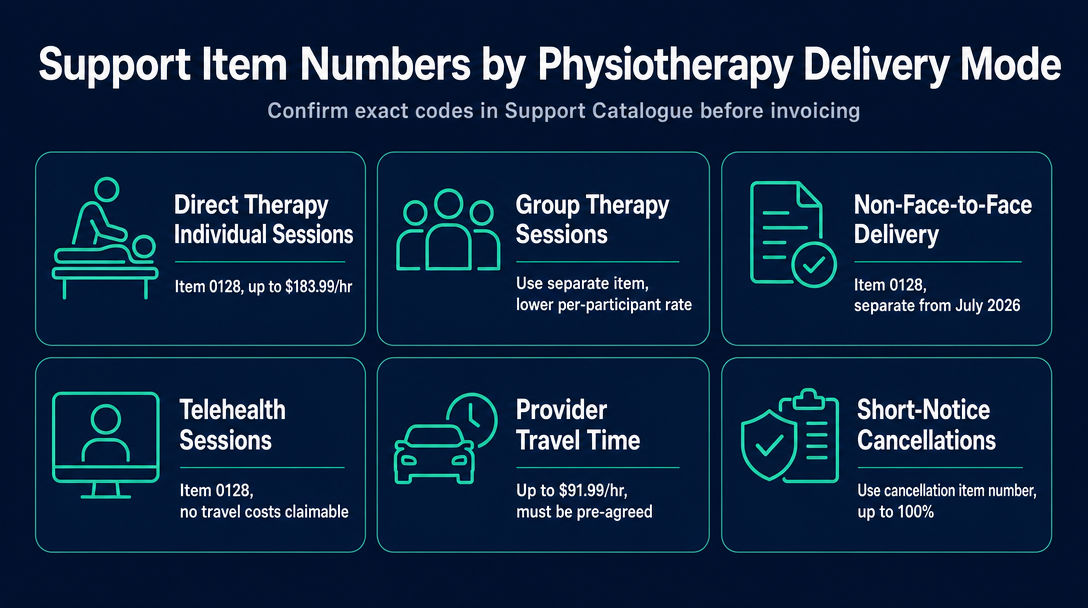
The Support Catalogue contains separate item numbers for each discipline and each delivery mode. The table below shows the item types you will encounter; confirm the exact current code in the Support Catalogue before invoicing, as item numbers can change between financial years.
Physiotherapy
| Line-Item Type | Registration Group | Rate | Notes |
|---|---|---|---|
| Direct therapy (individual, in-person) | 0128 | Up to $183.99/hr | Standard face-to-face session |
| Non-face-to-face (NF2F) | 0128 | Up to $183.99/hr | Separate item from July 2026 |
| Group therapy | 0128 | Lower per-participant rate | Must NOT use individual code |
| Telehealth | 0128 | Up to $183.99/hr | Separate item; no travel claimable |
| Provider travel | 0128 | Up to $91.995/hr (50% of $183.99) | Separate item; must be pre-agreed |
| Short-notice cancellation | 0128 | Up to 100% of session fee | Must use cancellation item number |
Common error: Physiotherapists delivering exercise-based group sessions sometimes bill the individual direct therapy code for each participant. Group delivery has its own item number and a lower per-participant rate - the individual code is not appropriate.
Registration group watch-out: Physio services primarily fall under 0128 - Therapeutic Supports. If you are delivering physiotherapy as part of an early childhood support arrangement, the relevant registration group may be 0118 - check the Support Catalogue row carefully before coding the invoice.
Occupational Therapy
| Line-Item Type | Registration Group | Rate | Notes |
|---|---|---|---|
| Direct therapy (individual, in-person) | 0128 | Up to $193.99/hr | Assessment, therapy, or training |
| Functional Capacity Assessment (FCA) | 0128 | Up to $193.99/hr | Separate item from standard therapy |
| Non-face-to-face (NF2F) | 0128 | Up to $193.99/hr | Separate item from July 2026 |
| Group therapy | 0128 | Lower per-participant rate | Must NOT use individual code |
| Telehealth | 0128 | Up to $193.99/hr | Separate item; no travel claimable |
| Provider travel | 0128 | Up to $96.995/hr (50% of $193.99) | Separate item; must be pre-agreed |
| Short-notice cancellation | 0128 | Up to 100% of session fee | Must use cancellation item number |
Common error - FCA vs. therapy code: A Functional Capacity Assessment is not billed under the standard direct therapy item. FCAs have their own item number in the Support Catalogue. OTs who bill a lengthy assessment under the standard therapy code are using the wrong item - a frequently cited cause of claim queries from plan managers and NDIA auditors.
Speech Pathology
| Line-Item Type | Registration Group | Rate | Notes |
|---|---|---|---|
| Direct therapy (individual, in-person) | 0128 | Up to $193.99/hr | Standard face-to-face session |
| Non-face-to-face (NF2F) | 0128 | Up to $193.99/hr | Separate item from July 2026 |
| Group therapy | 0128 | Lower per-participant rate | Must NOT use individual code |
| Telehealth | 0128 | Up to $193.99/hr | Separate item; no travel claimable |
| Provider travel | 0128 | Up to $96.995/hr (50% of $193.99) | Separate item; must be pre-agreed |
| Short-notice cancellation | 0128 | Up to 100% of session fee | Must use cancellation item number |
Registration group watch-out: Speech pathologists working in early childhood intervention may encounter participants whose plans use registration group 0118 - Early Childhood Supports - rather than 0128. The item numbers differ between these groups. Confirm which group applies to the specific participant and plan before invoicing.
A Note on Registration Groups 0128, 0136, and 0118
| Group | Name | Typical Allied Health Use |
|---|---|---|
| 0128 | Therapeutic Supports | Standard physio, OT, speech pathology, exercise physiology, psychology |
| 0136 | Group and Centre Based Activities | Some therapy assistant-delivered group programs; broader therapeutic services |
| 0118 | Early Childhood Supports | Therapy delivered under early childhood intervention arrangements |
The vast majority of standard physio, OT, and speech pathology invoices use 0128. If you are unsure which group applies, check the Support Catalogue row for the specific item - the registration group is embedded in the item number itself (segment 3 in the anatomy above).
Beyond the Hourly Rate: The Five Line-Item Types on a Therapy Invoice
Here is a naming convention worth bookmarking: the Five-Line NDIS Therapy Invoice. A single allied health session with an NDIS participant can legitimately generate up to five distinct billable line items, each requiring its own support item number. Most invoice errors come from providers treating all five as variations of the same code - when in fact, since 1 July 2026, each has its own separate item number in the Support Catalogue.
1. Direct Therapy (Face-to-Face)
This is the base item: time you spend with the participant in person delivering the therapy. Use the direct therapy item number for your discipline. This is the only line that most providers know well - the other four are where errors accumulate.
Invoice must include: participant's NDIS number, service delivery date, clinician's name and credential, item number, item description exactly as it appears in the Support Catalogue, duration or units, and the total charge at or below the price cap.
2. Non-Face-to-Face (NF2F) Time
NF2F time covers work directly connected to the participant's therapy that occurs outside of the session: writing progress reports, reviewing assessment results, coordinating with the treating team by phone or email, and preparing for the next session.
What qualifies: report writing, case note preparation, phone or written communication with the participant's treating team (GP, specialist, other therapists), preparing therapy materials specific to the participant.
What does not qualify: general administration, time spent on billing, marketing, or any work not directly connected to that participant's funded supports.
Critical change from July 2026: NF2F work now has its own separate item number - it is not a suffix or a note on the direct therapy line. You must use the NF2F-specific item number, and the invoice line must describe the NF2F activity clearly (e.g., "Report writing - 45 minutes - progress report for OT therapy").
3. Provider Travel
Travel time to reach the participant is billed at 50% of the clinician's hourly rate. For OT and speech pathology, that is up to $96.995 per hour of travel time. For physiotherapy, it is up to $91.995 per hour.
Rules:
- Travel must be pre-agreed with the participant (or their plan manager) before invoicing
- It appears as a separate line item on the invoice with its own item number
- Provider travel cannot be claimed for a telehealth session - if the clinician did not travel, the travel line does not exist
- Vehicle running costs (km allowance) may also be claimable as a separate item - check the Support Catalogue for the current travel cost item
4. Short-Notice Cancellations
If a participant cancels with less than two clear business days' notice, you may claim up to 100% of the scheduled session fee. However, the item number you use is the cancellation-specific item for your discipline - not the direct therapy code.
The invoice line must clearly state "short-notice cancellation," include the originally scheduled service date, and meet the same mandatory field requirements as any other invoice line. Using the standard therapy item number for a session that did not occur is a billing error - even if the dollar amount is the same.
5. Telehealth and Group Delivery
Telehealth: From 2026-27, telehealth delivery has its own distinct item number. The rate is the same as in-person ($193.99/hr for OT and speech, $183.99/hr for physio), but you must use the telehealth-specific item code - not the in-person direct therapy code. Provider travel cannot be claimed alongside a telehealth line.
Group therapy: Group delivery item numbers differ from individual therapy codes and carry a lower per-participant rate. The number of participants in the group may affect the claimable rate per person - confirm the specific group item and its rules in the Support Catalogue before the first group invoice you send.
Invoice Errors Allied Health Providers Make - and How to Catch Them
Error 1 - Using the Direct Therapy Code for Every Line
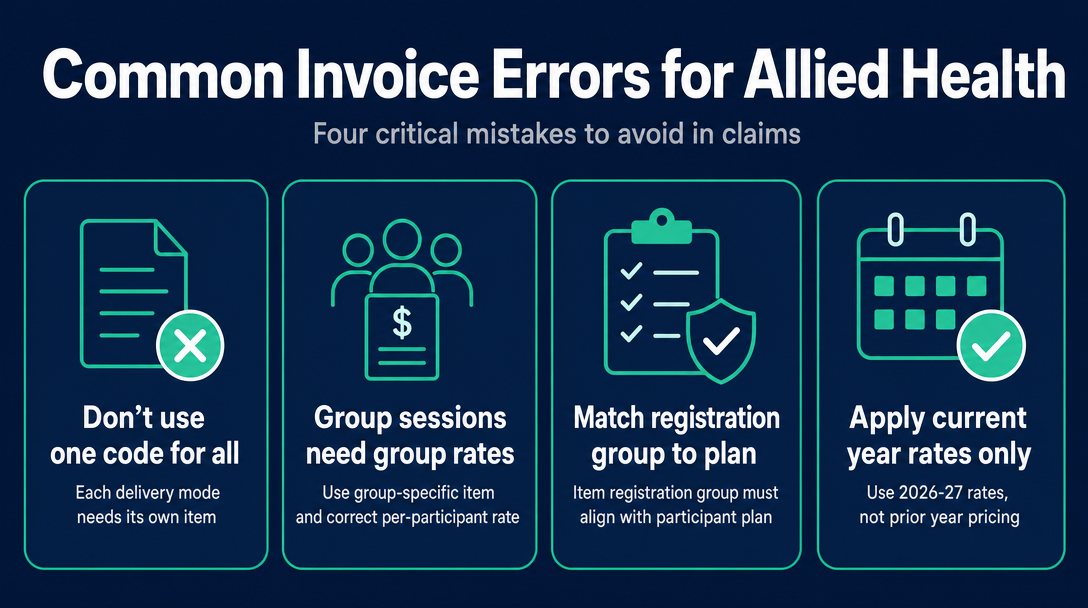
The single most common error: providers who know their direct therapy item number apply it to every claim type - NF2F time, travel, cancellations. Since July 2026, each delivery mode has its own item. One code does not cover all five lines.
Error 2 - Billing Group Sessions at the Individual Rate
If six participants attended a group session and you invoice each at the full $193.99 individual rate using the individual therapy code, that invoice is incorrect on two counts: wrong item number and rate above the group cap. Use the group-specific item and confirm the per-participant rate for that group size.
Error 3 - Wrong Registration Group (0136 vs 0128 vs 0118)
The registration group embedded in the item number must match the participant's plan and your registration. An 0128 item claimed against a participant whose plan was set up under 0118 will not process for agency-managed participants and will generate a query from most plan managers.
Error 4 - Rate Above the Price Cap, or Using a Prior Year's Rate
The 2026-27 rates replaced the previous schedule on 1 July 2026. Any invoice using a rate from 2025-26 or earlier (or any amount above the current national cap) will be queried or rejected. This is a particular risk for providers who copy last year's invoice template.
Error 5 - Claiming Provider Travel for a Telehealth Session
If you delivered therapy via video call, you were not physically travelling to the participant. A travel line on a telehealth invoice is an error - and one the NDIS Quality and Safeguards Commission flags as a compliance risk area.
Error 6 - Using the Wrong Budget Category (Core Supports Instead of Category 15)
Qualified physiotherapy, OT, and speech pathology must be claimed from Category 15 - Improved Daily Living. Attempting to invoice these services against a Core Supports budget will result in rejection. This is distinct from therapy assistant-delivered supports, which may have different category rules - confirm the specific item's category in the Support Catalogue.
Frequently Asked Questions
What support item number do I use for a standard OT session?
The primary OT therapy item is 15_617_0128_1_3 - "Occupational Therapist - Assessment Recommendation Therapy or Training" - for individual in-person direct therapy. However, if the session involves a Functional Capacity Assessment, a group, or telehealth delivery, you must use the relevant separate item number for that delivery mode. Always confirm the exact current code in the NDIS Support Catalogue before invoicing.
Can I bill for report writing as a physiotherapist?
Yes - report writing is a non-face-to-face (NF2F) activity and is billable under the NF2F-specific item number for physiotherapy, at up to $183.99 per hour. From 1 July 2026, NF2F has its own separate item number - it is not billed using the direct therapy code with a note attached. The invoice line must describe the NF2F activity (e.g., "NF2F - progress report writing - 30 minutes").
How much can I charge for provider travel as a speech pathologist?
Provider travel for speech pathology is billed at 50% of the hourly rate - up to $96.995 per hour of travel time (50% of $193.99). It must appear as a separate line item with its own item number, must be pre-agreed with the participant or plan manager, and cannot be claimed for telehealth sessions.
What happens if I use an outdated support item code?
An outdated item code - one from a prior financial year's Support Catalogue - will not match the current Pricing Arrangements and will result in claim rejection or a manual query. For agency-managed participants, the NDIA portal will reject the claim outright. For plan-managed participants, the plan manager will likely return the invoice for correction. Always validate item numbers against the current Support Catalogue before sending.
Is there a separate item code for telehealth therapy?
Yes. From 2026-27, telehealth delivery has its own distinct item number for each allied health discipline - it is not the same as the in-person direct therapy code. The price cap is the same ($193.99/hr for OT and speech pathology, $183.99/hr for physiotherapy), but the item number differs. Provider travel cannot be claimed on the same invoice as a telehealth line.
Can an unregistered allied health provider invoice plan-managed participants?
Depending on the participant's plan management type, this may be possible. Plan-managed and self-managed participants can generally engage unregistered providers. However, agency-managed (NDIA-managed) participants must use registered providers only - an unregistered physio or OT cannot invoice through the NDIA portal for these participants. Registration status also affects which item numbers and registration groups are valid on the invoice.
Before you send your next therapy invoice, validate every line item against the current NDIS Support Catalogue - not just the rate guide. Wrong item numbers, outdated codes, and mismatched registration groups are all errors that clear validation catches before the invoice leaves your desk. NDIS Invoice checks your support item numbers, rates, and claiming rules against the live 2026-27 pricing data, right in your browser. No subscription. Free to use. Check your invoice now at ndisinvoice.com.au
More articles
- How to Create Your First NDIS Invoice in Under 5 Minutes (Step-by-Step Video Companion)
- NDIS Plan Manager Turnaround Times: How Long Should You Wait to Be Paid After Submitting an Invoice?
- NDIS Invoice Numbering: Do You Need a Sequential System? (And What Happens If You Don't Have One)
- How to Handle a Rejected NDIS Invoice: Diagnosis, Correction, and Resubmission Step by Step
- NDIS Respite (Short-Term Accommodation) Invoicing: Codes, Rates, and Common Errors