NDIS Invoice Numbering: Do You Need a Sequential System? (And What Happens If You Don't Have One)
Written by Cory Nathan, founder of NDIS Invoice · Last reviewed
Yes - NDIS invoices must carry a unique invoice number on every document you send. This requirement comes from two separate sources: the NDIA's own
10 min read
NDIS Invoice Numbering: Do You Need a Sequential System? (And What Happens If You Don't Have One)
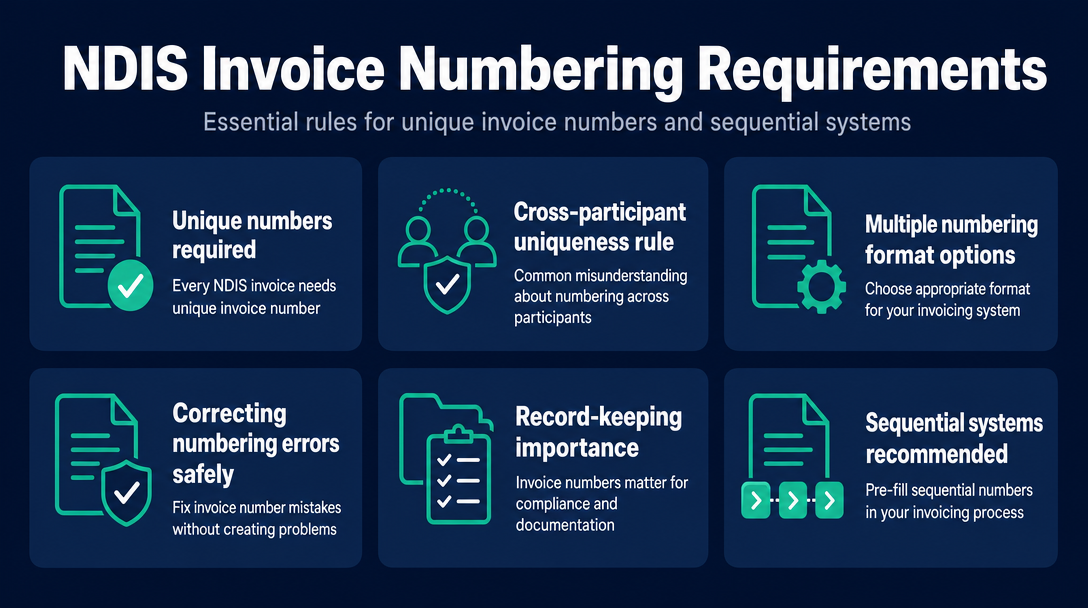
Yes - NDIS invoices must carry a unique invoice number on every document you send. This requirement comes from two separate sources: the NDIA's own payment guidance and the ATO's record-keeping standards. Neither body mandates a specific format, but both require that each invoice is uniquely identifiable and retrievable. Here is exactly what that means in practice.
What the Rules Actually Say About NDIS Invoice Numbers
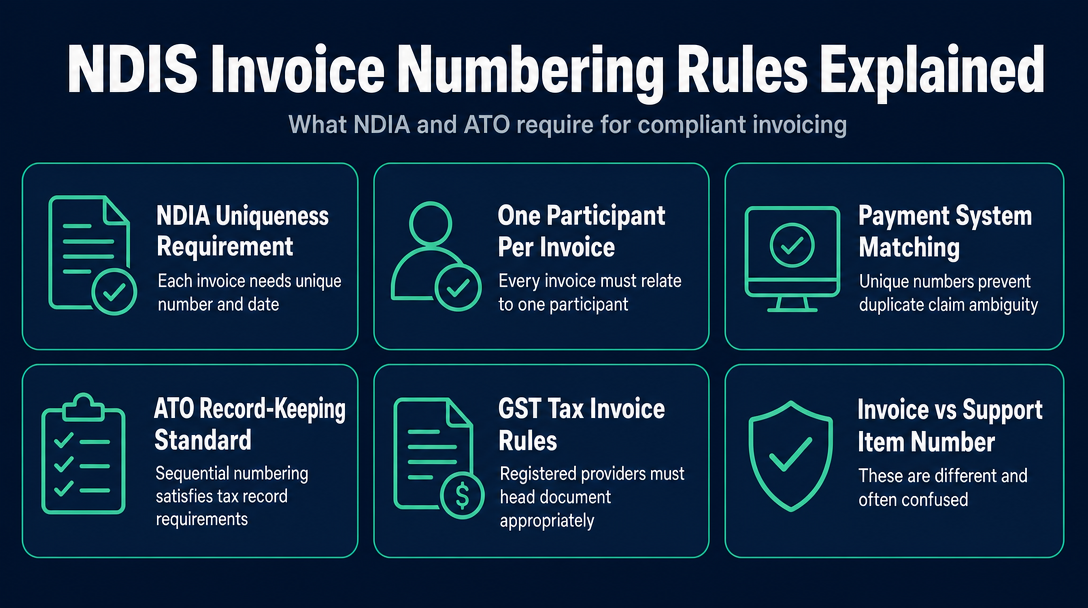
Two rule sources govern invoice numbering for NDIS providers, and understanding both is important because they apply for different reasons.
The NDIA's Uniqueness Requirement
The NDIA's guide to getting paid requires every invoice to include a unique invoice number and an issue date. Each invoice must relate to one participant only. The uniqueness requirement exists so the payment system can match each claim to exactly one transaction - duplicates create ambiguity the system cannot resolve.
The ATO's Record-Keeping Layer
The ATO's tax invoice standards apply alongside NDIA rules. Sequential, unique invoice numbering is the practical standard that satisfies the ATO's requirement that financial records explain all transactions clearly. If you are registered for GST, your document must be headed "Tax Invoice" - but regardless of GST status, the numbering discipline applies.
Invoice Number vs. Support Item Number - Not the Same Thing
This is one of the most reported points of confusion, so it is worth being direct: your invoice number and the NDIS support item number are entirely different fields.
Your invoice number is a reference you assign - for example, 2026-047. It identifies the document itself within your records.
The support item number is an NDIA code from the NDIS Pricing Arrangements and Price Limits that identifies the type of support delivered - for example, 01_011_0107_1_1 for a standard assistance-with-daily-life session. These two numbers appear on the same invoice but serve completely different purposes. Getting them confused does not cause a rejection by itself, but it means providers sometimes spend time troubleshooting the wrong field.
The Cross-Participant Uniqueness Rule (The Most Common Misunderstanding)
This is the part most published guidance skips, and it is where sole traders working across multiple participants most often run into payment holds.
Why Plan Managers and NDIS Systems Flag Duplicates
NDIS payment systems are designed to detect duplicate invoice numbers as part of fraud prevention. A duplicate number - regardless of which participant it is attached to - will trigger a review or hold payment on the second invoice. This is not a minor administrative flag; it can delay payment until the provider contacts the plan manager and clarifies the discrepancy.
The "Same Number, Different Participant" Trap for Growing Sole Traders
Here is the specific scenario that catches providers out: you begin with one participant and number your invoices 2026-001, 2026-002, and so on. You take on a second participant and - because your mental model is "per-person records" - you restart the counter. Now you have sent 2026-001 to Participant A and 2026-001 to Participant B.
To the plan manager's system, this looks like a duplicate. The fact that the two invoices name different participants, reference different ABNs, or cover different service dates does not resolve the conflict at the number-matching stage.
This is the basis of what we can call the Three-Dimension Uniqueness Rule: your invoice number must be unique across (1) every invoice you have ever issued, (2) every participant you serve, and (3) every time period including across financial year boundaries. All three dimensions simultaneously - not just one.
A participant-prefixed numbering scheme (SMITH-001, JONES-001) fails Dimension 2 by design. A simple counter that resets on 1 July without a year prefix fails Dimension 3. The only safe approach is a globally sequential numbering system that never resets without a year prefix that distinguishes it.
Numbering Format Options - Which One to Use
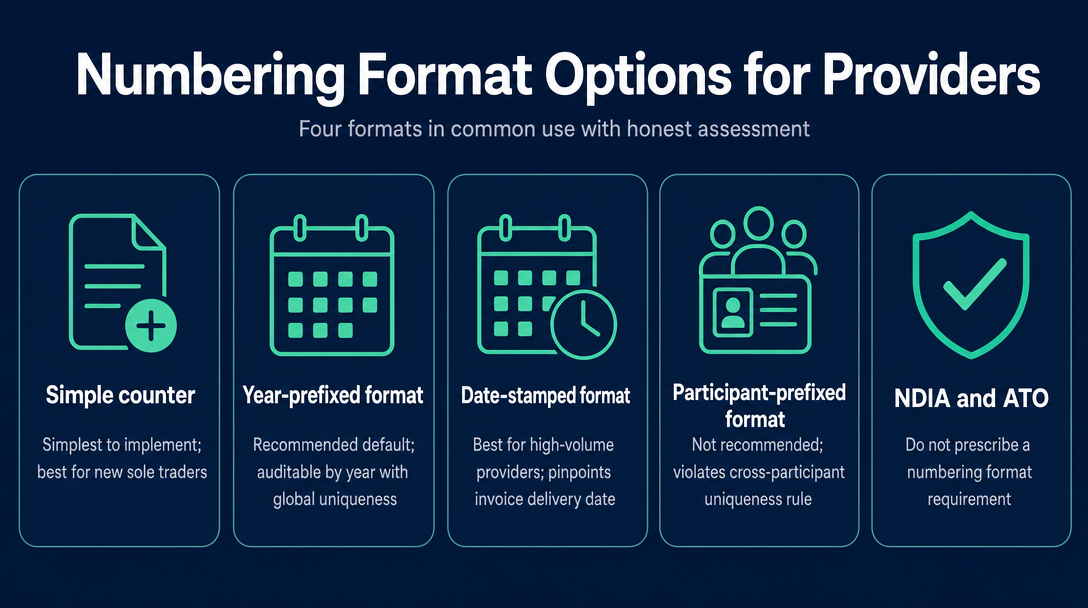
The NDIA and ATO do not prescribe a format. That flexibility is practical, but it means providers have to make their own choice. Here are the four formats in common use, with an honest assessment of each.
The Four Main Formats at a Glance
| Format | Example | Best for | Advantage | Watch-out |
|---|---|---|---|---|
| Simple counter | 001, 002, 003 | New sole trader, single participant | Simplest to implement | No date context; year-reset creates duplicates without a prefix |
| Year-prefixed | 2026-001, 2026-002 | Any sole trader - recommended default | Auditable by year; global uniqueness maintained with prefix; easy to reset cleanly on 1 July | None significant |
| Date-stamped | 20261015-001 | High-volume providers | Pinpoints invoice to delivery date | Long number; error-prone when typed manually |
| Participant-prefixed | SMITH-001, JONES-001 | Not recommended | Feels intuitive for small caseloads | Resets per-participant; violates the cross-participant uniqueness rule |
Why Participant-Prefixed Numbering Is a Trap
The participant-prefixed format feels logical when you think of invoicing as a per-person activity. The problem is that NDIS payment systems do not evaluate invoice numbers in the context of participant names - they check the number against their register of processed claims. SMITH-001 and JONES-001 are both read as 001 in a duplicate check if the system strips the prefix, which some do. Even where the system preserves the prefix, building a per-participant counter means you will eventually issue duplicates if you adopt a different naming scheme or take on participants with the same surname.
Does the Format Matter to Plan Managers?
No plan manager specifies a required format beyond "unique." What matters to them is that the number has not appeared in their system before for any provider. The year-prefixed sequential format (2026-001) is the recommended default because it is short enough to type without errors, immediately tells an auditor which year the document belongs to, and resets cleanly on 1 July with the new year prefix making it globally unique across years.
If you use a browser-based tool to generate invoices, check that it assigns numbers globally across all invoices - not per-participant. NDIS Invoice generates the next sequential invoice number as part of the invoice creation process, keeping the sequence visible and consistent across your drafts and sent invoices.
How to Correct an Invoice Number Error Without Making Things Worse
Errors happen. The critical rule is simple: never void and reissue using the same number. Reusing a voided number creates a second document with identical metadata, which payment systems will flag as a duplicate even when the amounts or dates differ.
The Six-Step Correction Process
- Identify the error - wrong format, reused number, or a number that was already processed by a plan manager.
- Do not resend the original invoice with the same number, even if you have changed other details.
- Issue a credit note or cancellation note that references the original invoice number explicitly, so your records show what happened to that number.
- Create a new invoice using the next available sequential number in your register.
- Add a brief note in your own records linking the voided number to its replacement - for example, "2026-031 voided; replaced by 2026-032."
- When you contact the plan manager or participant with the corrected invoice, reference both numbers so they can locate and close out the original.
When to Involve the Plan Manager
If the incorrect invoice was already paid under the wrong number, contact the plan manager before issuing any correction. They may need to reverse the payment on their end before reprocessing. If the invoice was held or rejected without payment being made, you can follow steps 1-6 above without needing plan manager involvement to initiate the correction. For the full rejection-resubmission workflow, the article on how to handle a rejected NDIS invoice covers that process in detail.
Record-Keeping: How Long to Keep Invoices and Why the Number Matters
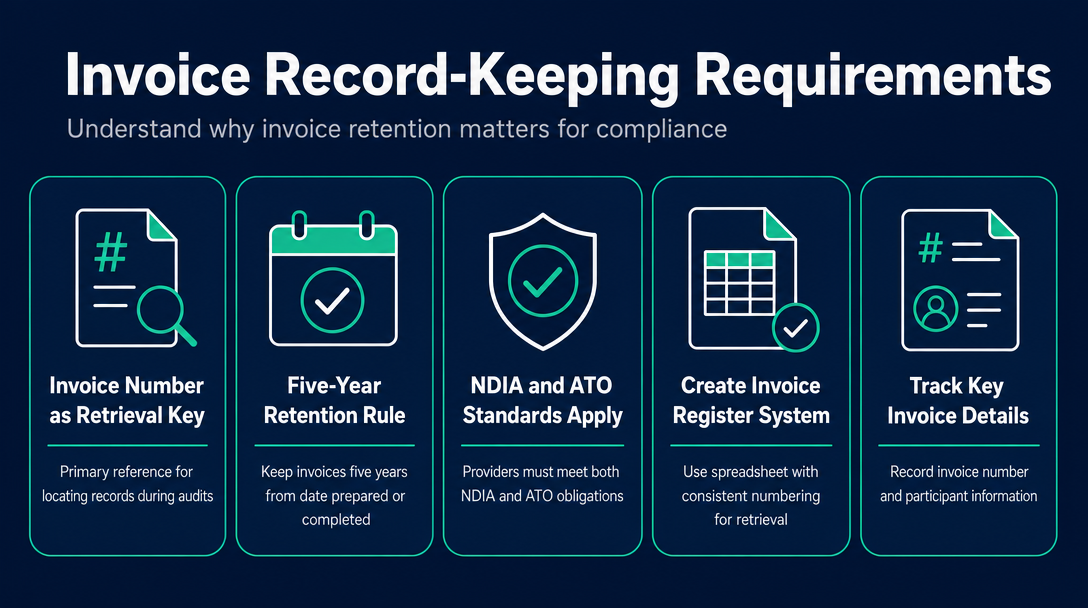
Your invoice number is not just a billing reference - it is your primary retrieval key when any record needs to be located during an audit.
The Five-Year Rule Explained
The NDIA's record-keeping requirements state that providers must keep records of supports and services delivered to NDIS participants. That page references ATO guidance on creating invoices, confirming that ATO standards apply alongside NDIA obligations. The ATO requires financial records - including invoices - to be kept for five years from the date the record is prepared or the transaction is completed, whichever is later. For an NDIS sole trader, this means every invoice you issue today must be retrievable until at least 2031.
Building a Simple Invoice Register Around Your Numbering System
A consistent numbering system is only useful if it connects to a retrievable record. The simplest approach is a spreadsheet with one row per invoice:
- Invoice number (row key)
- Participant first name (or initials)
- Date of service
- Support item code
- Amount invoiced
- Date payment received
- Notes (e.g., "voided - replaced by 2026-032")
The invoice number is what you search when a plan manager queries a claim from eight months ago. Without it, locating the right document from a folder of PDFs becomes time-consuming under normal circumstances and genuinely difficult under an NDIA audit.
NDIS Invoice keeps your sent invoices in your account, and you can print, download or export them at any time for the five-year retention obligation. That also means maintaining the register above is your responsibility, not something delegated to a cloud platform.
Frequently Asked Questions
Is there an official rule about what format my NDIS invoice number must be?
No prescribed format exists - neither the NDIA nor the ATO specifies INV-001 versus 2026-001 or any other pattern. The requirements are uniqueness and sequential order. Any consistent system you apply globally across all invoices satisfies both.
Can I start my invoice numbers at 001 again at the beginning of each financial year?
Yes, provided you use a year prefix so the numbers remain globally unique across years. 2026-001 and 2027-001 are distinct; 001 issued in July 2026 and 001 issued in July 2027 without prefixes are duplicates.
What if I accidentally send the same invoice number to two different plan managers?
One or both invoices may be held pending review. Issue a credit note referencing the duplicate number, create a new invoice using the next sequential number, and notify the relevant plan manager with both numbers cited so they can process the correction cleanly.
I am just starting out as an NDIS sole trader. Do I need a numbering system from day one?
Yes - start immediately. Your first invoice should be 2026-001 (or whatever prefix you choose). Retrofitting a numbering system onto a backlog of invoices already sent with inconsistent labels is significantly harder than establishing the habit on invoice one.
What is the difference between an invoice number and an NDIS support item number?
They are entirely different. Your invoice number is a sequential reference you assign to the document itself - for example, 2026-047. The NDIS support item number is an NDIA code from the Pricing Arrangements that identifies the type of support delivered - for example, 01_011_0107_1_1. Both appear on the same invoice but serve separate purposes and are checked by different parts of the system.
Will a plan manager reject an invoice if that number is already in their system?
Yes - or they will hold it pending clarification. NDIS payment systems flag duplicate invoice numbers as a payment risk. The plan manager cannot simply override this; the duplicate must be resolved by issuing a credit note and a new invoice with the next available sequential number.
Create Your Next Invoice With a Sequential Number Already Filled In
Before you send your next invoice, run it through NDIS Invoice - a free, browser-based tool that generates a sequential invoice number, validates every support item code against the current NDIS Pricing Schedule, and stores your invoices in your account in Sydney, Australia. No subscription.
Create a Compliant NDIS Invoice - Free
More articles
- How to Create Your First NDIS Invoice in Under 5 Minutes (Step-by-Step Video Companion)
- NDIS Plan Manager Turnaround Times: How Long Should You Wait to Be Paid After Submitting an Invoice?
- How to Handle a Rejected NDIS Invoice: Diagnosis, Correction, and Resubmission Step by Step
- NDIS Allied Health Invoicing: How Physiotherapy, Speech Therapy, and OT Codes Work in the Price Guide
- NDIS Respite (Short-Term Accommodation) Invoicing: Codes, Rates, and Common Errors