NDIS Respite (Short-Term Accommodation) Invoicing: Codes, Rates, and Common Errors
Written by Cory Nathan, founder of NDIS Invoice · Last reviewed
The support item code you use for NDIS respite depends entirely on how and where the support is delivered - not on whether it is labelled "respite" in the
14 min read
NDIS Respite (Short-Term Accommodation) Invoicing: Codes, Rates, and Common Errors
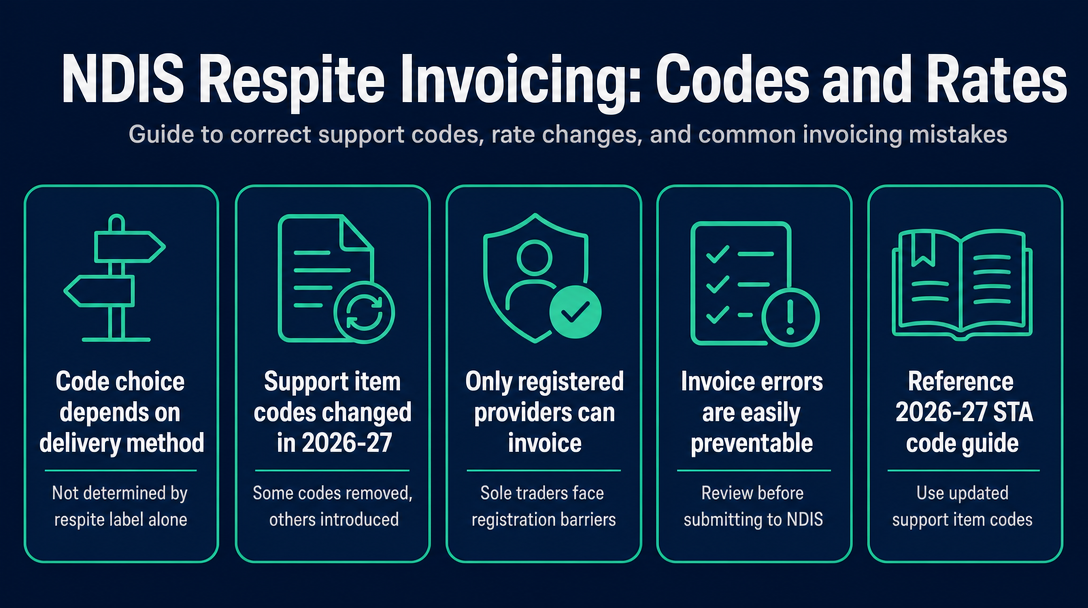
The support item code you use for NDIS respite depends entirely on how and where the support is delivered - not on whether it is labelled "respite" in the participant's plan. Using the wrong code family is the most common respite invoicing error, and it can trigger a rejected claim or a compliance flag. This article maps the correct codes to each delivery type, explains what changed in the 2026-27 Pricing Schedule, and shows exactly how a multi-night stay should appear on an invoice.
What "Respite" Means in the NDIS Pricing Catalogue - and Why the Code Choice Is Not Obvious
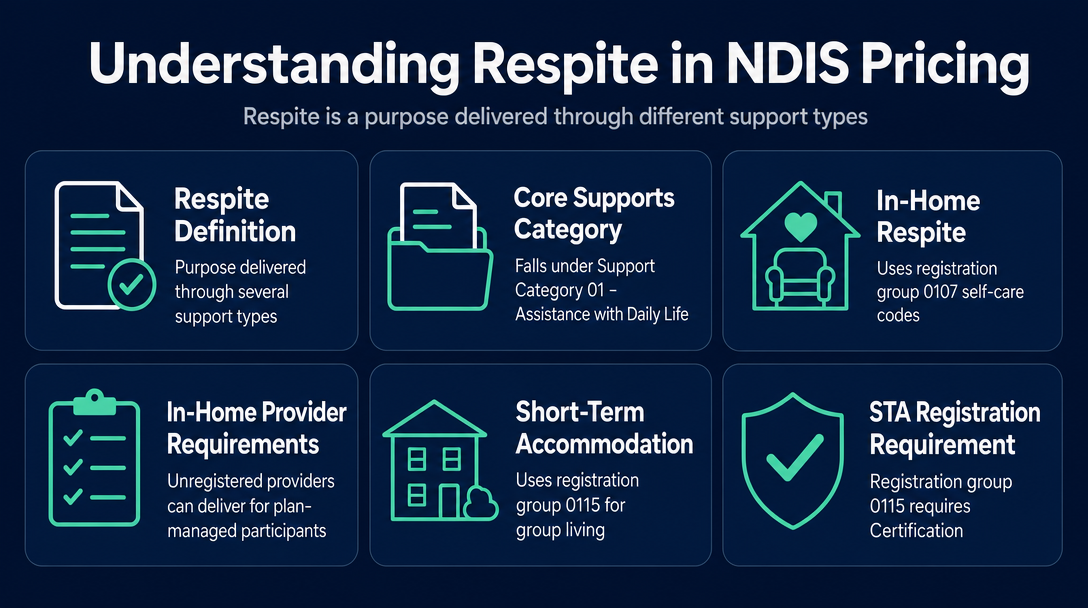
Respite is not a single support item in the NDIS Pricing Schedule. It is a purpose that can be delivered through several different support types, each with its own registration group and code family.
Respite sits within Core Supports, Support Category 01 (Assistance with Daily Life). But the specific registration group within that category - and therefore the codes you can use - depends on the setting:
In-home respite (a support worker visits the participant at their own home while a carer takes a break) is typically claimed under registration group 0107 - Assistance with Self-Care Activities, using standard daily life or self-care hourly codes from category 01. Unregistered providers can deliver these supports for plan-managed and self-managed participants.
Short-Term Accommodation (STA) - the participant stays away from home in a respite facility, host family, or other setting overnight - is claimed under registration group 0115 - Assistance with Daily Life Tasks in a Group or Shared Living Arrangement. Registration group 0115 requires Certification (the highest-tier NDIS audit), which means unregistered providers generally cannot deliver it.
This distinction is the root cause of many respite invoicing errors. A sole trader who visits a participant at home twice a week while the family carer takes a break is almost certainly a 0107 provider - not a 0115 provider. Claiming under 0115 codes for what is actually in-home support misrepresents the support type and creates a compliance risk well beyond a simple rejected claim.
STA is also distinct from Medium-Term Accommodation (MTA) and Supported Independent Living (SIL) - both of which use different funding rules and code structures. If you are not sure which accommodation type applies, the participant's plan and their plan manager can clarify before you invoice.
For a full explanation of how Core Supports fit into the broader NDIS support category framework, see the NDIS Price Guide 2026-27: How to Find the Right Support Item Code for Any Service You Deliver on this site.
The 2026-27 Code Change - What Was Removed and What Replaced It
The most consequential change in the 2026-27 NDIS Pricing Schedule for respite providers is the dismantling of the old bundled daily STA codes.
Under the previous model, a provider claimed a single daily rate that bundled together support hours and accommodation into one line item. The staffing ratio was embedded in the code itself - separate codes existed for 1:1, 1:2, 1:3, and 1:4 support. One line per day on the invoice covered everything.
The 2026-27 Pricing Schedule replaced that structure entirely. According to research consistent with the published schedule, the bundled daily STA rate and the old staffing ratio items (1:1 through 1:4) have been removed. STA support is now claimed hourly by day type, with a separate sleepover item and a separate accommodation day rate.
A brief note on naming: the NDIA renamed this support to Short-Term Respite (STR) in October 2025, but the 2026-27 Pricing Schedule reverted to Short-Term Accommodation (STA). Both terms refer to the same support. You may see either in documentation from different periods - use STA when completing your invoice.
The practical effect of this restructure is significant:
| 2025-26 Model | 2026-27 Model | |
|---|---|---|
| Claiming unit | Daily (per day) | Hourly (by day type) |
| Staffing ratio | Embedded in code | Not in code |
| Sleepover | Included in daily rate | Separate item (01_206_0115_1_1) |
| Accommodation | Included in daily rate | Separate day rate item |
| Standard vs High Intensity | Not distinguished | Separate items |
What was one line per day in 2025-26 is now three or more separate lines in 2026-27. Providers who have not updated their invoicing templates will be submitting structurally incorrect claims.
The 2026-27 STA Support Item Code Reference
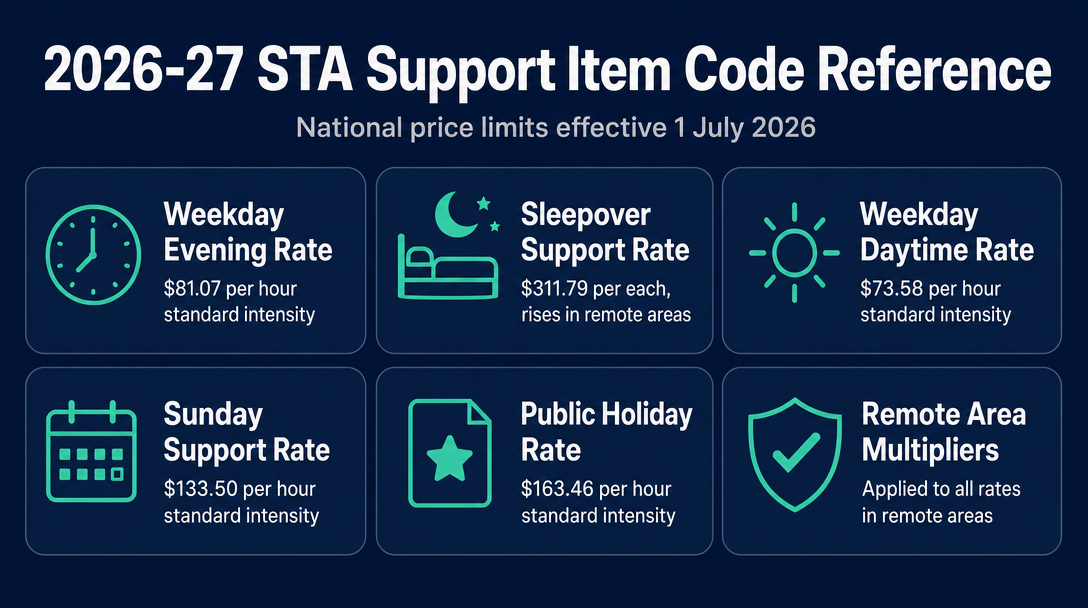
The table below covers the key STA codes for standard intensity delivery. All rates are the national price limits effective 1 July 2026, sourced from third-party references consistent with the 2026-27 NDIS Pricing Schedule. Verify figures against the current schedule at ndis.gov.au before invoicing.
| Code | Description | Unit | National Rate |
|---|---|---|---|
| 01_201_0115_1_1 | STA - Standard - Weekday Evening | Per hour | $81.07 |
| 01_206_0115_1_1 | STA - Sleepover | Per each | $311.79 |
| STA Standard - Weekday Daytime | STA - Standard - Weekday Daytime | Per hour | $73.58 |
| STA Standard - Sunday | STA - Standard - Sunday | Per hour | $133.50 |
| STA Standard - Public Holiday | STA - Standard - Public Holiday | Per hour | $163.46 |
| STA Accommodation | STA - Participant Accommodation | Per day | $162.85 |
Notes on reading this table:
Remote and very remote multipliers apply. For example, the sleepover item (01_206_0115_1_1) rises to $436.51 in remote areas and $467.69 in very remote areas. The same multipliers apply across the hourly items. For a full explanation of geographic loading, see our article on NDIS Remote and Very Remote Pricing.
High Intensity STA items exist as separate codes for participants with complex support needs. You can only claim High Intensity rates if the participant's plan specifically funds high-intensity STA. Do not apply High Intensity codes based on your own assessment.
The accommodation day rate is claimed per night the participant stays, not per support hour. It is a distinct line item, not an add-on to the hourly rate.
Saturday rates differ from Sunday rates - Saturday has its own line item code and rate. Check the current Pricing Schedule to confirm Saturday rates before invoicing.
Who Can Invoice for NDIS Respite - and the Registration Barrier Sole Traders Must Know
Registration group 0115 (the STA group) requires Certification - the higher-tier audit administered by the NDIS Quality and Safeguards Commission (ndiscommission.gov.au). This is not the lighter Verification audit that covers many sole trader services. It requires an audit by an approved quality auditor against the full NDIS Practice Standards, including those for complex bowel care and high-intensity daily activities.
The practical consequences for sole traders and unregistered providers:
NDIA-managed (agency-managed) participants: The provider must be NDIS registered. An unregistered sole trader cannot invoice for STA under group 0115 for these participants at all.
Plan-managed participants: The participant may use an unregistered provider for some supports, but plan managers apply their own risk frameworks and the participant's plan terms govern what is allowable. In practice, most STA services involve overnight accommodation and physical care, which most plan managers will require a registered provider to deliver. Confirm with the plan manager before accepting an STA booking from a plan-managed participant.
Self-managed participants: The participant can choose any provider they wish, including unregistered providers. The invoice goes directly to the participant, who claims reimbursement from their NDIS funds. Participants are responsible for managing their own compliance.
In-home respite is different. If you are a sole trader delivering in-home respite - visiting a participant at their home, providing personal care or supervision while a carer steps out - you are almost certainly working under registration group 0107 (Assistance with Self-Care Activities), not 0115. Group 0107 does not require Certification, and unregistered providers can deliver these supports to plan-managed and self-managed participants. This distinction is frequently missed by sole traders who label their service "respite" and then reach for an STA code.
Two further points worth noting: STA is generally funded for up to 28 days per year, with no more than 14 consecutive days in a single stay - this is an eligibility consideration, not an invoicing one, but it affects whether a plan has funds available when you submit. And if you need guidance on what the registration requirement means for your worker obligations more broadly, the NDIS Support Worker Requirements 2026 article on this site covers that ground.
Worked Example - How a Two-Night STA Stay Looks on a 2026-27 Invoice
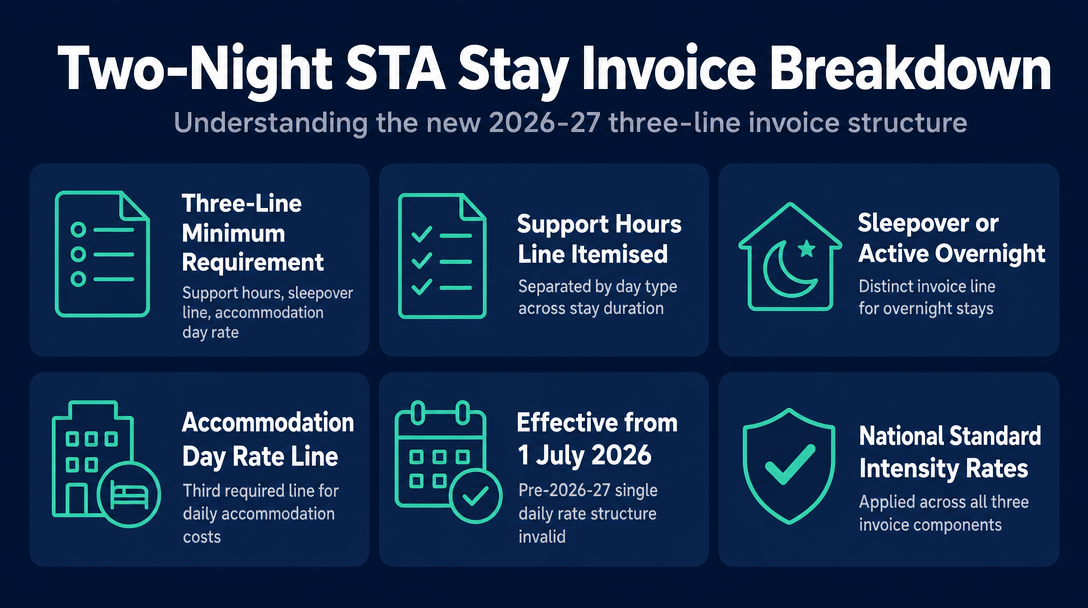
This is the section no competing resource currently provides: a line-by-line invoice structure for a multi-night stay under the new 2026-27 model.
Introducing the Three-Line STA Invoice Rule: From 1 July 2026, every NDIS short-term accommodation stay that includes an overnight requires at minimum three separate invoice lines - (1) a support hours line itemised by day type, (2) a sleepover or active overnight line, and (3) an accommodation day rate line. Any respite invoice that collapses these into a single daily rate is using the pre-2026-27 structure and will not validate correctly against the current pricing schedule.
Scenario: A registered STA provider delivers a two-night stay. The participant arrives Thursday evening (3 hours of evening support), receives 6 hours of Friday weekday daytime support, sleeps over Thursday and Friday nights (two sleepovers), and departs Saturday morning after 2 hours of Sunday-rate support. Standard intensity, national rates.
| Line | Code | Description | Unit | Qty | Rate | Total |
|---|---|---|---|---|---|---|
| 1 | 01_201_0115_1_1 | STA Standard - Weekday Evening | Hour | 3 | $81.07 | $243.21 |
| 2 | STA Standard Weekday Daytime | STA Standard - Weekday Daytime | Hour | 6 | $73.58 | $441.48 |
| 3 | 01_206_0115_1_1 | STA - Sleepover (Thursday night) | Each | 1 | $311.79 | $311.79 |
| 4 | 01_206_0115_1_1 | STA - Sleepover (Friday night) | Each | 1 | $311.79 | $311.79 |
| 5 | STA Standard Saturday | STA Standard - Saturday | Hour | 2 | [Saturday rate] | [Saturday subtotal] |
| 6 | STA Accommodation | STA - Participant Accommodation | Day | 2 | $162.85 | $325.70 |
(Saturday hourly rate: verify against the current 2026-27 Pricing Schedule at ndis.gov.au before invoicing.)
Invoice construction notes:
- Each line carries its own date of service - the date the support was delivered, not the invoice date. Use the actual service date for each line, even when invoicing after the fact.
- Each line has its own support item code, unit type (hour or each or day), quantity, and rate.
- The accommodation day rate (line 6) is claimed for each night stayed, not each calendar day.
- GST does not apply. NDIS supports, including STA, are GST-free. Do not add GST to any line.
- Food and everyday living costs are excluded. Meals, personal spending money, and everyday living expenses are the participant's personal expense. They cannot be embedded in the STA support lines or claimed as a separate NDIS line item.
- Transport to and from the STA facility is not included in any of these codes. If transport applies, claim it separately under the relevant transport support item.
- If the participant is plan-managed, send the completed invoice to their plan manager. If self-managed, send it to the participant directly.
Common Invoicing Errors for NDIS Respite - and How to Catch Them Before Submitting
1. Using a bundled daily code as if it still works the same way Some older systems and templates still contain codes like 01_058_0115_1_1 (the pre-restructure 1:1 weekday daily item). Where these codes remain in the 2026-27 schedule, they do not represent the full-day bundled service they once did. If you are working from a 2024-25 or 2025-26 template, check every STA code against the current Pricing Schedule before you submit.
2. Claiming STA codes (0115) for in-home respite If the participant stayed in their own home and received a support worker visit, the correct code is a standard self-care or daily activities code under group 0107 - not an STA code from group 0115. The reverse error also occurs: claiming 0107 codes for an overnight away-from-home stay misclassifies an STA support as in-home. Both directions create a mismatch between the support delivered and the code claimed.
3. Including food costs in the STA claim Meals, groceries, and personal items are not NDIS-fundable through STA codes. Embedding food costs in support hour quantities or accommodation rates is an error that can surface during audits.
4. Claiming both the sleepover rate and an active overnight rate for the same night A sleepover (01_206_0115_1_1) applies when the worker is on-call overnight and the participant is asleep. An active overnight rate applies when the worker was awake and actively providing support for an extended period during the night. These are mutually exclusive for the same night. Claiming both for the same shift is incorrect - determine which applies based on what actually occurred.
5. Charging above the national price limit The rates in the Pricing Schedule are maximum caps, not recommended fees. A service agreement that specifies a higher rate does not override the price limit. Submitting a claim above the cap is a compliance breach.
6. Date-of-service errors Each invoice line must show the date the support was delivered. Invoicing all lines under the invoice issue date - rather than the individual service dates - is an error that affects both claim accuracy and audit trails.
Before you submit a respite invoice, run it through NDIS Invoice - a free, browser-based tool that validates every line item against the current 2026-27 NDIS Pricing Schedule. It flags outdated codes, rates above the price cap, and missing required fields. No subscription required.
Frequently Asked Questions
What support item code do I use for NDIS respite?
It depends on how the support is delivered. In-home respite - where a worker visits the participant at their own home - uses category 01 codes under registration group 0107. Overnight respite away from home (Short-Term Accommodation) uses group 0115 codes, including hourly support codes by day type, a separate sleepover item (01_206_0115_1_1), and a separate accommodation day rate. Using a 0115 code for what is actually in-home support, or vice versa, misrepresents the support type and creates a compliance risk.
Can an unregistered sole trader invoice for NDIS respite?
It depends on the type of respite and how the participant's plan is managed. For overnight STA (group 0115), the provider must be registered at Certification level - unregistered providers cannot deliver this for NDIA-managed participants and should confirm with the plan manager before accepting STA bookings from plan-managed participants. For in-home respite under group 0107, unregistered providers can work with plan-managed and self-managed participants.
What changed with STA codes in 2026-27?
The bundled daily STA codes (which combined support hours and accommodation into one daily rate, with staffing ratio embedded in the code) were replaced. From 1 July 2026, STA support is claimed hourly by day type, with a separate sleepover item and a separate accommodation day rate. A stay that produced one invoice line per day under the old model now requires three or more lines per night under the new model.
How much is the NDIS sleepover rate for STA?
The national price limit for the STA sleepover item (01_206_0115_1_1) is $311.79 per sleepover, effective 1 July 2026. Remote and very remote rates are higher. This is a flat rate per night, not an hourly amount, and it applies when the worker is on-call while the participant sleeps.
Should I add GST to an NDIS respite invoice?
No. NDIS supports, including Short-Term Accommodation, are GST-free. Do not add GST to any line on an NDIS respite invoice.
Can food costs be claimed through STA support item codes?
No. Food, meals, and everyday living expenses are personal costs for the participant. They cannot be included in STA support hour claims or the accommodation day rate, and there is no separate NDIS line item to claim them through STA funding.
More articles
- How to Create Your First NDIS Invoice in Under 5 Minutes (Step-by-Step Video Companion)
- NDIS Plan Manager Turnaround Times: How Long Should You Wait to Be Paid After Submitting an Invoice?
- NDIS Invoice Numbering: Do You Need a Sequential System? (And What Happens If You Don't Have One)
- How to Handle a Rejected NDIS Invoice: Diagnosis, Correction, and Resubmission Step by Step
- NDIS Allied Health Invoicing: How Physiotherapy, Speech Therapy, and OT Codes Work in the Price Guide