How to Become an NDIS Support Worker in Australia: What the Invoicing Side Actually Looks Like
Written by Cory Nathan, founder of NDIS Invoice · Last reviewed
Becoming an NDIS support worker involves two parallel tracks: the care credentials track (checks, qualifications, compliance) and the business track (ABN
12 min read
How to Become an NDIS Support Worker in Australia: What the Invoicing Side Actually Looks Like
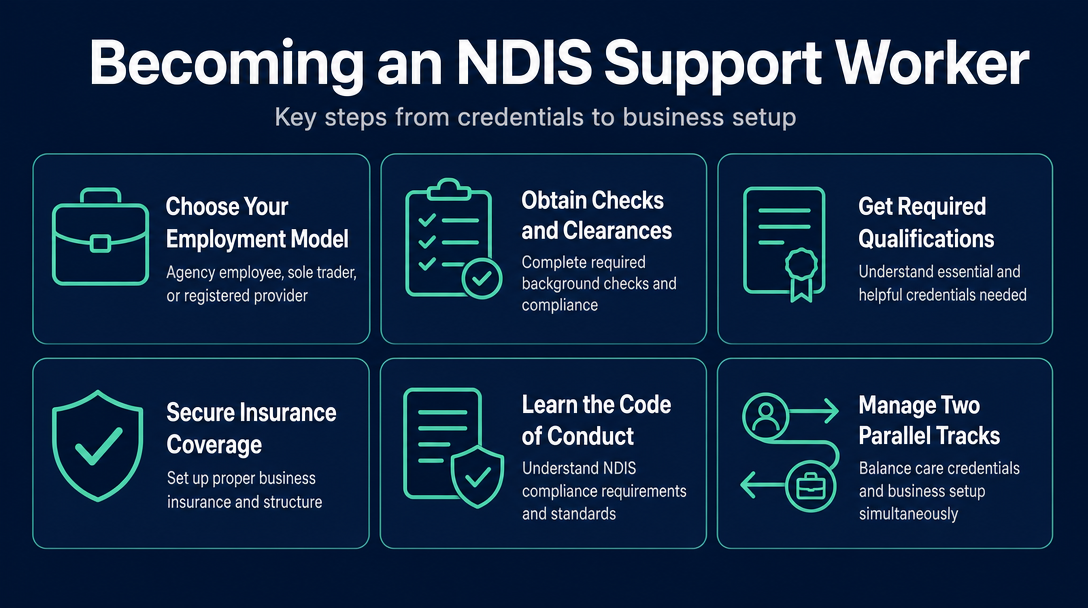
Becoming an NDIS support worker involves two parallel tracks: the care credentials track (checks, qualifications, compliance) and the business track (ABN, pricing, invoicing). Most guides cover the first track thoroughly and stop there. This article covers both - with particular focus on the business and invoicing realities that catch new sole-trader support workers off guard, because that is where the avoidable mistakes happen.
The 7-Step NDIS Support Worker Setup Sequence below takes you from the decision about how to operate through to sending your first compliant invoice.
What Does an NDIS Support Worker Actually Do?
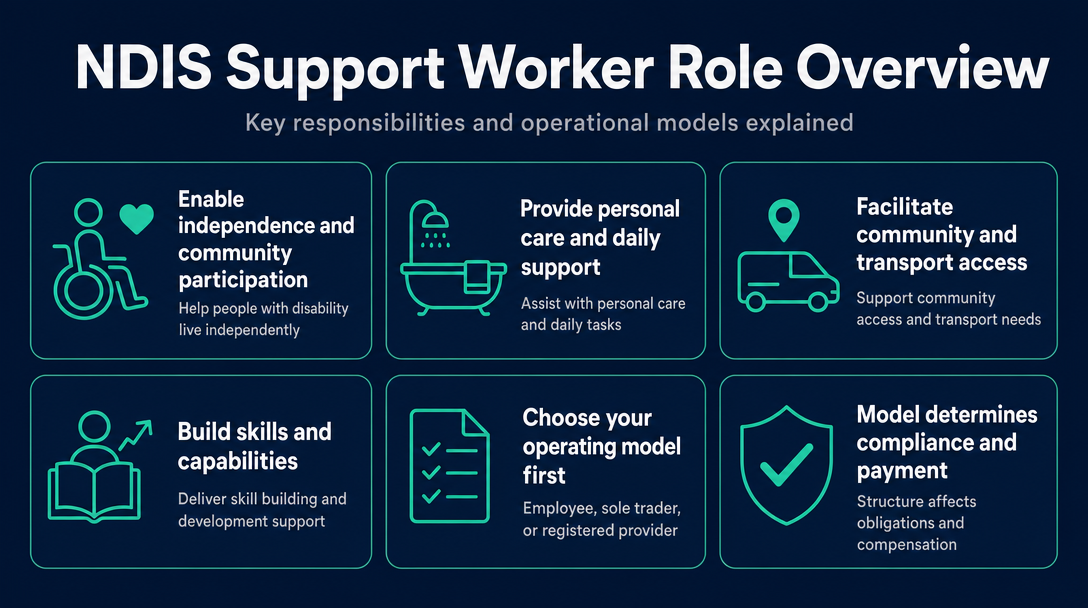
An NDIS support worker assists people with disability to live more independently and participate in their communities. Supports range from personal care and help with daily tasks through to community access, transport, and skill building.
What most entry guides gloss over is that "NDIS support worker" is not a single operating model - it is a role you can fill as an employee, as an independent sole trader, or as a registered provider. The model you choose determines your compliance obligations, the participants you can work with, and how you get paid. That decision comes first.
Step 1 - Decide: Agency Employee, Unregistered Sole Trader, or Registered Provider
This is the foundational choice, and it shapes every other step in the process.
Agency or registered provider employee: You are hired by an organisation that holds its own NDIS registration. Your employer runs the screening checks, carries the insurance, and handles invoicing. This is the lowest-admin entry point and the most common starting position for people new to the sector.
Unregistered sole trader: You operate your own business, set your own hours, and work directly with participants. You do not need to register with the NDIS Quality and Safeguards Commission - but you can only work with self-managed and plan-managed participants, not agency-managed ones. You carry your own insurance, issue your own invoices, and manage your own compliance. This is the model most relevant to the business-setup content on this site. The ABN side of this setup is covered in detail in our NDIS Sole Trader ABN Setup guide.
Registered provider (individual): You register with the NDIS Commission, which unlocks access to agency-managed (NDIA-managed) participants. This involves an audit process, significant compliance overhead, and ongoing reporting obligations. Most sole traders do not start here - they move to it later if demand warrants it.
| Operating model | Who can you work with? | Commission registration required? |
|---|---|---|
| Agency/registered provider employee | Self-managed, plan-managed, agency-managed | No - your employer registers |
| Unregistered sole trader | Self-managed and plan-managed only | No |
| Registered provider (individual) | All three, including agency-managed | Yes |
This table is the single most practical piece of information a new worker needs before applying for anything - and it is the one most guides skip.
Step 2 - Obtain Your Checks and Clearances
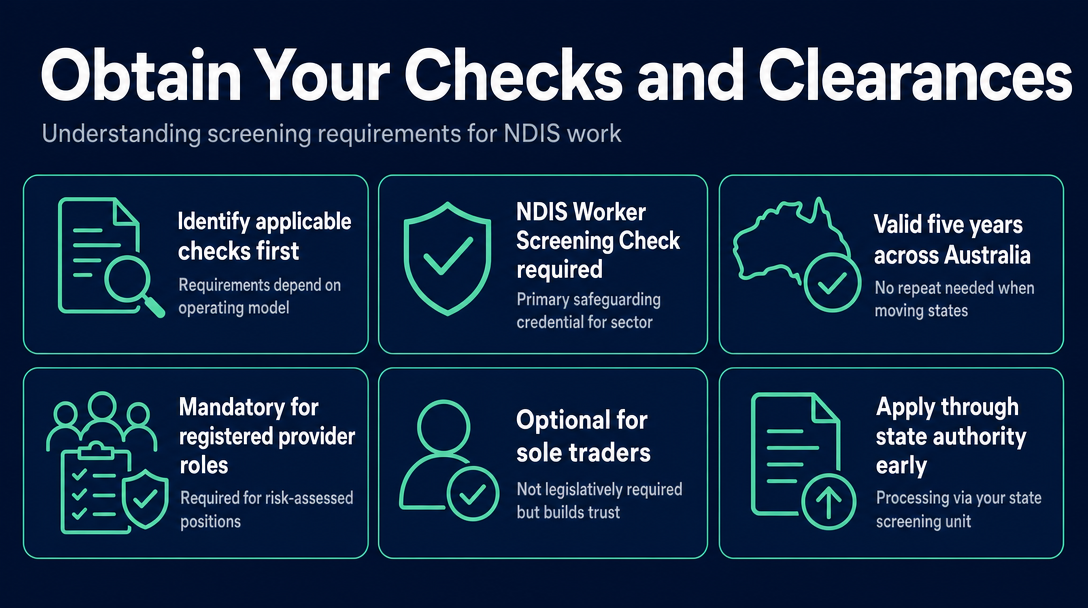
Once you know your operating model, you can work out which checks apply to you. There is no single universal list - it depends on who you work with and how.
NDIS Worker Screening Check
The NDIS Worker Screening Check is the primary safeguarding credential for the sector. It is issued by your state or territory screening unit and recorded on the NDIS Commission's National Worker Screening Database, making it valid for five years across Australia - you do not need to repeat it if you move states.
For workers employed by registered providers, this check is mandatory for roles classified as risk-assessed. For unregistered sole traders working only with self-managed participants, it is not legislatively required - but many plan managers treat it as a baseline trust signal before engaging an independent worker. Applying early is worth it regardless of your model.
Applications go through your state or territory authority (Service NSW, the Worker Screening Unit in Victoria, Communities in WA, and equivalent bodies in other states).
National Police Check
The National Police Check is a separate credential from the NDIS Worker Screening Check. Many employers, plan managers, and participant platforms request both. The NDIS Worker Screening Check is the more thorough assessment - it draws on a wider range of information than a standard police check - but having both removes any ambiguity when you are introducing yourself to new referral sources.
Working with Children Check
If any of your work involves participants under 18, a Working with Children Check (or equivalent) is required. The name and issuing body vary by state: it is a Blue Card in Queensland, a Working with Children Check in NSW and Victoria, a Working with Vulnerable People registration in the ACT, and so on. Check your state government's requirements before you start.
First Aid and CPR Certificate
No NDIS legislation mandates a specific First Aid qualification - but in practice, almost every plan manager, registered provider, and independent platform expects one. The standard unit is HLTAID011 Provide First Aid (which includes CPR). Without it, you will face unnecessary friction when approaching referral sources. Book it early; it is typically completed in a single day.
Step 3 - Qualifications: What You Need vs. What Helps
There is no single mandatory formal qualification to work as an NDIS support worker in every context. For unregistered sole traders working with self-managed participants, you can technically begin without a Certificate III. The NDIS Code of Conduct does require that you provide supports "in a safe and competent manner with care and skill" - so if your competence cannot be demonstrated, the absence of a qualification becomes a practical (and ethical) problem rather than just a legal one.
CHC33021 Certificate III in Individual Support (Disability) is the standard entry-level qualification. It includes a minimum practical placement component completed in a real support setting. It is what most plan managers and employers look for, and it is what independent platforms typically require to list on their services. If you are serious about building a practice, this qualification removes the most common objection you will face.
CHC43121 Certificate IV in Disability is the next step for those working with participants with higher support needs, or moving into team leader or coordination-adjacent roles.
NDIS Worker Orientation Module - "Quality, Safety and You": This free online module is available through the NDIS Commission's workforce training page. It is mandatory for workers employed by registered providers and strongly recommended for all workers regardless of registration status. It takes a few hours to complete and demonstrates baseline understanding of the Code of Conduct, safeguarding, and participant rights.
Step 4 - Sort Your Insurance and Business Structure
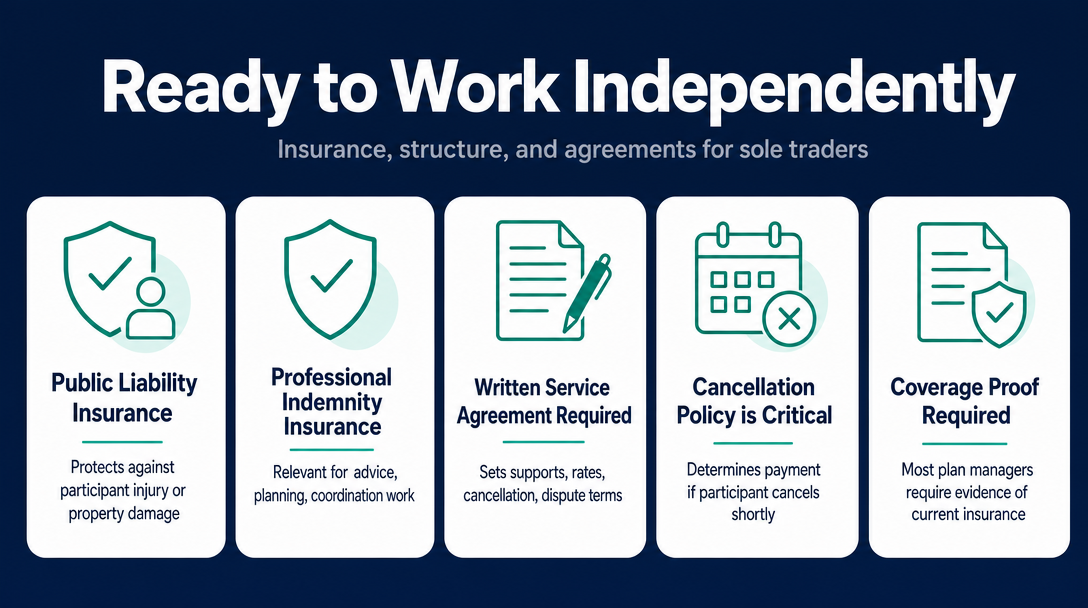
For sole traders, this is the step that makes you ready to work independently.
Public liability insurance protects you if a participant is injured or property is damaged in the course of your support work. It is mandatory for registered providers and the de facto standard for any independent worker. Most plan managers will not engage a sole trader who cannot provide evidence of current coverage.
Professional indemnity insurance is less common in direct support work but relevant if your role involves any advice, planning support, or coordination-adjacent activities.
Service agreement: Before you begin with any participant, you need a written service agreement. This document sets out the supports you will provide, the agreed rates, cancellation terms, and how disputes are handled. For a sole trader, the cancellation policy clause is critical - it is what determines whether you get paid if a participant cancels at short notice. The NDIS Commission provides service agreement guidance at ndis.gov.au that you can use as a starting template.
For the ABN registration process and business bank account setup that sit alongside these steps, the NDIS Sole Trader ABN Setup guide covers that ground specifically.
Step 5 - Understand the NDIS Code of Conduct
The NDIS Code of Conduct applies to every worker and provider, registered or not. This is one of the most important points for new sole traders to understand: you do not need Commission registration for the Code to apply to you.
The seven obligations are:
- Act with respect for individual rights to freedom of expression, self-determination, and decision-making
- Respect the privacy of people with disability
- Provide supports and services in a safe and competent manner with care and skill
- Act with integrity, honesty, and transparency
- Promptly take steps to raise and act on concerns about matters that might have an impact on the quality and safety of supports
- Take all reasonable steps to prevent and respond to all forms of violence, exploitation, neglect, and abuse
- Take all reasonable steps to prevent and respond to sexual misconduct
Breaching the Code can result in enforcement action from the NDIS Commission even if you are an unregistered sole trader. The Worker Orientation Module mentioned in Step 3 walks through each obligation in practical terms.
Step 6 - Find Your First Participant or Employer
This is the step that most guides treat as self-evident - and it is the one where new workers lose momentum.
Independent worker platforms such as Mable, Hireup, and Careseekers connect sole-trader support workers directly with self-managed and plan-managed participants. Each platform has its own verification requirements (typically screening check, police check, First Aid, and references), but they handle participant matching and some administrative functions. These are worth researching directly.
Disability employment agencies and registered providers offer the lowest-friction start if your credentials are fresh. You work within their systems while building experience and referral networks.
Plan managers and support coordinators are a referral source that independent workers underuse. A brief, professional introduction - including your clearance certificate, insurance evidence, qualifications, and First Aid certification - positions you as a low-risk, ready-to-engage contractor.
NDIS Provider Finder at ndis.gov.au allows participants to search for providers by location and support type. Registered providers can list here; unregistered sole traders cannot, which is one reason some workers eventually pursue full registration.
Step 7 - Set Up to Invoice Correctly from Day One
Once your clearances are confirmed, your service agreement is signed, and your first support shift is delivered, you need to get paid. This is where the plan management type of your participant matters directly.
According to the NDIS's own guidance, if a participant has a plan manager, you send invoices directly to that plan manager. If the participant is self-managed, the invoice goes to the participant or their nominee. Agency-managed participants are only accessible to registered providers via the NDIS Portal.
Every support item you invoice has a specific support item number and a price cap set by the NDIS Pricing Arrangements and Price Limits. The pricing schedule defines what the NDIS "considers to be the appropriate and reasonable maximum prices for all NDIS supports." Charging above those caps, using an outdated support code, or misclassifying a day-type (weekday vs. weekend vs. public holiday) are the most common errors new workers make - and they result in delayed or rejected payment.
The fastest way to avoid those errors is to validate every invoice before it leaves your hands. NDISInvoice.com.au is a free, browser-based tool that checks every line item against the current NDIS Pricing Schedule as you build the invoice - flagging wrong codes, above-cap prices, and day/time misclassifications before you send. For a new sole trader sending their first few invoices, this removes the single most expensive category of mistake.
For the specific fields that must appear on every NDIS invoice, see What Must Be on an NDIS Invoice? The 9 Required Fields.
Frequently Asked Questions
Do I need formal qualifications to become an NDIS support worker?
There is no single mandatory formal qualification required in all contexts. Unregistered sole traders working with self-managed participants can legally operate without a Certificate III. In practice, most plan managers, platforms, and agencies expect CHC33021 Certificate III in Individual Support (Disability) as a baseline credential - and the NDIS Code of Conduct requires that all workers provide supports "in a safe and competent manner," so competence must be demonstrable regardless of formal qualifications.
Is an NDIS Worker Screening Check the same as a police check?
No. They are separate checks. The NDIS Worker Screening Check is a more comprehensive assessment conducted by your state or territory screening unit and recorded on the national NDIS worker screening database. A standard National Police Check is a separate document. Many employers and plan managers request both, though the NDIS Worker Screening Check is the more thorough of the two.
Can I work as an NDIS support worker without registering with the NDIS Commission?
Yes. Unregistered sole traders do not need to register with the NDIS Quality and Safeguards Commission. However, unregistered workers can only provide services to self-managed and plan-managed participants - not to participants whose funding is managed directly by the NDIA (agency-managed). The NDIS Code of Conduct applies to all workers regardless of registration status.
Which types of NDIS participants can an unregistered sole trader work with?
An unregistered sole trader can work with self-managed participants and plan-managed participants. They cannot work with agency-managed (NDIA-managed) participants - those participants must use registered providers. If working with agency-managed participants is important to your practice, you will need to pursue full NDIS Commission registration.
How long does it take to get an NDIS Worker Screening Check?
Processing times vary by state and territory and depend on application volumes. Many applications are cleared within a few weeks; complex cases or those requiring further assessment take longer. The clearance is valid for five years across Australia once issued, so applying as early as possible in your setup process avoids delays to your start date.
What happens if I use the wrong support code or charge above the price cap on an invoice?
The invoice is likely to be rejected or queried by the plan manager or participant. You will need to reissue a corrected invoice, which delays payment. Repeated errors can affect your relationship with plan managers and participants. Validating every invoice against the current NDIS Pricing Arrangements before sending - using a tool like NDISInvoice.com.au - catches these errors before they cause a problem.
Ready to send your first invoice? Once your screening is cleared, your service agreement is signed, and your first shift is delivered, use NDISInvoice.com.au to build and validate your invoice against the current NDIS Pricing Schedule before it leaves your hands. The setup work is done - getting paid correctly is the only step left.
More articles
- How to Create Your First NDIS Invoice in Under 5 Minutes (Step-by-Step Video Companion)
- NDIS Plan Manager Turnaround Times: How Long Should You Wait to Be Paid After Submitting an Invoice?
- NDIS Invoice Numbering: Do You Need a Sequential System? (And What Happens If You Don't Have One)
- How to Handle a Rejected NDIS Invoice: Diagnosis, Correction, and Resubmission Step by Step
- NDIS Allied Health Invoicing: How Physiotherapy, Speech Therapy, and OT Codes Work in the Price Guide