NDIS Core Supports vs. Capacity Building: Which Support Category Applies to What You Delivered?
Written by Cory Nathan, founder of NDIS Invoice · Last reviewed
Core Supports and Capacity Building are not interchangeable budget pools - they are separate, locked categories, and every line item code you put on an
12 min read
NDIS Core Supports vs. Capacity Building: Which Support Category Applies to What You Delivered?
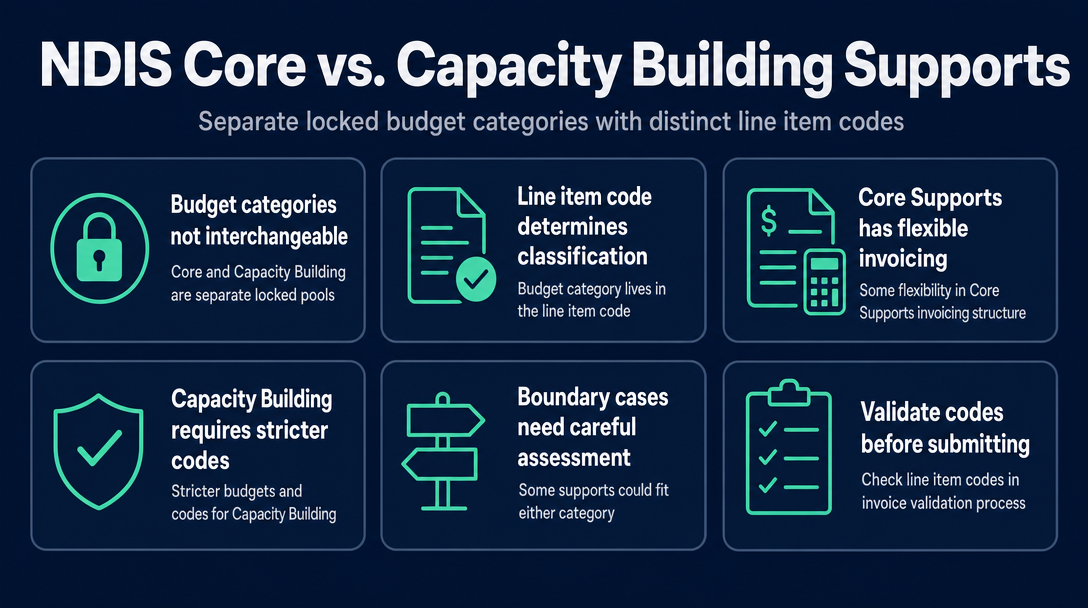
Core Supports and Capacity Building are not interchangeable budget pools - they are separate, locked categories, and every line item code you put on an invoice signals which one you are drawing from. Submit a code that pulls from the wrong budget and the claim will be rejected, regardless of whether the participant actually needed the support. Here is how the distinction plays out at the invoice level, and how to get it right before you send.
Why the Budget Category Is Not Just a Label - It Lives in the Line Item Code
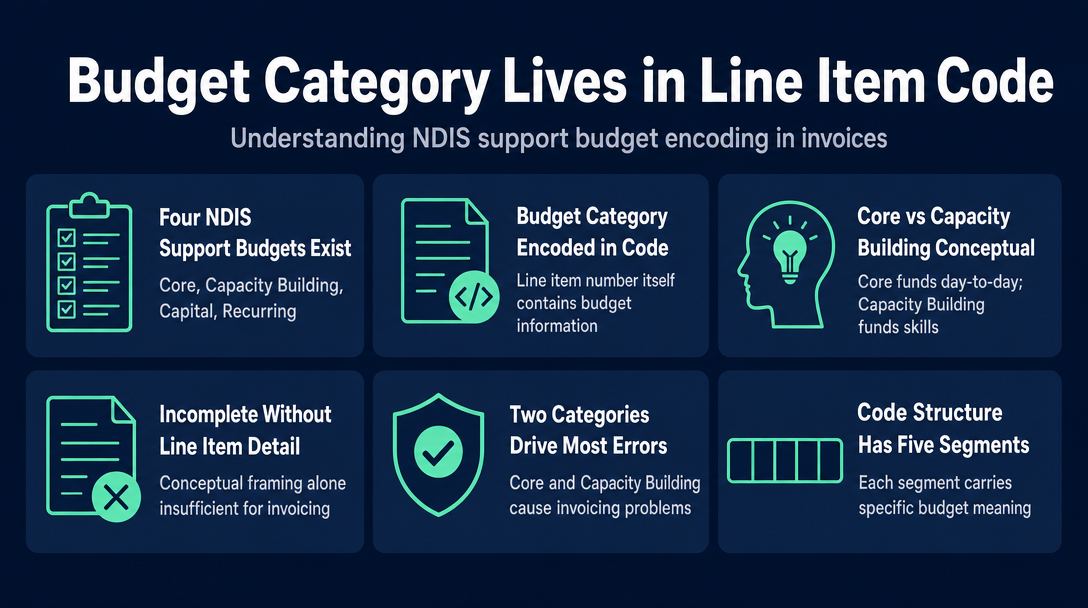
Most explanations of Core vs Capacity Building stop at the conceptual level: Core funds day-to-day assistance; Capacity Building funds skill development. That framing is accurate but incomplete for anyone creating an invoice. The NDIS Pricing Arrangements make each support item's budget category machine-readable - it is encoded directly in the line item number itself.
According to the NDIS guide to support budgets, NDIS plans currently have four support budgets: Core Supports, Capacity Building Supports, Capital Supports, and Recurring Supports. The two largest - Core and Capacity Building - are the source of most invoicing errors, so that is where this article focuses.
The Five Segments of an NDIS Line Item Code - What Each One Means
An NDIS line item code like 01_011_0107_1_1 is structured across five segments, each carrying specific meaning:
| Segment | Example Value | What It Tells You |
|---|---|---|
| Support Category | 01 |
Which of the 15 support categories (e.g., 01 = Assistance with Daily Life) |
| Sequence Number | 011 |
The specific support item within that category |
| Registration Group | 0107 |
The NDIS registration group the provider needs |
| Outcome Domain | 1 |
Which NDIS outcome domain the support relates to |
| Support Purpose | 1 |
1 = Core Supports; 3 = Capacity Building |
That final digit - the Support Purpose - is the invoice-level signal that tells the NDIA portal and every plan manager which budget bucket the claim draws from. Get it wrong and the claim does not just come back with a query; it fails.
Support Purpose 1 vs Support Purpose 3 - The Digit That Splits Your Invoice
Support Purpose 1 means the code draws from the Core Supports budget. Support Purpose 3 means it draws from Capacity Building. The first two digits of the code (the support category prefix) reinforce this: categories 01 through 04 are Core; categories 07 through 15 are Capacity Building. A code cannot have a Core prefix with a CB support purpose digit, or vice versa - the entire code is internally consistent, which is why using the wrong code for the right service causes a clean rejection rather than a partial payment.
Core Supports Invoicing - What's Flexible and What Isn't
Core Support Categories and Their Invoice Code Prefixes
Core Supports cover four invoiceable areas. Each has a two-digit prefix that opens the line item code:
| Core Support Category | Code Prefix | Typical Services |
|---|---|---|
| Assistance with Daily Life | 01_ |
Personal care, domestic assistance, meal preparation |
| Transport | 02_ |
Transport to community, work, or appointments |
| Consumables | 03_ |
Low-cost assistive products, continence aids |
| Assistance with Social, Economic & Community Participation | 04_ |
Support to access community activities |
The NDIS pricing schedules set out the maximum prices for these supports, and each item carries its own price limit that varies by time of day, day of week, and remoteness classification.
The Flexibility Rule - and Its Hard Ceiling at the Budget Boundary
Within Core, budget is generally flexible: if a participant underspends their Transport allocation, those funds can shift to cover additional Assistance with Daily Life. This flexibility is one of Core's defining features, and it is why sole traders delivering personal care or domestic assistance have relatively straightforward invoicing - the participant's plan manager or the participant themselves can direct available Core funds as needed.
But that flexibility has one absolute ceiling: Core funds cannot cross into Capacity Building. This is not a soft rule or a policy preference - it is a structural constraint built into how the NDIS distinguishes flexible and stated supports within plan budgets. A claim submitted with a CB code against a participant's Core budget will not partially succeed; it will fail entirely.
Capacity Building Invoicing - Stricter Budgets, Stricter Codes
The 9 Capacity Building Lines - and Why Each Is a Separate Invoicing Bucket
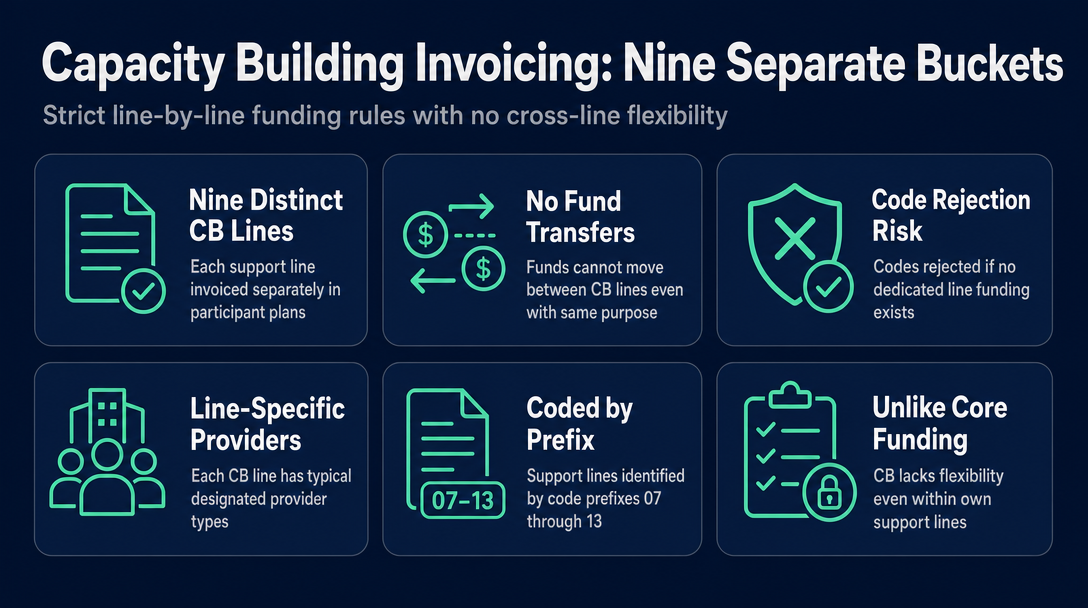
Unlike Core, Capacity Building is not flexible even within itself. Each of its nine support lines is separately stated in the participant's plan, and funds from one CB line cannot cover another. If a participant has funding in CB - Improved Daily Living but nothing in CB - Social Community and Civic Participation, a code from the social participation line will be rejected - even though both codes carry a Support Purpose of 3.
| CB Support Line | Code Prefix | Typical Provider |
|---|---|---|
| Support Coordination | 07_ |
Support coordinators |
| Improved Living Arrangements | 08_ |
Specialist support workers, housing teams |
| Increased Social & Community Participation | 09_ |
Support workers (skill-building programs) |
| Finding & Keeping a Job | 10_ |
Employment services |
| Improved Health & Wellbeing | 11_ |
Dietitians, exercise physiologists |
| Improved Learning | 12_ |
Education support services |
| Improved Life Choices | 13_ |
Plan management (stated separately) |
| Improved Daily Living | 14_ |
OT, physiotherapy, speech pathology, psychology |
| Improved Relationships | 15_ |
Behaviour support practitioners |
Can a Sole Trader Invoice for Capacity Building Supports?
This is where the distinction matters most for unregistered sole traders. Most Capacity Building supports require either NDIS registration, specific professional qualifications, or both. A sole trader delivering personal care under Core codes is not automatically entitled to invoice under CB codes for the same participant, even if the participant wants to structure a session as "skill-building."
If a participant is self-managed or plan-managed, an unregistered sole trader can invoice for supports that do not legally require registration - but whether a particular CB line requires registration depends on the specific support item. The practical reality: most sole trader support workers operate exclusively under Core codes, and the CB lines accessible without registration are narrow. If you are uncertain, checking the Support Catalogue entry for the specific line item is the reliable test.
The Boundary Cases - Supports That Could Be Either Core or Capacity Building
This is the gap that causes the most real-world invoice errors, and it is the area no other explanation addresses clearly. Some supports genuinely look like they could sit in either budget - the determining factor is not what the worker does physically, but what purpose the service agreement nominates.
This principle is what we call the Budget-Lock Rule: the service agreement determines the budget, and the budget determines the code - not the other way around. A sole trader cannot decide at invoicing time to shift a service between budget categories to access available funds.
Community Access - Core or Capacity Building?
Accompanying a participant to a community event as assistance - helping them get there, move around, and participate - is a Core support, invoiced under category 04_ (Assistance with Social, Economic and Community Participation). If the same outing is structured as a skill-building program toward greater independence, documented as such in the service agreement and support notes, it could draw from CB - Increased Social and Community Participation (09_). The distinguishing factor is not the physical activity; it is the purpose on record.
A sole trader cannot make this classification call unilaterally. If the service agreement says Core, the invoice code is Core.
ADL Assistance vs. Skill-Building: Why Purpose - Not Activity - Determines the Code
Helping a participant prepare a meal as daily living assistance is a Core support (01_). An occupational therapist running a formal cooking-skills program as part of a therapeutic plan can invoice under CB - Improved Daily Living (14_). A sole trader personal care worker running what they consider an informal cooking lesson cannot reclassify that session under CB codes - regardless of intent - because CB - Improved Daily Living is delivered by qualified allied health practitioners, not unregistered support workers.
The same logic applies to any support that superficially resembles skill-development: the qualification requirement attached to the CB line item, not just the activity, determines eligibility.
What to Do When You're Unsure Which Budget Applies
Check the participant's plan document and their service agreement before invoicing. If the support purpose is not clearly nominated, ask the participant's LAC (Local Area Coordinator) or plan manager - not after the fact, but before you deliver the support. Once a service is delivered and invoiced under the wrong code, correction requires cancellation, resubmission, and - if the correct budget is exhausted - potentially no payment at all.
Validating Your Invoice Before You Submit - The Code-Check Process
The practical guide to NDIS support item codes and the Pricing Schedule structure is covered in depth in NDIS Price Guide 2026-27: How to Find the Right Support Item Code for Any Service You Deliver on this site. The steps below focus specifically on confirming you have the right budget category before the invoice goes out.
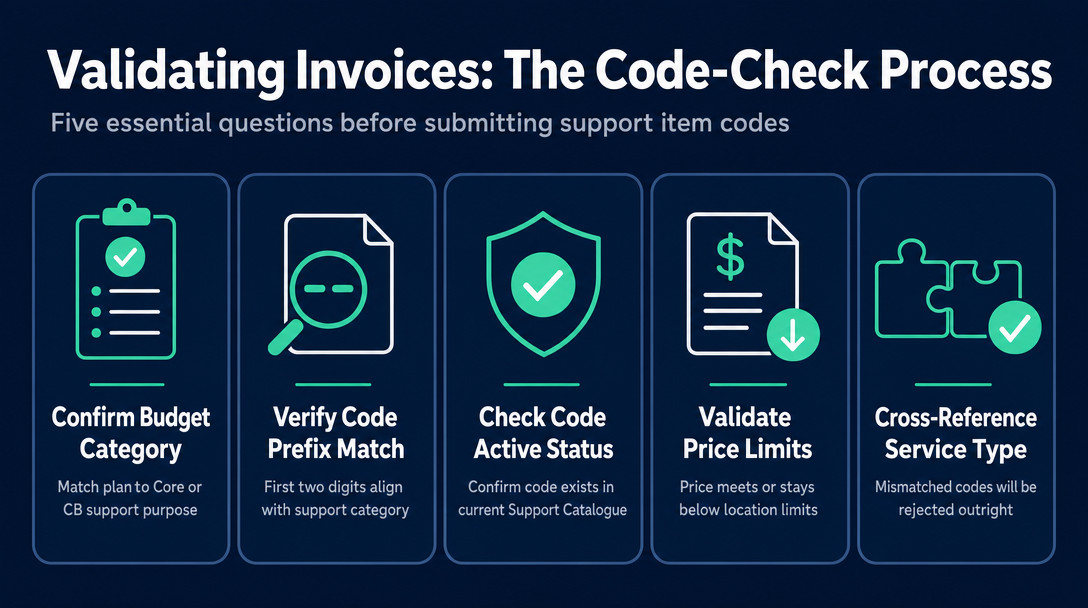
Five Questions to Ask Before Entering a Line Item Code
Which budget does the participant's plan and service agreement nominate for this support? If it says Core, the code must have a Support Purpose of
1. If it says CB, the code must have a Support Purpose of3.Does the first two digits of the code match the correct support category? Cross-check the category prefix against the support type - a
14_code for a personal care session is a red flag.Is this code currently active in the 2026-27 Support Catalogue? Codes are retired or updated between pricing periods. An outdated code will be rejected even if every other detail is correct.
Is the price at or below the current price limit for your location and this time of day? The price limit for the same code differs across standard, remote, and very remote locations.
If the participant is plan-managed, does this code align with what their plan manager has on file from the service agreement? Plan managers check submitted codes against the service agreement - a mismatch triggers a return for correction, which delays payment.
What Plan Managers Check - and What Triggers a Rejection
When a plan-managed participant's invoice arrives (a prior article in this series covers the plan management billing workflow in detail), the plan manager's first check is whether the code matches the service agreement category. A Core code where the service agreement shows CB, or a CB prefix against an exhausted CB line, are both common causes of rejected claims. The invoice goes back to the provider for correction - and if the correct budget is genuinely exhausted, resubmitting with the right code does not guarantee payment.
Before you create your invoice, NDIS Invoice validates every line item against the current NDIS Support Catalogue - checking that the code is active, the price is within the 2026-27 cap, and the support purpose digit matches the budget category. It is a practical first check before any invoice reaches a plan manager or the NDIA portal.
Frequently Asked Questions
Can Core Supports funding pay for Capacity Building services? No. Core and Capacity Building are separate, structurally locked budgets - they cannot be used interchangeably. A claim submitted with a CB code against Core funding, or vice versa, will be rejected by the plan manager or the NDIA payment system.
How do I tell from a line item code which budget it draws from?
Check the first two digits and the final digit of the code. Codes starting with 01 through 04 and ending in a Support Purpose digit of 1 are Core Supports. Codes starting with 07 through 15 and ending in 3 are Capacity Building. Both signals should be consistent within any valid code.
What happens if I accidentally invoice the wrong budget category? For plan-managed participants, the plan manager will return the invoice for correction. For NDIA-managed participants, the MyPlace portal claim will fail at submission. You must resubmit with the correct code - and if the correct budget is already exhausted, you may not be paid for that support at all.
As a sole trader, can I invoice for Capacity Building supports? Only in limited circumstances. If the participant is self-managed or plan-managed, you can invoice for CB support items that do not legally require NDIS registration. However, the majority of CB lines - particularly Improved Daily Living (OT, physiotherapy, speech, psychology), Behaviour Support, and Support Coordination - require registration or professional qualifications. A sole trader delivering personal care cannot reclassify that service under CB codes.
Is community access a Core or Capacity Building support?
It depends on the purpose documented in the service agreement. Assisting a participant to access community activities is Core (category 04_). If the session is a structured skill-building program explicitly aimed at increasing independence, it may draw from CB - but that purpose must be stated in the plan and service agreement before delivery, not decided by the worker at invoicing time.
Before you send that invoice, let the code check itself. NDIS Invoice is a free, browser-based tool that validates every line item against the current NDIS Support Catalogue - confirming the code is active, the price is within the 2026-27 cap, and the support purpose matches the correct budget category. Validate your invoice now at ndisinvoice.com.au.
More articles
- How to Create Your First NDIS Invoice in Under 5 Minutes (Step-by-Step Video Companion)
- NDIS Plan Manager Turnaround Times: How Long Should You Wait to Be Paid After Submitting an Invoice?
- NDIS Invoice Numbering: Do You Need a Sequential System? (And What Happens If You Don't Have One)
- How to Handle a Rejected NDIS Invoice: Diagnosis, Correction, and Resubmission Step by Step
- NDIS Allied Health Invoicing: How Physiotherapy, Speech Therapy, and OT Codes Work in the Price Guide