NDIS Pricing Schedule 2026-27 vs. 2025-26: What Changed, What Codes Were Retired, and How to Update Your Invoicing
Written by Cory Nathan, founder of NDIS Invoice · Last reviewed
The 2026-27 NDIS Pricing Schedule replaced the old Pricing Arrangements and Price Limits (PAPL) on 1 July 2026. Support worker rates increased by
13 min read
NDIS Pricing Schedule 2026-27 vs. 2025-26: What Changed, What Codes Were Retired, and How to Update Your Invoicing
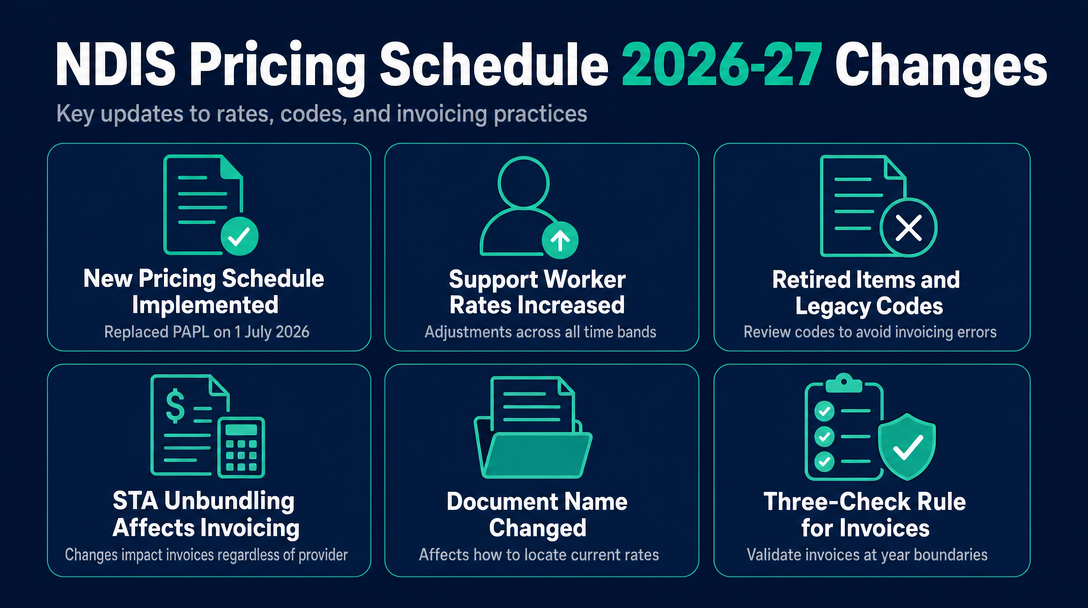
The 2026-27 NDIS Pricing Schedule replaced the old Pricing Arrangements and Price Limits (PAPL) on 1 July 2026. Support worker rates increased by approximately 3.95%, 22 legacy support items are scheduled to retire on 30 September 2026, STA billing was restructured, and - from 24 September 2026 - the price limits became a legally binding ministerial determination. If you invoice plan managers or self-managed participants, here is exactly what changed and what to check before your next claim.
The Short Version: Five Things That Changed
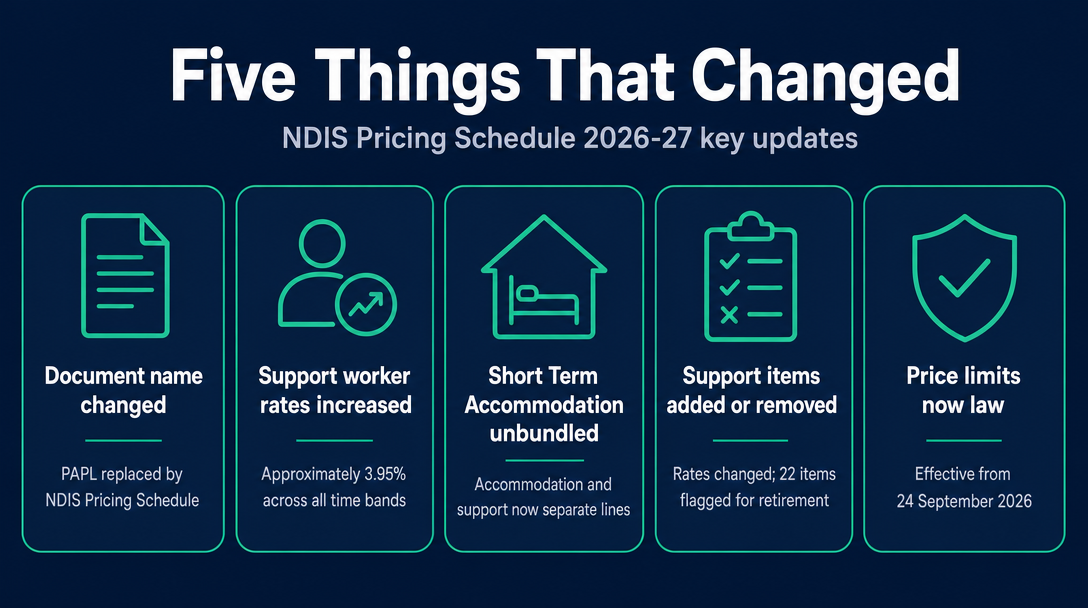
Before diving into each change, here is the at-a-glance summary. If you only deliver standard daily living or community support shifts, points 1, 2, and 5 are the ones that directly affect your invoice lines.
- The document name changed. The PAPL no longer exists. It was replaced by the NDIS Pricing Schedule 2026-27, effective 1 July 2026.
- Standard support worker rates went up - approximately 3.95% across all time bands, driven by the Fair Work Commission Annual Wage Review and the superannuation guarantee rising from 11.5% to 12%.
- STA (Short Term Accommodation) was unbundled. Accommodation and support hours are now separate invoice lines, not one bundled daily rate.
- Dozens of items were added or removed. A large number of support items increased in rate, while others decreased or were removed entirely from the catalogue - including 22 flagged for retirement on 30 September 2026.
- Price limits are now law. From 24 September 2026, the price limits in the Pricing Schedule became a ministerial pricing determination - a legislative instrument under the National Disability Insurance Act.
Support Worker Rates: What Moved, by How Much, and What It Means Per Time Band
The direct answer: Every standard support worker time band increased for 2026-27. The weekday daytime national rate is now $73.58 per hour.
The rate rise reflects two compounding inputs: the Fair Work Commission's annual wage decision and the superannuation guarantee increase from 11.5% to 12%. Together, these pushed the core support worker rate up approximately 3.95% on the 2025-26 figure.
2026-27 National Price Limits by Time Band
| Time Band | 2025-26 Rate | 2026-27 Rate (national) | Direction |
|---|---|---|---|
| Weekday Daytime | approx. 3.95% lower | $73.58/hr | Up |
| Weekday Evening | approx. 3.95% lower | increased in step | Up |
| Saturday | approx. 3.95% lower | $103.54/hr | Up |
| Sunday | approx. 3.95% lower | $133.50/hr | Up |
| Public Holiday | approx. 3.95% lower | $163.46/hr | Up |
| Sleepover (inactive overnight) | approx. 3.95% lower | flat rate - check current Schedule | Up |
The exact 2025-26 rate for each band is not reproduced here to avoid stating a superseded figure. The current 2026-27 limits above are sourced from the 2026-27 Pricing Schedule. Verify the current figures at ndis.gov.au/providers/pricing-and-payments/pricing/pricing-arrangements.
Invoice action: If your service agreement, Word template, or spreadsheet still carries the old dollar amount, you will either over-bill (rejected or clawed back) or under-bill (you receive less than you are entitled to). Check the figure on every line before sending.
Standard vs. High Intensity - Does the Increase Apply Equally?
Both standard and high-intensity support worker items moved upward by a similar margin. High-intensity items carry a higher base rate by definition, so the absolute dollar increase is larger - but the percentage uplift is consistent with the overall Award decision. If you hold a high-intensity qualification and invoice those items, check the current Schedule for the specific high-intensity rate, as it sits above the standard figures in the table above.
NDIS Invoice applies the current NDIS Pricing Schedule 2026-27 v1.1 to every line automatically - so the rate check happens before the invoice leaves your screen, not after it is rejected.
New Items, Retired Items, and the "Legacy Code" Risk
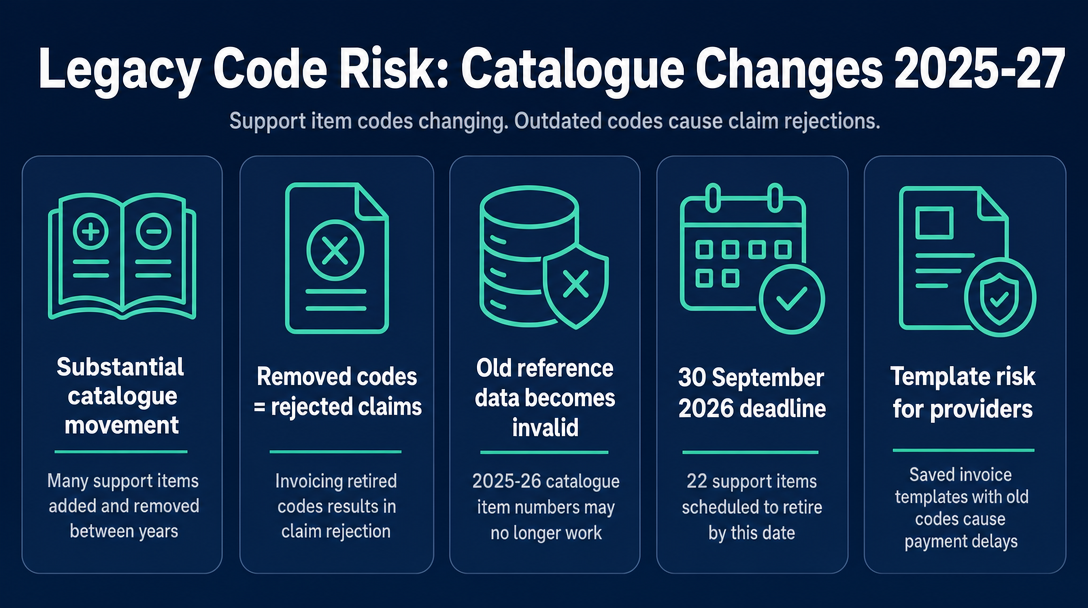
The direct answer: A large number of support items were added and others removed between 2025-26 and 2026-27. Invoicing a removed code is functionally identical to using an invalid item number - the claim will be rejected.
The 2026-27 catalogue saw substantial movement across support categories. Where the 2025-26 PAPL catalogue is used as a reference for item numbers, those numbers may no longer be valid.
The more immediate risk is the 30 September 2026 retirement deadline. As of the date of writing, 22 support items are scheduled to retire on that date - check the current status at ndis.gov.au/providers/pricing-and-payments/pricing/pricing-updates, because the NDIA has extended similar deadlines before and the status may have changed.
Practical example: A sole trader who has been supporting someone in an overnight active support role, with item codes pre-filled in a saved invoice template from last year, may not notice a code was removed until a payment fails to arrive. The plan manager's system will reject the line, but the rejection reason may not be immediately obvious if the worker does not know the code was retired.
Invoice checklist for this section:
- Look up every support item code you use regularly against the current NDIS Support Catalogue 2026-27
- If you use overnight, STA-adjacent, or community nursing codes, check these first - they had the most movement
- If a code you rely on is no longer in the catalogue, speak to the plan manager or the participant's self-management contact before re-using it
- Use the free price-guide search at ndisinvoice.com.au/price-guide to confirm a code still exists in the current schedule before invoicing
What Happens If You Invoice a Retired Code After 30 September 2026?
The plan manager's claiming system will reject the line - a retired code is not claimable regardless of whether the service was delivered. If you have invoiced a retired code and been rejected, the prior article on handling a rejected NDIS invoice covers the correction and resubmission process. The key point here is that using an outdated invoice template is one of the most common causes of post-schedule-change rejections, because the error is invisible until claim time.
STA Unbundling: How It Affects Your Invoice Even If You Are Not the Accommodation Provider
The direct answer: From 1 July 2026, Short Term Accommodation billing was split into two separate lines - accommodation and support hours. The old bundled daily rate codes are gone.
Before 2026-27, a single STA code could cover both the accommodation component and the support delivered during the stay. That structure no longer exists in the current catalogue. The accommodation component is now a separate flat daily amount (check the current Support Catalogue for the exact figure, as it varies by support intensity); support hours are invoiced at the standard time-band rate as separate lines.
For a sole trader support worker: if you provide support within an STA setting but are not the accommodation provider, you should be invoicing only the support hours component at the applicable time-band rate. The accommodation is handled separately - either by the STA facility or another provider. If you try to use the old bundled code, it will not exist in the current catalogue and the line will fail.
For a full walkthrough of STA codes and how to structure an STA invoice, see the client's existing article on NDIS Respite (Short Term Accommodation) Invoicing. This section covers only the structural change between 2025-26 and 2026-27 and its direct impact on your invoice lines.
Invoice action: If you support someone in an STA setting, confirm with the participant or their plan manager which component you are responsible for invoicing - support hours, accommodation, or both - before building the invoice.
The Document Name Changed - and Why That Matters When You Look Up a Rate
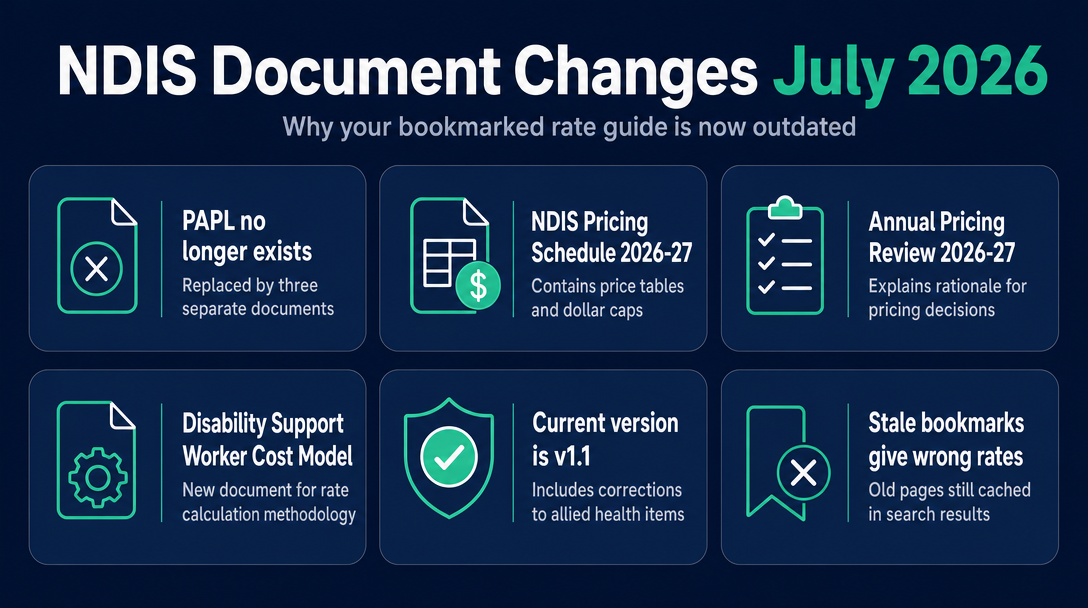
The direct answer: The PAPL no longer exists. Searching for it - or using a bookmarked copy - will surface a superseded document, and any rate you pull from it will be wrong.
The PAPL was a single combined document covering price tables and claiming rules together. From 1 July 2026, it was replaced by three separate documents:
- NDIS Pricing Schedule 2026-27 - the price tables: which items exist, their dollar caps, and registration group assignments
- Annual Pricing Review 2026-27 - the NDIA's rationale for the pricing decisions (the "why" behind each rate movement)
- Disability Support Worker Cost Model - the methodology behind support worker rate calculations (a new separate document for 2026-27)
The NDIS Pricing Schedule 2026-27 v1.1 is the version currently in force, following corrections to allied health modifier items after the initial 1 July release.
The stale-document risk: If you or a bookkeeper look up a rate by Googling "NDIS price guide" and follow the first result, there is a real chance it leads to a 2025-26 PAPL page - still indexed, still cached, no longer valid. This is one of the most common post-July invoicing errors, and none of the information in that document applies to services delivered from 1 July 2026 onward.
The legislative change: From 24 September 2026, the price limits in the Pricing Schedule became a ministerial pricing determination - a legislative instrument under the National Disability Insurance Act. This means the price limits are no longer NDIA administrative guidance. Invoicing above the limit was already a claim rejection risk; it is now a breach of a legal instrument. For questions about how this affects your specific situation, speak with your plan manager. Check the official position at ndis.gov.au/providers/pricing-and-payments/pricing/pricing-updates.
Invoice action: Delete bookmarks to the 2025-26 PAPL. Use ndis.gov.au/providers/pricing-and-payments as your primary reference, or the free price-guide search at ndisinvoice.com.au/price-guide - which is locked to v1.1 of the 2026-27 schedule.
The Three-Check Rule for Year-Boundary Invoices
When the NDIS Pricing Schedule rolls over each 1 July, every invoice you send should pass three checks before it leaves your screen. This framework applies specifically to the period immediately after a schedule change, when stale codes, old rates, and mixed-year service dates create the highest concentration of avoidable errors:
Check 1 - Rate: Is the dollar amount for each line at or below the current 2026-27 price limit for that time band? An amount pulled from last year's document, or from a service agreement that was never updated, may be above or below the current limit.
Check 2 - Code: Is every support item code still in the NDIS Support Catalogue 2026-27? A code that existed in 2025-26 may have been removed, renamed, or replaced. Check before invoicing.
Check 3 - Year: Do the service dates on the invoice match the pricing year? Services delivered before 1 July 2026 should be invoiced at 2025-26 rates. Services from 1 July 2026 use 2026-27 rates. A mixed-year invoice - with a June shift and a July shift on the same document - requires care: the June line uses the old rate, the July line uses the new one. Applying the new rate to a pre-July shift is an error.
Full Invoice Checklist for Post-July 2026 Claims
- Rate check: Dollar amount per hour is at or below the current 2026-27 price limit for the time band
- Day/time code check: The support item code matches the actual day and time (a weekday code on a Saturday, or a Saturday code on a Sunday, will be rejected)
- Code exists check: Every item code is still present in the NDIS Support Catalogue 2026-27
- STA code check (if applicable): New unbundled codes are used, not the old bundled codes
- Year boundary check: Service dates before 1 July 2026 use 2025-26 rates; dates from 1 July 2026 use 2026-27 rates
- GST check: GST treatment has not changed - NDIS supports delivered by unregistered providers remain GST-free; no rate change altered this
- Template check: If you use a spreadsheet or Word document, the price limits in it reflect the 2026-27 schedule, not the superseded PAPL
Every item on this checklist runs automatically in NDIS Invoice. Log a shift, and the tool selects the right 2026-27 code for the time band, checks the dollar amount against the current price limit, and flags anything that looks wrong before you send. Try it free at ndisinvoice.com.au - no card needed, and there is a demo mode if you want to explore without signing up first.
Frequently Asked Questions
Did NDIS support worker rates go up in 2026-27?
Yes. Standard support worker rates increased by approximately 3.95% across all time bands from 1 July 2026. The weekday daytime national rate is $73.58 per hour. The increase reflects the Fair Work Commission Annual Wage Review outcome and the superannuation guarantee rising from 11.5% to 12%.
What is the difference between the Pricing Schedule 2026-27 and the old PAPL?
The PAPL combined price tables and claiming rules in a single document. From 1 July 2026, it was replaced by three separate documents: the Pricing Schedule (price limits), the Annual Pricing Review (rationale), and the Disability Support Worker Cost Model (methodology). If you are still referencing the PAPL, you are using a superseded document.
Can I invoice at 2025-26 rates if the service date was before 1 July 2026?
Services delivered before 1 July 2026 should be invoiced at 2025-26 rates, not the new 2026-27 rates. If you are submitting a late claim that spans both financial years, apply the correct rate to each service date and check with your plan manager before sending.
Are NDIS price limits now legally binding?
From 24 September 2026, yes. The Minister made a pricing determination that established the price limits as a legislative instrument under the National Disability Insurance Act. Invoicing above the limit was already a rejection risk; it is now a legal one. For questions about how this applies to your invoicing, speak with your plan manager or check the official announcement at ndis.gov.au/providers/pricing-and-payments/pricing/pricing-updates.
What happens if I use a support item code that was removed from the 2026-27 catalogue?
The claim line will be rejected. A retired or removed code is not claimable regardless of whether the service was genuinely delivered. Check every code you use regularly against the current Support Catalogue before invoicing, especially if you use a saved template.
NDIS Invoice is an independent tool - not the NDIA, not a plan manager, and not a registered provider. It checks invoice lines against the current Pricing Schedule before sending, but a clean check does not guarantee payment. It does not verify plan budgets or a plan manager's own policies. For questions about NDIS rules, pricing determinations, or your specific plan, speak with your plan manager.
More articles
- NDIS Invoicing for Group Supports: How to Split Line Items Across Multiple Participants
- How to Create Your First NDIS Invoice in Under 5 Minutes (Step-by-Step Video Companion)
- NDIS Plan Manager Turnaround Times: How Long Should You Wait to Be Paid After Submitting an Invoice?
- NDIS Invoice Numbering: Do You Need a Sequential System? (And What Happens If You Don't Have One)
- How to Handle a Rejected NDIS Invoice: Diagnosis, Correction, and Resubmission Step by Step