NDIS Record-Keeping for Sole Traders: What to Keep, For How Long, and How Invoices Help
Written by Cory Nathan, founder of NDIS Invoice · Last reviewed
Most sole traders assume that keeping their invoices is enough. It is not. Under changes that took effect from 27 August 2026, NDIS providers - including
13 min read
NDIS Record-Keeping for Sole Traders: What to Keep, For How Long, and How Invoices Help
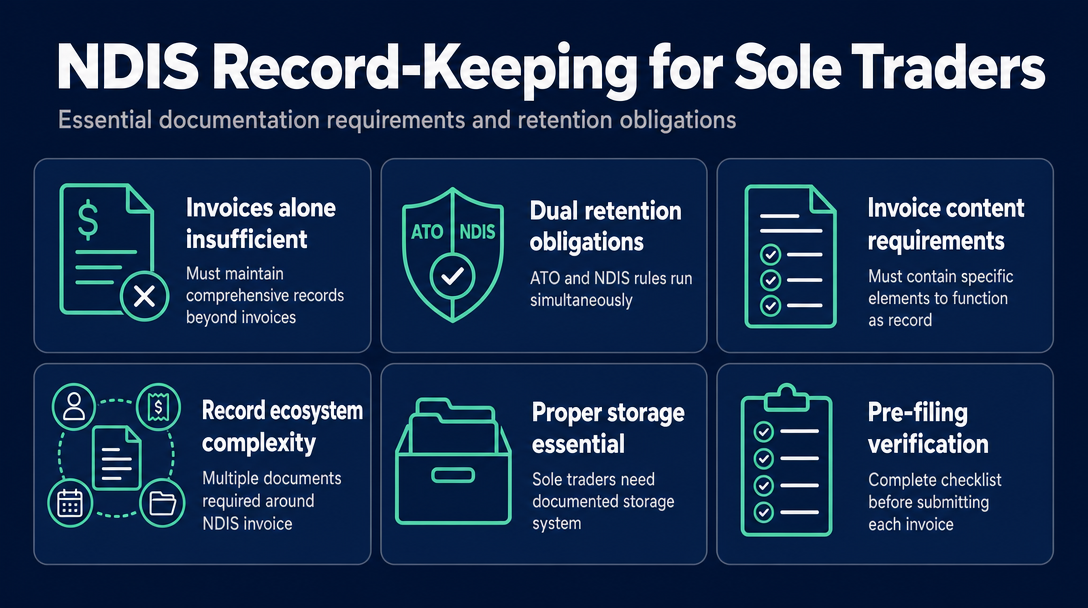
Most sole traders assume that keeping their invoices is enough. It is not. Under changes that took effect from 27 August 2026, NDIS providers - including unregistered sole traders - are now subject to a seven-year record retention duty backed by a civil penalty. Combine that with the ATO's separate five-year obligation and a new 90-day claim window arriving 1 December 2026, and the paperwork ecosystem around every support delivery has become significantly more consequential. This article maps exactly what you must store, how long to store it, and how your invoice itself must be built to function as evidence - not just a billing request.
The Two-Clock Rule: ATO vs. NDIS Retention Obligations Running Simultaneously
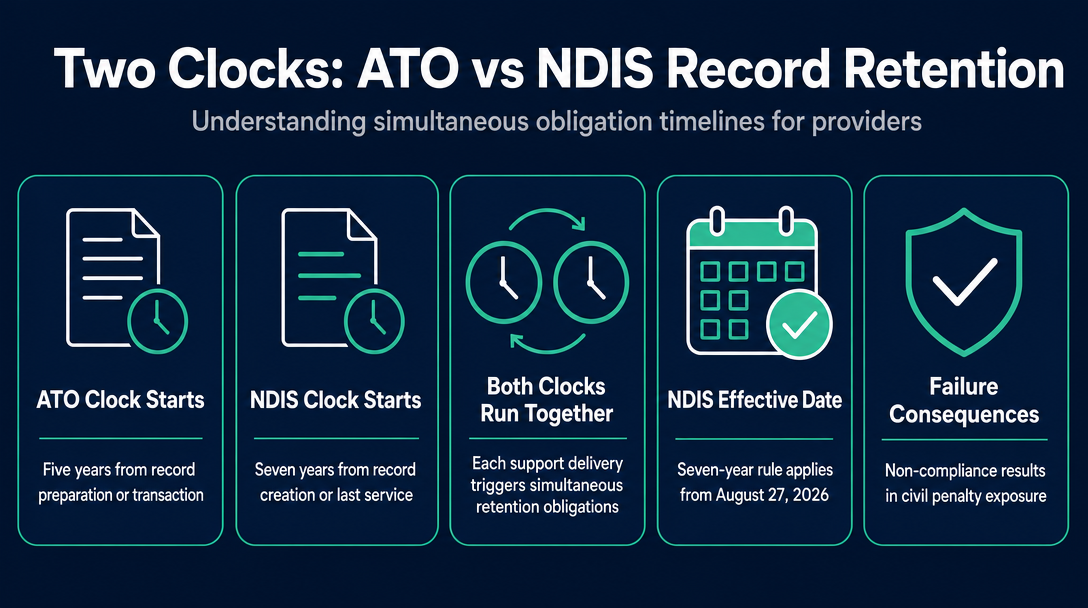
Every time you deliver a support, two clocks start. Understanding which one governs will save you from under-keeping.
Clock 1 - The ATO's rule: five years from lodgement
The Australian Taxation Office requires businesses to keep most records for five years from the date the records are prepared, obtained, or the transaction is completed - whichever is latest. For a sole trader, this covers invoices, payment receipts, and any records that support your tax return.
Clock 2 - The NDIS rule: seven years from the record date or last service
From 27 August 2026, NDIS providers must retain records relating to the payment and receipt of NDIS funds for seven years - measured from when the record was created, or from the last date a service was delivered to that participant, whichever is later. Failure to retain records results in a civil penalty under the NDIS Amendment (Securing the NDIS for Future Generations) Act 2026.
Which clock wins? The NDIS clock - at seven years - is longer. A sole trader who satisfies the NDIS obligation automatically satisfies the ATO requirement. Keep everything for seven years and both bodies are covered. No separate filing system needed.
The child-participant exception: keep records until age 25 or seven years - whichever is longer
If you deliver supports to a participant who is a minor, the seven-year rule is extended. You must retain all records until the participant turns 25, or for seven years from the last service date - whichever period is longer. A participant who is 10 years old when you last support them means records kept until they are 25 - potentially 15 years from your last shift. Flag these participant folders clearly.
Which NDIS Rules Apply to Unregistered Sole Traders (and Which Do Not)?
This is the question every generic record-keeping article avoids answering. The short answer: the seven-year duty and the 90-day claim window apply to you. The NDIS Practice Standards do not.
What the 2026 Act covers for unregistered sole traders
"Provider" under the NDIS Act is not limited to registered providers. Unregistered sole traders who receive NDIS funds - whether directly from self-managed participants or through plan managers - fall within scope of the record-keeping duty and the new claim window. The NDIS Commission can audit any provider and request evidence that supports were actually delivered. Without adequate records, a claim can be reversed.
What Practice Standards require that you do not have to do (but probably should)
NDIS Practice Standards impose formal quality management documentation requirements - incident management frameworks, complaints handling registers, governance records - on registered providers only. As an unregistered sole trader, you are exempt from that layer.
What you are not exempt from: the NDIS Code of Conduct, the duty to submit accurate claims, and the obligation to retain evidence that supports your invoices. The practical gap between what is legally mandated for unregistered providers and what protects you in an audit is small. Treat your record-keeping as if you might be audited - because you might be.
The 90-day claim window changes this further: from 1 December 2026, claims must be submitted within 90 days of the support being delivered. Under the previous two-year window, a sole trader could invoice months after the fact and still be paid. That buffer is gone. A support delivered on 4 December 2026 must be claimed by 4 March 2027 at the latest. Late-batching invoices is no longer a viable habit.
The Record-Keeping Ecosystem Around an NDIS Invoice
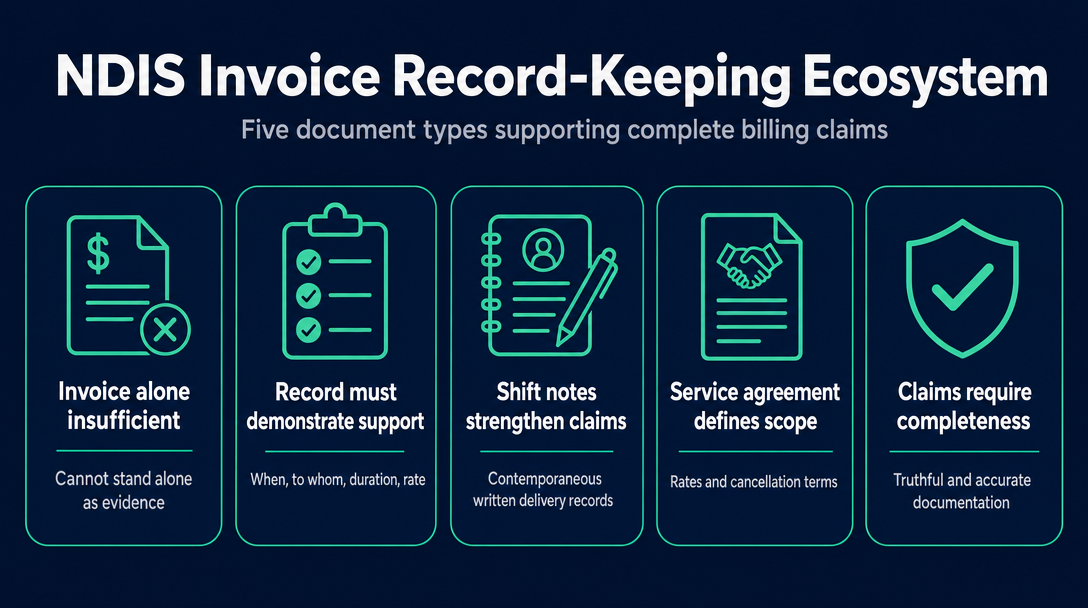
An invoice is both a billing document and a record - but it cannot stand alone as evidence. The NDIS expects your claims to be complete, truthful and accurate, and that standard is met by the invoice working together with the documents below.
What "a record" actually means under NDIS rules
A record must be complete, accurate, and capable of demonstrating that the support was delivered - when, to whom, for how long, and at what rate. An invoice that cannot be matched against a contemporaneous service delivery note is a much weaker piece of evidence in an audit than an invoice that links directly to dated shift notes.
The five document types that sit alongside every invoice
- The invoice itself - containing all mandatory fields (see H2 4 below)
- Shift / service delivery notes - a contemporaneous written record of what support was provided, when, for how long, and the participant's response
- Signed service agreement - setting out scope, rates, and cancellation terms; not legally mandated for unregistered sole traders but requested frequently by plan managers
- Participant NDIS plan extract - the portion showing the funded support category you are billing against
- Payment confirmation - the receipt of payment from the participant, plan manager, or PACE system, matched to the specific invoice
Sole trader record-keeping reference table
| Document | Required for unregistered sole traders? | Retention period | Notes |
|---|---|---|---|
| Invoice (compliant, all mandatory fields) | Yes - mandatory for payment | 7 years (or until participant turns 25, whichever is longer) | Satisfies both NDIS and ATO obligations |
| Shift / service delivery notes | Strongly required as audit evidence | 7 years | Not formally mandated by Practice Standards for unregistered providers, but essential protection if a claim is disputed |
| Signed service agreement | Recommended - not legally mandated for unregistered | 7 years after the last service delivered | Plan managers frequently request this before processing claims |
| Participant NDIS plan extract | Recommended | While active + 7 years | Proves the support category was legitimately funded |
| Payment confirmation / receipt | Yes - required for ATO and NDIA purposes | 7 years | Match every payment record to its invoice |
| Incident records | Required if any incident occurs | 7 years | NDIS Code of Conduct applies regardless of registration status |
| NDIS Worker Screening Check | Yes - must be valid during engagement | Duration of engagement | See the article on NDIS support worker requirements for full credential obligations |
What Your Invoice Must Contain to Work as a Record, Not Just a Bill
A correctly constructed invoice is your first line of evidence. Every field below is load-bearing - missing or incorrect information is not just a payment error, it is a record-keeping failure.
The fields that turn an invoice into evidence
- Participant's full name and NDIS number - ties the invoice to the person and their plan
- Date of service delivery (not the invoice creation date) - establishes when the support occurred, which is critical for the 90-day claim window and for matching against shift notes in an audit
- Support item number from the NDIS Pricing Arrangements and Support Catalogue - proves the support category was appropriate and correctly classified
- Quantity and unit (hours or each) - must match the shift notes exactly
- Rate - must be at or below the current price cap for that item, day, and time classification
- GST treatment - most core NDIS supports are GST-free under section 38-38 of the A New Tax System (Goods and Services Tax) Act 1999; the invoice should show "GST-free" or "N/A" for GST, not a zero-dollar GST line
- Your ABN - required on all invoices above $82.50 and satisfies ATO tax invoice requirements
- Invoice number - sequential and unique, creating an auditable trail across all your claims
Support item numbers: why the code is a record-keeping element, not just a payment code
A wrong support item number is not just a processing error - it is evidence that you billed a support against a category that was not funded for that participant. Billing Assistance with Daily Activities under a Capacity Building code, for example, can lead to claim reversal even if the support itself was genuinely delivered. Similarly, billing a weekday daytime rate for a Saturday shift is an error that surfaces immediately in an audit comparison between your invoice and your shift notes.
The NDIS Pricing Arrangements and Support Catalogue is updated periodically. Billing against a retired support code is a record-keeping error in its own right - it creates a discrepancy between your invoice and the current schedule that cannot be explained away later.
How NDISInvoice.com.au builds these fields in automatically
NDISInvoice.com.au validates every line item against the current NDIS Pricing Schedule before you finalise the invoice - catching wrong support codes, prices above the current cap, and incorrect day/time classifications before the invoice is created. That is directly relevant to your record-keeping obligations: the invoice you download is both evidence-ready and privacy-compliant from the moment it is created.
If you are setting up your full documentation workflow as a sole trader, the cornerstone checklist at NDISInvoice.com.au covers the complete invoicing setup sequence.
How to Actually Store Your NDIS Records as a Sole Trader
Digital storage: what the NDIS Commission accepts
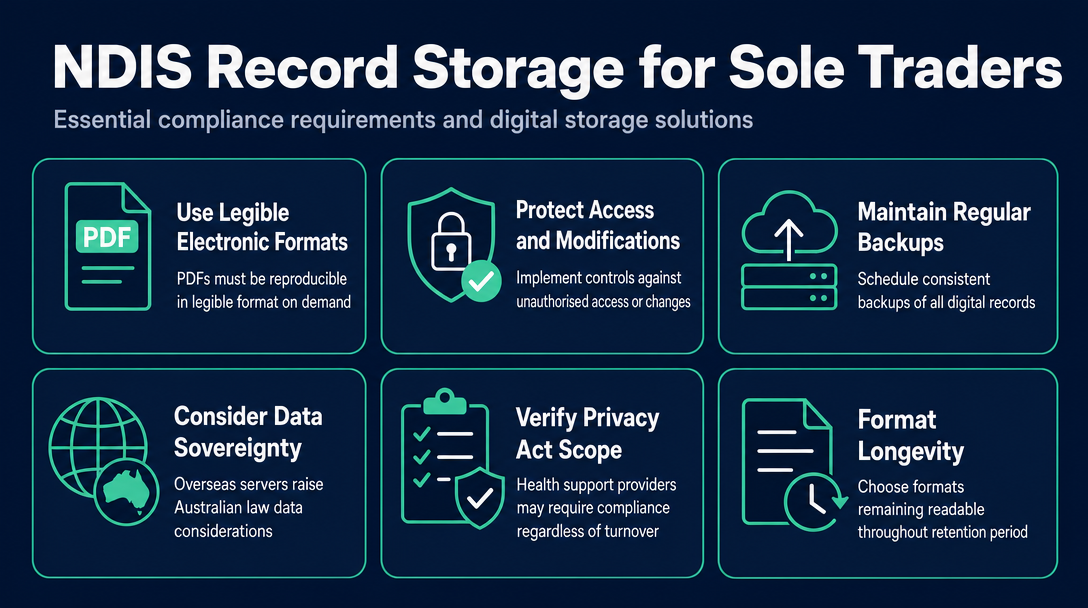
Electronic records are acceptable provided they can be reproduced in a legible format when requested, are protected from unauthorised access or modification, are backed up regularly, and are stored in a format that will remain readable throughout the retention period. A PDF saved to a cloud folder satisfies this if the folder has appropriate access controls.
If you use cloud storage, note that participant data stored on overseas servers raises data sovereignty considerations under Australian law. NDISInvoice.com.au stores your data in Sydney, Australia; the optional capture feature is the only step that sends text overseas, and its privacy policy says exactly where.
If your annual turnover is under $3 million, you are generally exempt from the Privacy Act 1988 as a small business. However, if you are providing any form of health-related support, the health service provider exception may bring you within scope of the Australian Privacy Principles regardless of turnover. Verify your specific situation with a compliance adviser if you are unsure.
A folder structure that works for a one-person business
[Participant Name]
  [Year-Month]
    Invoice_[number]_[YYYY-MM-DD].pdf
    ShiftNotes_[YYYY-MM-DD].pdf
    ServiceAgreement_[signed date].pdf
Simple, auditable, and easy to retrieve when a plan manager queries a claim from six months ago.
The 90-day clock: why end-of-quarter batching is now dangerous
From 1 December 2026, the window for submitting an NDIS claim drops from two years to 90 days from the date the support was delivered. A sole trader who delivers support on 4 December 2026 and batches everything together for a February submission still makes the window - but any December service invoiced after 4 March 2027 does not. The practical discipline: create and file your invoice and shift notes within seven days of each support delivery. Invoice as you go, not as the quarter ends.
Pre-Filing Checklist: Before You File Each Invoice
Run through this list before submitting any claim:
- Invoice contains the participant's full name and NDIS number
- Date shown is the date of service delivery, not today
- Support item number matches the current NDIS Pricing Arrangements and Support Catalogue
- Rate is at or below the current price cap for that item, day, and time classification
- GST treatment is correct (most core supports: GST-free under s. 38-38 of the GST Act)
- Your ABN appears on the invoice
- Invoice number is sequential and unique
- Shift/service delivery notes are written up for the same session and match the date and hours on the invoice
- Notes record what support was delivered, the participant's response, and the duration
- Invoice and notes are saved together in the participant's folder
- If the participant is a child, their records are flagged for extended retention (until age 25 or seven years, whichever is longer)
- Submission will be within 90 days of the service date (mandatory from 1 December 2026)
- A copy of the invoice is retained in your own records after payment is received
Every invoice created with NDISInvoice.com.au already contains the mandatory fields above - participant name, NDIS number, support item code, date of service, rate, and GST status - all validated against the current NDIS Pricing Schedule before you send it. No subscription. No upload.
Frequently Asked Questions
Is it five years or seven years for NDIS record keeping in 2026?
Seven years for providers - including unregistered sole traders - under the NDIS Amendment (Securing the NDIS for Future Generations) Act 2026, which took effect from 27 August 2026. The ATO requires five years for tax records. Because the NDIS obligation is longer, keeping records for seven years satisfies both. For records relating to child participants, the period extends until the participant turns 25 or seven years - whichever is longer.
Does the seven-year record-keeping duty apply to unregistered sole traders?
Yes. "Provider" under the NDIS Act includes unregistered providers who receive NDIS funds. The seven-year retention duty and the civil penalty for failing to retain records both apply regardless of registration status. What unregistered sole traders are exempt from is the NDIS Practice Standards, which impose additional quality management obligations on registered providers only.
What is the 90-day claim rule and when does it start?
From 1 December 2026, NDIS claims must be submitted within 90 days of the support being delivered. Previously the window was two years. A sole trader who delivers support on a given date has 90 days from that date to submit the claim - not 90 days from the end of the month or the end of the quarter.
Do I need to keep shift notes if I am an unregistered sole trader?
Shift notes are not formally mandated by the NDIS Practice Standards for unregistered providers - but the NDIA can audit any provider and request evidence that supports were actually delivered. Without contemporaneous shift notes, an invoice alone is a weak piece of evidence. Keeping brief but accurate service delivery notes for every shift is strongly recommended, and they should be retained for the same seven-year period as the invoice.
What happens if I cannot prove a support was delivered?
If the NDIA or a plan manager cannot verify that a support was delivered - because records are missing, incomplete, or inconsistent with the invoice - the claim can be reversed and repayment required. This applies to unregistered sole traders as much as registered providers. Invoices that cannot be matched to shift notes are the most common audit vulnerability for sole traders.
Do I need a written service agreement as an unregistered sole trader?
A written service agreement is not legally mandated for unregistered sole traders under the NDIS rules. However, it is strongly recommended: plan managers frequently request one before processing claims, and it provides the clearest record of the agreed scope, rates, and cancellation terms if a dispute arises. If you have one, retain it for seven years after the last service you delivered under it.
More articles
- How to Create Your First NDIS Invoice in Under 5 Minutes (Step-by-Step Video Companion)
- NDIS Plan Manager Turnaround Times: How Long Should You Wait to Be Paid After Submitting an Invoice?
- NDIS Invoice Numbering: Do You Need a Sequential System? (And What Happens If You Don't Have One)
- How to Handle a Rejected NDIS Invoice: Diagnosis, Correction, and Resubmission Step by Step
- NDIS Allied Health Invoicing: How Physiotherapy, Speech Therapy, and OT Codes Work in the Price Guide