NDIS Support Coordination Invoicing: Support Item Codes, Price Limits, and What to Record
Written by Cory Nathan, founder of NDIS Invoice · Last reviewed
Support coordination invoicing codes all begin with 07 - they live exclusively in Support Category 07 (Support Coordination and Psychosocial Recovery
12 min read
NDIS Support Coordination Invoicing: Support Item Codes, Price Limits, and What to Record
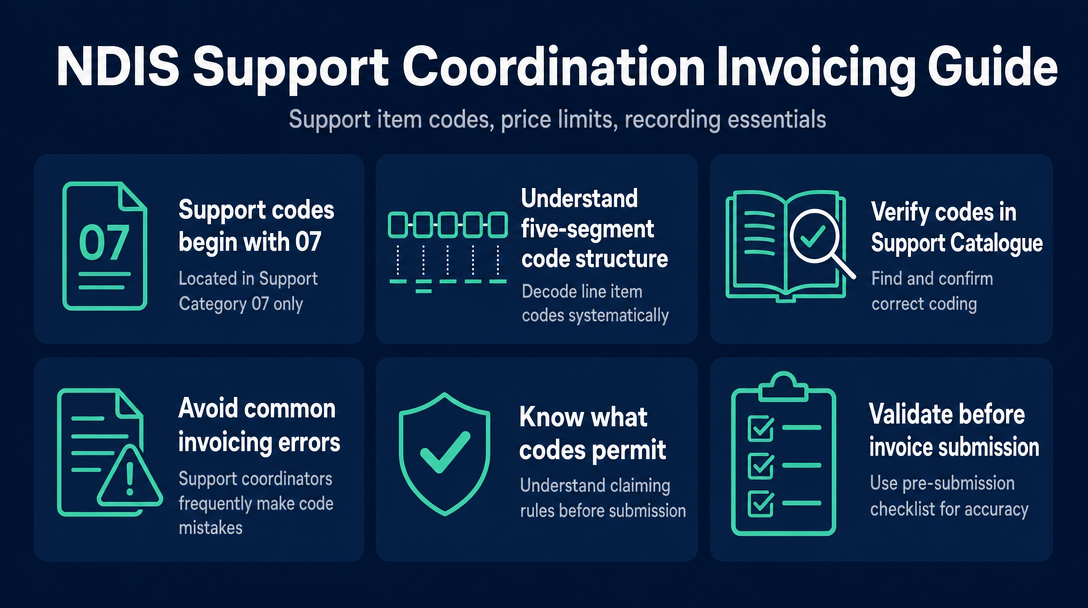
Support coordination invoicing codes all begin with 07_ - they live exclusively in Support Category 07 (Support Coordination and Psychosocial Recovery Coaches) of the NDIS Support Catalogue. Three billing levels apply: Level 1 (Support Connection), Level 2 (Coordination of Supports), and Level 3 (Specialist Support Coordination). Selecting the wrong code - or misreading any of its five segments - is one of the most common reasons support coordination payment requests are rejected or queried by plan managers.
This article maps every relevant 07_ code, decodes how the item number is constructed, and identifies the specific errors to avoid before you submit.
The 07_ Codes at a Glance: 2026-27 Price Limits
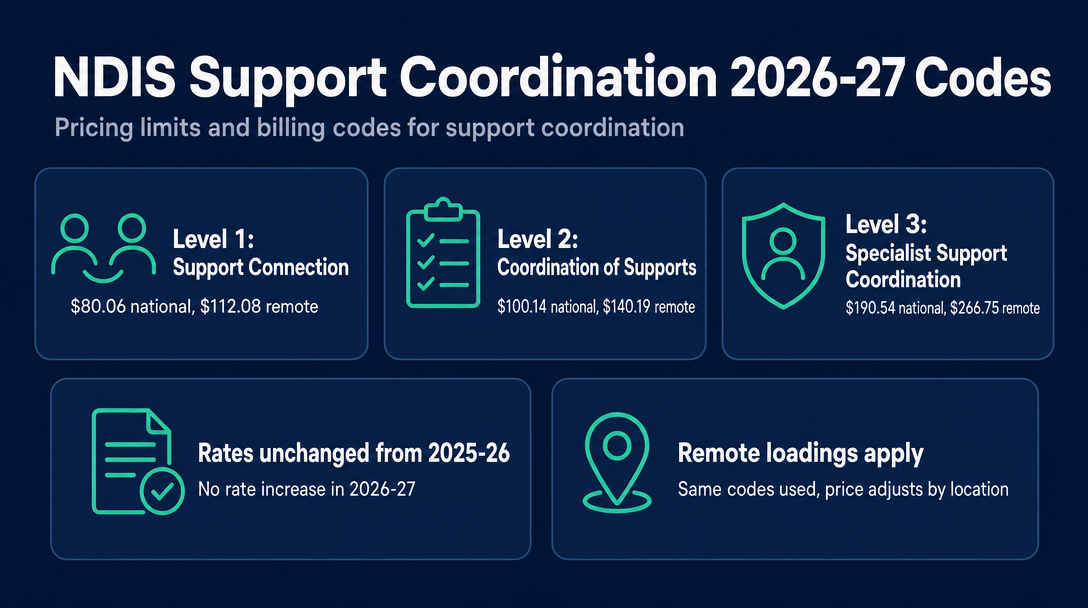
All support coordination invoicing draws from Category 07 of the NDIS Support Catalogue. As of 1 July 2026, three primary billing codes apply. Support coordination price limits are unchanged from 2025-26 - no rate increase was introduced in the 2026-27 Pricing Schedule.
| Code | Support Item | Reg. Group | Unit | National | Remote | Very Remote |
|---|---|---|---|---|---|---|
| 07_001_0106_8_3 | Level 1: Support Connection | 0106 | Hour | $80.06 | $112.08 | $120.09 |
| 07_002_0106_8_3 | Level 2: Coordination of Supports | 0106 | Hour | $100.14 | $140.19 | $150.21 |
| 07_004_0132_8_3 | Level 3: Specialist Support Coordination | 0132 | Hour | $190.54 | $266.75 | $285.80 |
Remote and very remote loadings apply to the same codes - no separate code is used; only the price changes to reflect the participant's location tier. For how the Modified Monash Model determines which tier applies, see the prior client article on remote and very remote pricing.
All three codes draw from the Capacity Building - Support Coordination budget, not Core Supports. One sentence is all that needs to be said here; the NDIS Core Supports vs. Capacity Building article covers budget distinctions in full.
Psychosocial Recovery Coach (PRC) codes also live in Category 07 and use different item numbers and rates. A support coordinator cannot invoice under a PRC code, and a PRC cannot invoice under an SC code. If you deliver both services to the same participant, each requires its own correctly coded line item. Check the current NDIS Support Catalogue for PRC item numbers, as these are distinct from the three SC codes above.
Decoding the Support Coordination Line Item: The Five-Segment Code Key
Every NDIS support item number encodes five pieces of information in a fixed structure. Using 07_002_0106_8_3 (Level 2: Coordination of Supports) as the worked example, here is what each segment tells you.
Segment 1 - Support Category (07)
The first two digits identify the support category. 07 = Support Coordination and Psychosocial Recovery Coaches. This is the only category that covers support coordination. Categories 01-04 cover Core Supports; Categories 05-15 cover Capacity Building (where 07 sits).
Segment 2 - Sequence Number (001, 002, 004)
The three-digit sequence number identifies the specific item within Category 07. For SC:
001= Level 1, Support Connection002= Level 2, Coordination of Supports004= Level 3, Specialist Support Coordination
The gap at 003 is not an error - the NDIA's Support Catalogue frequently has non-consecutive sequence numbers due to deprecated or reserved slots. Never infer a code exists because a number is "between" two you know. Always verify against the current Catalogue.
Segment 3 - Registration Group (0106 or 0132)
The four-digit registration group embedded in the code identifies which provider registration group can legitimately claim that item.
0106= Assistance In Coordinating Or Managing Life Stages, Transitions and Supports - covers Level 1 and Level 2 SC0132= Support Coordination - covers Level 3 Specialist only
Mandatory provider registration for registration group 0106 was paused in December 2025 while broader NDIS reform is considered. This means unregistered coordinators may invoice plan-managed and self-managed participants under 0106 codes in certain circumstances. However, claiming under a 0132 code (Specialist) requires the appropriate specialist qualification and registration status. For the policy detail on who can deliver to whom, refer to the prior article on agency-managed NDIS invoicing - this section only explains what the registration group digit means within the code structure.
Segment 4 - Support Purpose Flag (8)
The digit 8 in position four of the suffix confirms that this support is funded from Capacity Building. The three support purpose codes are:
1= Core2= Capital8= Capacity Building
Every legitimate support coordination code carries 8 in this position. If you ever see 1 here on a code presented as an SC line item, the wrong code family has been selected.
Segment 5 - Support Category Type (3)
The final digit 3 denotes Supports for Daily Life as the broad NDIS activity group. This segment rarely causes confusion in SC invoicing, but it is present in every code string.
How to Find and Verify a Code in the Support Catalogue
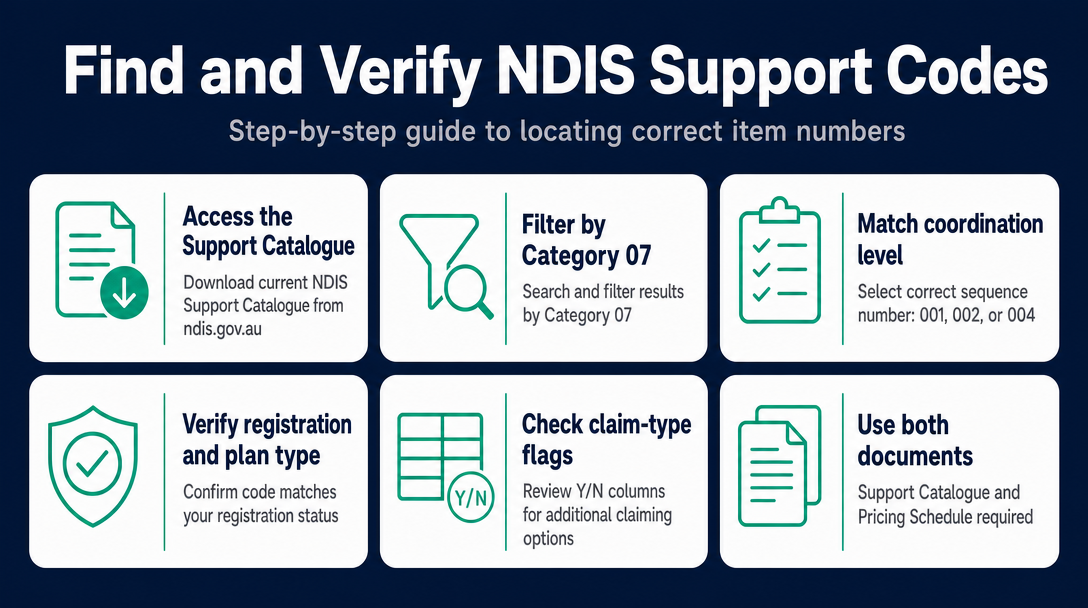
The NDIS Support Catalogue is published by the NDIA and is the authoritative source for item numbers and claim type flags. The NDIS Pricing Schedule sets the price caps. From 1 July 2026, these are two separate documents - you need both.
Step-by-step lookup:
- Download or open the current NDIS Support Catalogue (available at ndis.gov.au)
- Filter or search by Category 07
- Match the level of coordination delivered to the correct sequence number (001, 002, or 004)
- Confirm the registration group in the code matches your registration status and the participant's plan management type
- Check the claim-type flags (Y/N columns) for any additional claiming you intend to make - non-face-to-face time, provider travel, short-notice cancellations, and NDIA-requested reports each have a separate flag per code
The claim-type flags are the column most often overlooked. The NDIA's own guidance confirms the Support Catalogue "shows which claim type applies to each support item." A Y means that claim type is permitted for that code; an N means it is not, regardless of the work you actually performed. Submitting a non-face-to-face claim against a code where the flag is N will result in rejection.
Once you have verified the code, check that the payment request is submitted within 90 days from the end of the service booking, as required by the NDIA.
For a broader walkthrough of finding the right code across all support categories, see the cornerstone guide NDIS Price Guide 2026-27: How to Find the Right Support Item Code for Any Service You Deliver on this site.
Common Invoicing Errors Support Coordinators Make with 07_ Codes
These errors are specific to SC invoicing. No competitor content addresses them at this level of specificity.
Billing Level 3 work under a Level 2 code. A Specialist Support Coordinator billing at $100.14/hr instead of $190.54/hr is underselling. Billing Level 3 work but using a Level 2 code is underclaiming that may not be correctable once processed - and claiming the higher Specialist rate under a Level 2 code is overclaiming with audit consequences.
Using 07_004_0132_8_3 without the appropriate specialist qualification. Level 3 invoicing is reserved for suitably qualified practitioners - typically social workers, occupational therapists, or allied health professionals operating in a specialist capacity. Invoicing under 0132 without meeting that threshold creates a Quality and Safeguards Commission compliance risk.
Drawing from the wrong budget. If a support coordinator accidentally selects a Core Supports code (any code with
1in Segment 4), the claim draws from the wrong budget. Look for8in Segment 4 every time.Using an outdated code after 1 July 2026. NDIS codes are updated annually with each new financial year. The Temporary Transformation Payment (TTP), for example, was removed from 30 June 2024 - any invoice still referencing TTP-suffix codes after that date is rejected. At the start of each financial year, re-download the current Support Catalogue before invoicing.
Claiming non-face-to-face time without checking the claim-type flag. SC coordinators frequently perform claimable admin - researching providers, writing reports, coordinating on behalf of the participant. Whether this is claimable depends entirely on the Y/N flag in the Support Catalogue for that specific code. Do not assume; check the flag.
Mixing SC and PRC lines under one code. Psychosocial Recovery Coaching is a distinct service with distinct codes, both of which happen to sit in Category 07. A coordinator delivering SC cannot invoice PRC time under an SC code, and vice versa.
Applying the wrong location rate. The national price limit applies unless the participant's address - not the coordinator's office - triggers a remote or very remote loading. Billing $150.21/hr (the very remote Level 2 rate) for a participant in a metropolitan area is a pricing violation.
Claiming Rules: What the Code Permits
Non-Face-to-Face Time
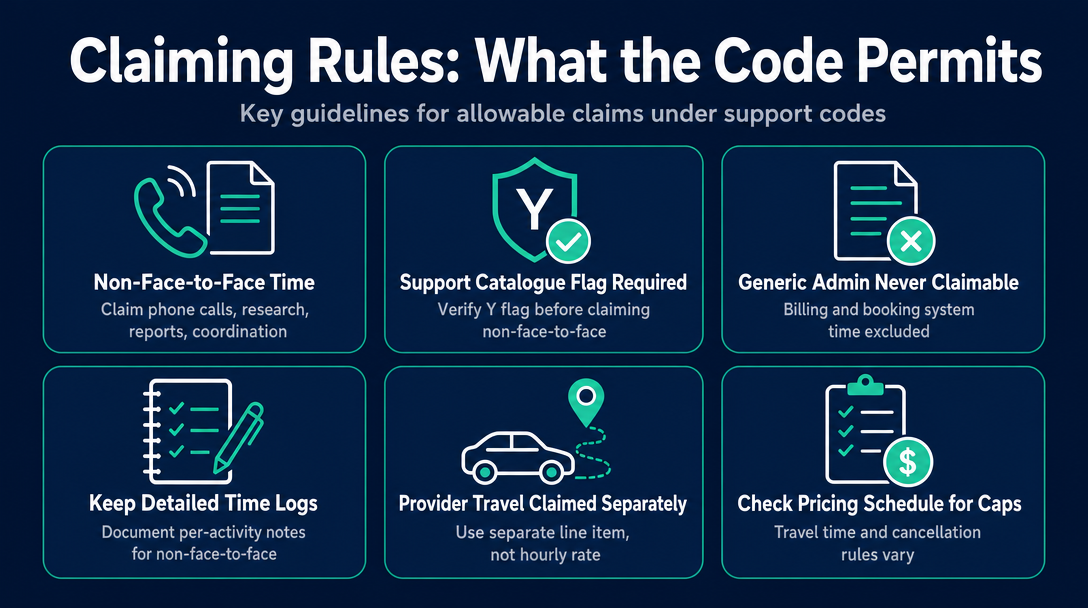
SC coordinators may claim time spent on activities that directly benefit the participant but are not conducted face-to-face - phone calls, provider research, report writing, case coordination. The Support Catalogue claim-type flag for your specific code must be Y. Generic admin (time on billing, booking systems) is never claimable. Keep a time log with per-activity notes for any non-face-to-face billing.
Provider Travel
If the claim-type flag for your SC code permits provider travel, claim it as a separate line item - do not fold travel time into the hourly service rate. Maximum travel time rules apply; check the current Pricing Schedule for the applicable cap.
Short-Notice Cancellations
Where the Support Catalogue flag permits it, a short-notice cancellation by the participant may be claimable as a percentage of the scheduled session fee. The NDIA sets the applicable percentage in the current Pricing Schedule - check the official document rather than relying on prior-year figures or third-party summaries, as these rules are subject to change.
NDIA-Requested Reports
If the NDIA requests a report from a support coordinator, this may be separately claimable under a distinct report code - it is not invoiced under the standard 07_ hourly code. Check the Support Catalogue for the specific code that applies to NDIA-requested reporting.
For record-keeping requirements alongside these invoices - what notes to retain, for how long, and how service records support your claims - the NDIS Record-Keeping for Sole Traders article covers this in full.
Pre-Submission Validation Checklist for Support Coordination Invoices
Run through this before sending any SC invoice:
- The code starts with
07_- you are in the correct category - The sequence number (001, 002, or 004) matches the level of coordination actually delivered
- The registration group in the code (0106 or 0132) matches your provider registration status and the participant's plan management type
- The price charged is at or below the 2026-27 national price limit for that code - or the correct remote/very remote limit if the participant's address qualifies
- Non-face-to-face time has been checked against the Support Catalogue claim-type flag for this specific code before including it
- The Capacity Building budget is being drawn from - confirmed by
8in Segment 4 of the code - The code has been verified against the 2026-27 Support Catalogue, not last year's version
- Travel and cancellation fees appear as separate line items with their own codes, not folded into the hourly rate
- The invoice is being submitted within 90 days of the end of the service booking
Frequently Asked Questions
What is the difference between 07_001, 07_002, and 07_004?
These three codes represent the three levels of support coordination: 07_001 is Level 1 (Support Connection) at $80.06/hr nationally, 07_002 is Level 2 (Coordination of Supports) at $100.14/hr, and 07_004 is Level 3 (Specialist Support Coordination) at $190.54/hr. The correct code must match the level of coordination actually delivered and the provider's qualifications.
What does each part of an NDIS support coordination line item number mean?
Using 07_002_0106_8_3 as an example: 07 is the support category (Support Coordination), 002 is the sequence number identifying the specific item (Level 2), 0106 is the registration group the provider must belong to, 8 confirms the support is funded from Capacity Building (not Core), and 3 denotes the Supports for Daily Life activity group.
Are support coordination codes and psychosocial recovery coaching codes interchangeable?
No. Both code families live in Category 07, but they cover distinct services with different rates and claim-type rules. A support coordinator cannot invoice under a PRC code, and a PRC provider cannot invoice under an SC code. If a provider delivers both services to the same participant, each requires a correctly coded separate line item.
Can a support coordinator invoice for non-face-to-face time?
It depends on the claim-type flag in the NDIS Support Catalogue for the specific code being used. Where the flag is Y, activities that directly benefit the participant - such as provider research, case coordination calls, and report writing - may be claimable. Where the flag is N, non-face-to-face time cannot be claimed regardless of the work performed.
What happens if I use the wrong support coordination code?
Using the wrong code can result in claim rejection by the plan manager or NDIA, an audit flag, drawing from the wrong budget, or - in the case of using a Level 3 code without the appropriate qualification - a Quality and Safeguards Commission compliance issue. Corrections after a claim is processed are not always possible.
What changed in 2026-27 that affects how I find support coordination codes?
From 1 July 2026, the NDIA split the former single Pricing Arrangements and Price Limits document into two separate documents: a Pricing Schedule (which sets price caps) and a Support Catalogue (which lists item numbers and claim-type flags). Support coordinators now need to consult both documents - not just one - before invoicing.
Before you send your next support coordination invoice, let NDIS Invoice check the code, price, and claim type for you - free and browser-based. It validates every 07_ line item against the current Support Catalogue automatically, catching errors like wrong level codes, prices above the cap, and outdated item numbers before they reach your plan manager or the NDIA.
Check your invoice now at ndisinvoice.com.au
More articles
- How to Create Your First NDIS Invoice in Under 5 Minutes (Step-by-Step Video Companion)
- NDIS Plan Manager Turnaround Times: How Long Should You Wait to Be Paid After Submitting an Invoice?
- NDIS Invoice Numbering: Do You Need a Sequential System? (And What Happens If You Don't Have One)
- How to Handle a Rejected NDIS Invoice: Diagnosis, Correction, and Resubmission Step by Step
- NDIS Allied Health Invoicing: How Physiotherapy, Speech Therapy, and OT Codes Work in the Price Guide