NDIS Support Worker Requirements 2026: What You Must Have to Invoice Compliantly as a Sole Trader
Written by Cory Nathan, founder of NDIS Invoice · Last reviewed
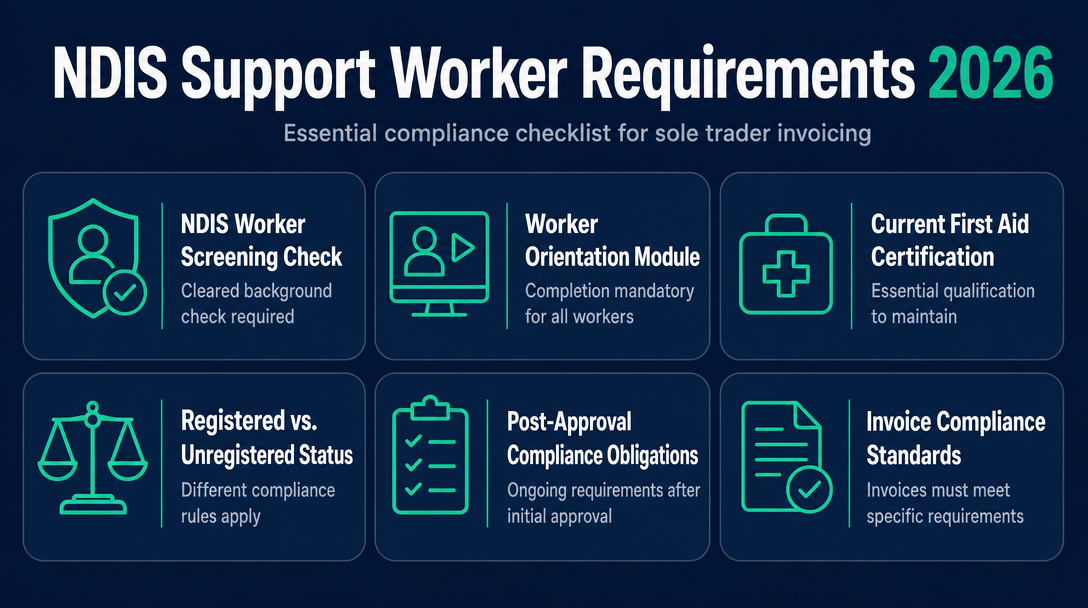
To work as an NDIS support worker, you need five things: a cleared NDIS Worker Screening Check, completion of the Worker Orientation Module, current First
10 min read
NDIS Support Worker Requirements 2026: What You Must Have to Invoice Compliantly as a Sole Trader
To work as an NDIS support worker, you need five things: a cleared NDIS Worker Screening Check, completion of the Worker Orientation Module, current First Aid and CPR, a Working with Children Check if you support participants under 18, and the right to work in Australia. But meeting those five requirements is only Stage 1. Once you are working as a sole trader, a separate compliance layer kicks in - one that governs how you invoice, which support codes you use, and what rates you can legally charge. Almost no one explains Stage 2.
The NDIS Compliance Funnel: Getting In vs. Staying Right
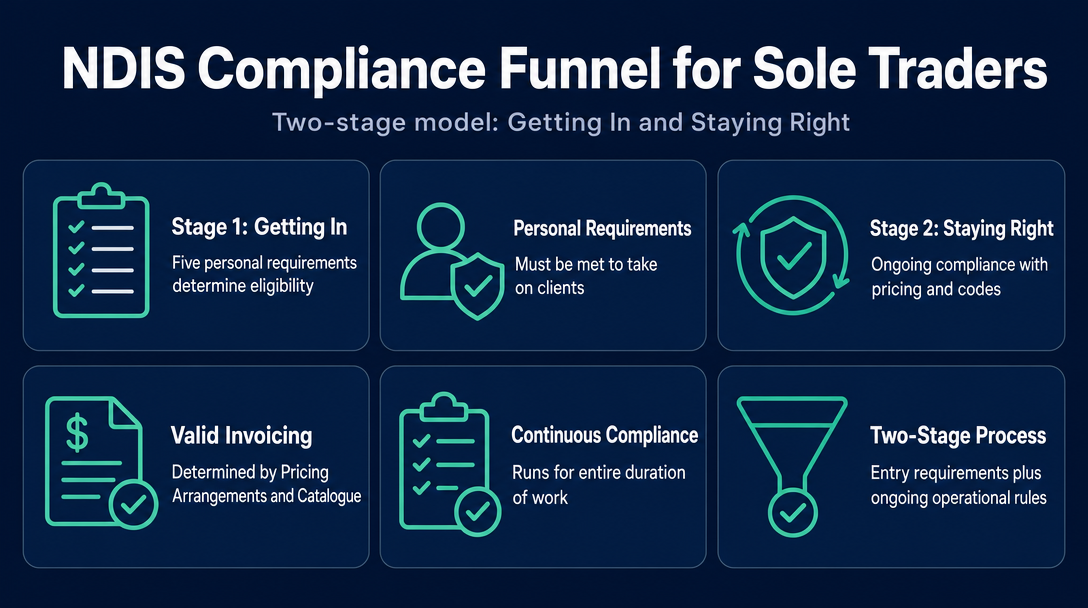
Think of NDIS compliance for sole traders as a two-stage funnel:
Stage 1 - Getting In: The five personal requirements below determine whether you are permitted to work as an NDIS support worker. Without them, you cannot take on a client.
Stage 2 - Staying Right: The NDIS Pricing Arrangements, the Support Catalogue, and support item codes determine whether your invoices are valid and payable. This stage never ends - it runs for as long as you work.
Every checklist on the internet covers Stage 1. This article covers both.
Stage 1: The NDIS Support Worker Requirements Checklist (2026)
| Requirement | Mandatory? | Administered by | Key Notes |
|---|---|---|---|
| NDIS Worker Screening Check | Yes - for all risk-assessed roles | State/territory screening units | Valid 5 years; nationally portable |
| Worker Orientation Module "Quality, Safety and You" | Required for registered provider workers; universally expected for all | NDIS Quality and Safeguards Commission | Free, self-paced, downloadable certificate |
| First Aid and CPR | Expected for all; level is role-dependent | Registered training organisations | Must be current |
| Working with Children Check (WWCC) | Yes - when supporting participants under 18 | State/territory bodies | State-specific; varies by jurisdiction |
| Right to work in Australia | Yes | Home Affairs / employer verification | Australian citizen, permanent resident, or appropriate visa |
Optional but expected: Certificate III in Individual Support (CHC33021) for most paid roles, or Certificate IV in Disability Support (CHC43121) for higher-complexity work. Neither is mandated nationally, but many plan managers and employers will not engage workers without them.
Is the NDIS Worker Screening Check the same as a police check?
No - and this distinction matters. A police check returns criminal history information. The NDIS Worker Screening Check is a broader risk assessment run by your state or territory's screening unit; it draws on criminal history plus workplace misconduct information held by the NDIS Quality and Safeguards Commission. A cleared police check does not substitute for a cleared NDIS Worker Screening Check. You need both where a police check is separately requested by an employer.
The screening check is valid for five years and is nationally recognised - if you move states or change employers, you do not need to reapply. Your clearance follows you.
What is the Worker Orientation Module, and is it compulsory?
The NDIS Worker Orientation Module "Quality, Safety and You" is a free, self-paced online course published by the NDIS Quality and Safeguards Commission. It explains the NDIS Code of Conduct from a participant safety perspective and takes roughly 90 minutes. On completion, you download a certificate.
For workers employed by a registered NDIS provider, completion is required. For unregistered sole traders, it is not always legislated as mandatory - but it is expected by plan managers and participants as a baseline indicator of professional conduct. Treat it as non-negotiable in practice.
State and territory variations
Screening check fees are set by each state and territory and change periodically - check your state screening unit's current fee schedule before applying rather than relying on third-party figures that may be out of date. The administering bodies are:
- NSW: NSW Office of the Children's Guardian
- VIC: Working with Children Check Victoria and the Victorian Disability Worker Commission (see below)
- QLD: Blue Card Services and NDIS screening
- WA, SA, TAS, ACT, NT: equivalent state/territory bodies
Victoria is the only state with an additional mandatory registration layer for paid support workers. The Victorian Disability Worker Commission introduced mandatory registration requirements for people in paid disability support roles. If you operate in Victoria, verify your obligations at the Victorian Disability Worker Commission directly - the requirements sit on top of the national NDIS framework.
Stage 2: Registered vs. Unregistered - How Your Status Changes the Rules
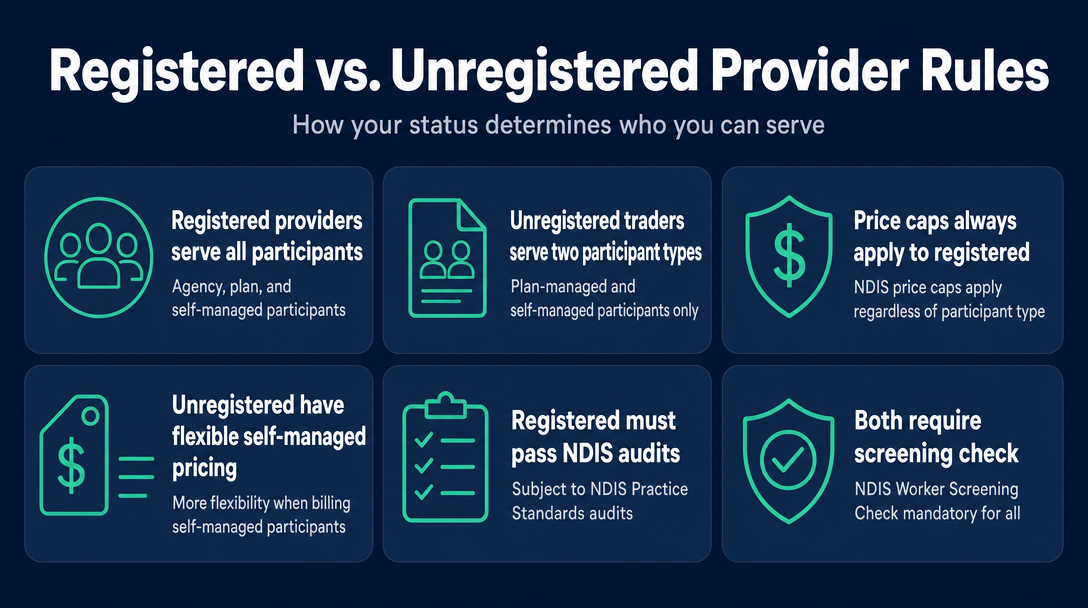
Once you are cleared to work, your billing obligations depend on how you operate. There are two distinct structures, and they carry different rules.
| Rule | Registered Provider | Unregistered Sole Trader |
|---|---|---|
| Can serve agency-managed participants | Yes | No |
| Can serve plan-managed participants | Yes | Yes |
| Can serve self-managed participants | Yes | Yes |
| NDIS price caps apply | Yes - always | Yes - when billing plan-managed; more flexibility with self-managed |
| Subject to NDIS Practice Standards audit | Yes | No |
| NDIS Worker Screening Check required | Yes | Yes |
The practical implication: as an unregistered sole trader, you can only work with self-managed and plan-managed participants. When you bill a plan-managed participant, the plan manager processes your invoice against the NDIS Support Catalogue - which means your support item codes and prices must align with the current Pricing Arrangements. When you bill a self-managed participant, you have more pricing flexibility, but using current support item codes remains best practice for clarity and record-keeping.
For ABN registration and GST obligations as a sole trader, that ground is covered in detail in the NDIS Sole Trader ABN Setup article - one internal reference is all you need here.
Stage 2 in Practice: The Post-Approval Compliance Obligations
This is where sole traders get caught out. Your screening check and orientation module tell you who you are permitted to support. What they do not tell you is how to bill for it without triggering a rejection or clawback.
Here are the five ongoing obligations that apply from your first invoice:
1. Use current support item codes on every line
The NDIS Support Catalogue assigns a specific item number to each type of support. A worker approved to deliver "Assistance with Daily Life" must use the correct support item number for that support - not an older code from a previous pricing year. Outdated codes are rejected by plan managers or, if paid, can trigger compliance review.
2. Rates reset on 1 July every year
The NDIS Pricing Arrangements and Price Limits update annually. Charging last year's rate - even marginally above the new cap - makes the invoice non-compliant. As a sole trader, tracking this is your responsibility. There is no payroll system or employer doing it for you. Check the current NDIS Pricing Arrangements each financial year before your first invoice after 1 July.
3. Day and time classification creates separate line items - not just different prices
Weekday daytime, evening, Saturday, Sunday, and public holiday supports are distinct support items with distinct codes. Billing a Sunday shift under the Saturday support item code is not simply a pricing error - it is a mis-code. Plan managers are required to check that the code on the invoice matches the support delivered. A mis-coded invoice is a compliance failure, not just an admin slip.
4. A service agreement should precede your first invoice
Before you send an invoice to a plan manager or self-managed participant, a service agreement referencing the support items and agreed rates should be in place. This is part of the ongoing compliance framework - not a one-time registration step - and it provides the contractual basis for the invoice.
5. Record-keeping must match your invoice line items
Every invoice you send should be backed by delivery records: date, hours, support type, and participant. If a plan manager or the NDIA queries a line item, your records are your evidence. A completed invoice with no supporting records is a compliance risk.
Where NDISInvoice.com.au fits: Catching Stage 2 errors before they leave your hands is exactly what NDISInvoice.com.au does. The tool validates every line item against the current NDIS Pricing Schedule - flagging outdated support codes, prices above the cap, and wrong day/time classifications in real time. For a sole trader managing their own compliance without an employer's back-office, that check is the practical equivalent of a second pair of eyes on every invoice.
Requirements for Specialised NDIS Roles
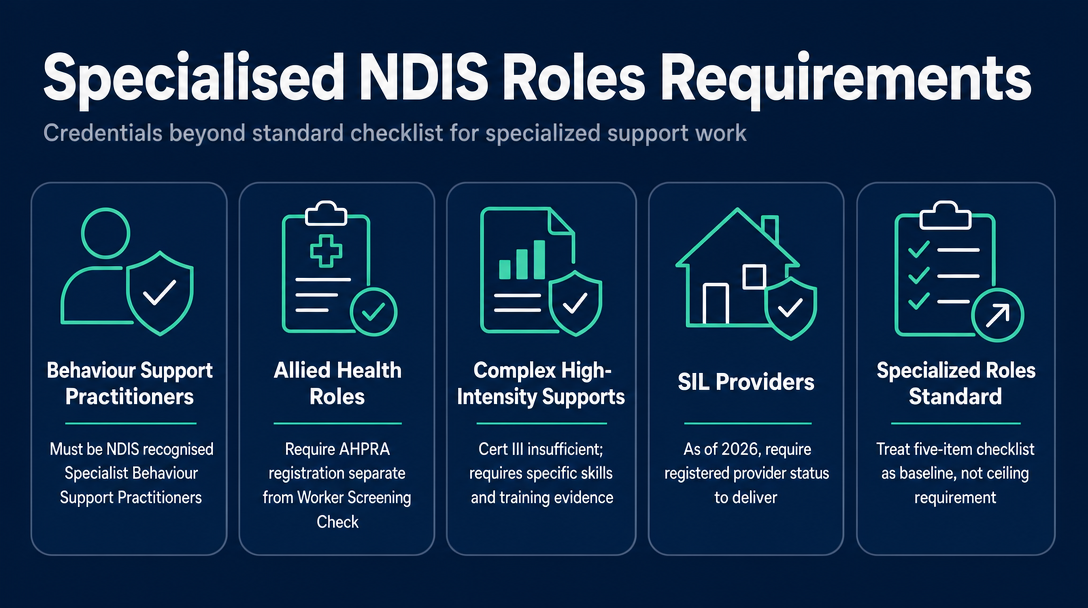
The five-item checklist covers most support work. Some roles require credentials above and beyond it:
- Behaviour Support Practitioners - must be recognised as Specialist Behaviour Support Practitioners by the NDIS Quality and Safeguards Commission; specific qualification pathways apply
- Allied health roles (occupational therapy, physiotherapy, speech pathology, psychology) - AHPRA registration is required; this sits above and separate from the NDIS Worker Screening Check
- Complex and high-intensity supports - the NDIS Practice Standards require evidence of specific skills and training for supports such as medication management, complex bowel care, or ventilator support; a Cert III alone does not qualify a worker for these roles
- Supported Independent Living (SIL) providers - as of 2026, SIL is a registered-only support category; if you are delivering SIL supports, you need registered provider status
If your role falls into any of these categories, treat the standard checklist as the floor, not the ceiling.
Frequently Asked Questions
Do I need a formal qualification to work as an NDIS support worker?
No national legislation mandates a specific qualification for general support work. The five core requirements - screening check, orientation module, First Aid, WWCC where applicable, and right to work - are the non-negotiables. Certificate III in Individual Support (CHC33021) is widely expected by employers and plan managers but is not legislatively required for standard roles.
Is the NDIS Worker Screening Check mandatory for sole traders?
Yes. The screening check is required for workers in risk-assessed roles regardless of whether they operate through a registered provider or as an unregistered sole trader. Self-employed status does not remove this obligation. Apply through your state or territory's screening unit.
How long is the NDIS Worker Screening Check valid, and do I need a new one if I move states?
The screening check is valid for five years. It is nationally recognised, meaning you do not need to reapply when changing employers, changing states, or moving between registered and unregistered arrangements. Your clearance remains current for its full five-year term.
Does my registration status affect how I invoice?
Yes - materially. As an unregistered sole trader, you can only serve self-managed and plan-managed participants. When billing plan-managed participants, the NDIS Pricing Arrangements apply and your support item codes and prices must align with the current Support Catalogue. Registered providers face price caps across all participant types and are also subject to Practice Standards audits.
What happens if I use the wrong support item code on an invoice?
The invoice may be rejected by the plan manager at processing. If an incorrect code results in an overpayment that is later identified by the NDIA, clawback or compliance action is possible. Using the current Support Catalogue and validating codes before sending is the practical safeguard.
Is the Worker Orientation Module free?
Yes. The NDIS Worker Orientation Module "Quality, Safety and You" is published by the NDIS Quality and Safeguards Commission at no cost. It is self-paced, available online, and issues a downloadable certificate of completion. There is no fee to access or complete it.
Tick the Checklist. Then Make Sure Your Invoices Pass Too.
Meeting the NDIS support worker requirements gets you in the door. Keeping your invoices compliant is what keeps you working.
NDISInvoice.com.au validates every line item against the current NDIS Pricing Schedule before you send - catching outdated support codes, prices above the cap, and wrong day/time classifications in real time. Create a compliant invoice now.
More articles
- How to Create Your First NDIS Invoice in Under 5 Minutes (Step-by-Step Video Companion)
- NDIS Plan Manager Turnaround Times: How Long Should You Wait to Be Paid After Submitting an Invoice?
- NDIS Invoice Numbering: Do You Need a Sequential System? (And What Happens If You Don't Have One)
- How to Handle a Rejected NDIS Invoice: Diagnosis, Correction, and Resubmission Step by Step
- NDIS Allied Health Invoicing: How Physiotherapy, Speech Therapy, and OT Codes Work in the Price Guide