NDIS Support Worker Salary vs. Sole Trader Rate: What You Actually Take Home at 2026-27 Prices
Written by Cory Nathan, founder of NDIS Invoice · Last reviewed
A sole-trader support worker invoicing at the NDIS price limit earns a higher gross rate than a SCHADS Award employee working the same hours - but once
12 min read
NDIS Support Worker Salary vs. Sole Trader Rate: What You Actually Take Home at 2026-27 Prices
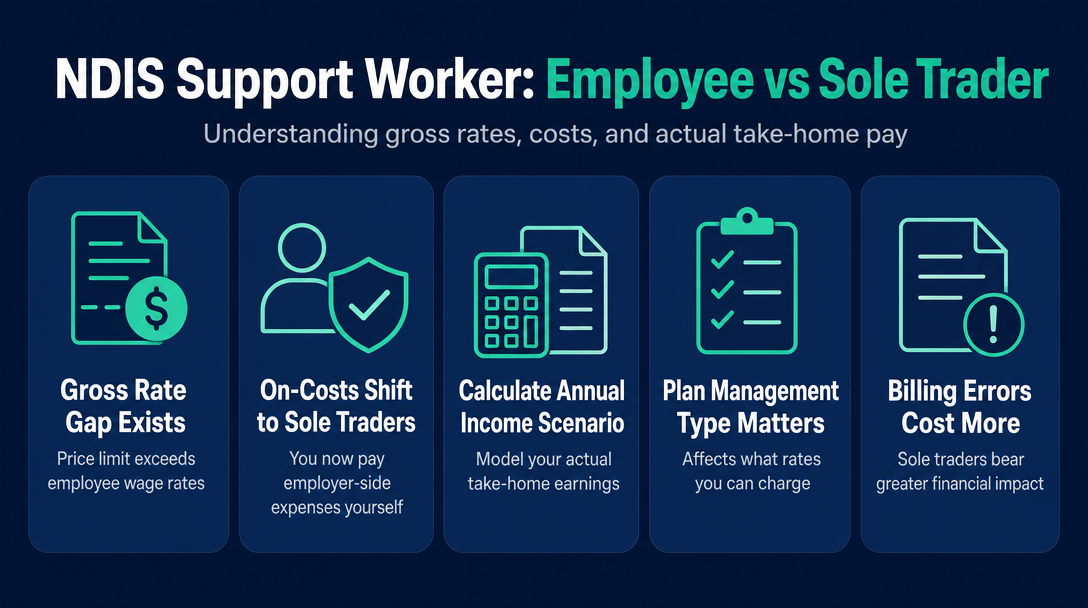
A sole-trader support worker invoicing at the NDIS price limit earns a higher gross rate than a SCHADS Award employee working the same hours - but once you subtract self-funded superannuation, unpaid leave, insurance, and non-billable admin time, the gap shrinks considerably. Whether you actually come out ahead depends on your billable-hour volume and how tightly you control what we call the Sole Trader On-Cost Stack.
The Gross Rate Gap - Why the Price Limit Doesn't Equal Your Pay
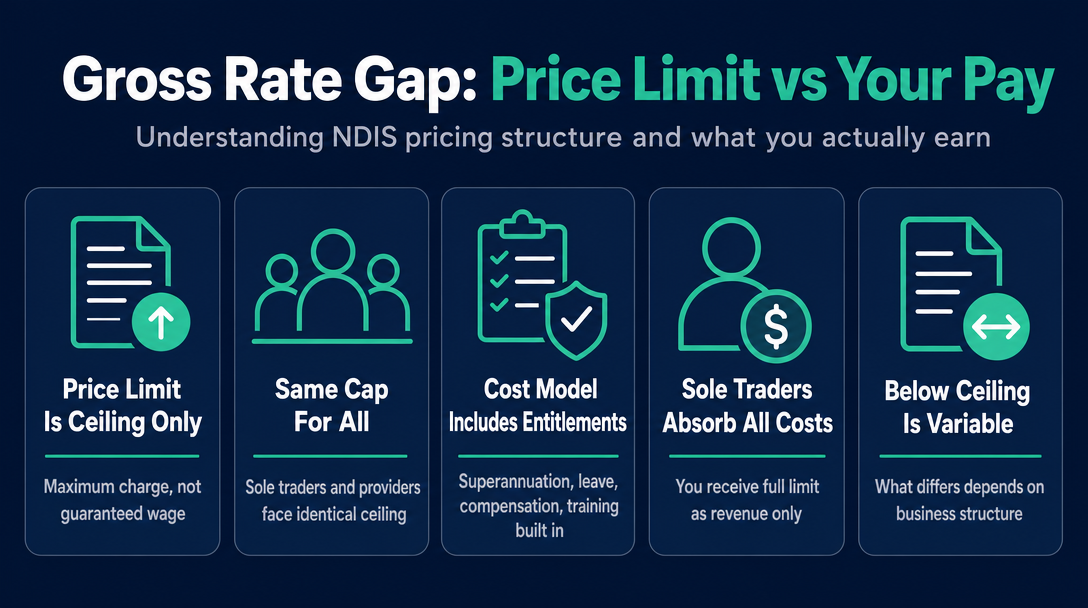
The NDIS Pricing Arrangements and Price Limits 2026-27 set a maximum charge, not a guaranteed wage. A large disability provider and a sole trader with an ABN face the same ceiling - there are no separate "sole trader rates." The price limits are identical regardless of your business structure.
What differs is what happens below that ceiling.
The NDIA publishes a Disability Support Worker Cost Model alongside its pricing schedules. That cost model is how the NDIA justifies the price limit levels - it builds in the cost of employee entitlements (superannuation, annual leave loading, workers' compensation, training) so that a registered provider can pay a SCHADS-compliant wage and still operate within the cap. When you operate as a sole trader, you receive the full price limit as revenue. You also absorb every one of those baked-in costs personally.
What is the NDIS price limit for standard support work?
For weekday daytime standard support (Assistance with Daily Life, support item 01_011_0107_1_1), the 2026-27 price limit is listed at $73.58 per hour (verify this against the current NDIS Pricing Schedule before invoicing, as rates update each July under the Annual Pricing Review). Public holiday support reaches $163.46 per hour under the same schedule.
What does the SCHADS Award guarantee an employee?
The Social, Community, Home Care and Disability Services Industry Award sets the minimum a registered employer must pay. From the first full pay period after 1 July 2026, SCHADS rates increased by 4.75%. For the current Level 2.1 weekday rate, check the Fair Work Ombudsman's pay guide directly - the precise dollar figure is not reproduced here because Fair Work updates it with each Annual Wage Review and a stale number causes more harm than a live link. What matters for this comparison is that the employer pays that rate plus the superannuation guarantee plus leave entitlements on top.
The Sole Trader On-Cost Stack - What Employers Pay That You Now Pay Yourself
When you map every entitlement an employer would pay on top of an employee's SCHADS wage, you get the Sole Trader On-Cost Stack - the portion of your price-limit revenue that doesn't reach your bank account. Here is every item, side by side:
| Cost item | SCHADS employee | Sole trader (ABN) |
|---|---|---|
| Base pay / charge rate | Employer pays SCHADS minimum; entitlements are in addition | You invoice at or below the price limit; this is your gross revenue |
| Superannuation | Employer pays 11.5% SGC (rising to 12% from 1 July 2026) on top of wages | You self-fund from your own revenue - it is not compulsory, but forgoing it means no employer contribution |
| Annual leave (4 weeks) | Paid by employer; you still get paid | No revenue for those weeks - four weeks of zero income |
| Personal / sick leave (10 days) | Paid by employer | No revenue if you are unwell - ten days at zero income |
| Public holidays | Penalty rates or paid day off depending on roster | Only earns revenue if you invoice a shift on that date |
| Workers' compensation insurance | Employer arranges and pays the premium | You self-arrange; often bundled with public liability cover |
| Public liability + professional indemnity insurance | Employer holds the policy | Self-fund - combined cover starts from around $420 per year according to insurance providers, and higher-risk work attracts higher premiums |
| Payroll tax / employer compliance | Employer manages all obligations | You manage BAS lodgements, income tax, and GST registration if applicable |
| Non-billable admin time | You are paid for your contracted hours including admin | Invoicing, scheduling, travel, reporting, and compliance are all unpaid - they come directly out of your effective hourly rate |
Superannuation: the cost most sole traders underestimate
From 1 July 2026, the Superannuation Guarantee sits at 12%. An employee earning $60,000 in base wages receives an additional $7,200 in superannuation from their employer each year. A sole trader who does not set aside an equivalent amount is effectively earning $7,200 less annually in total compensation - even if their gross invoiced revenue looks higher.
Insurance: not optional, practically speaking
Most plan managers and participants expect you to carry public liability insurance at a minimum. Professional indemnity is strongly advisable for any work involving personal care. Combined cover starts from around $420 per year at the lower end of the market; it rises with the hours you work and the complexity of the supports you deliver. This is a fixed cost that reduces your net income regardless of how many shifts you complete.
The Real Numbers - A Worked Annual Income Scenario
Rather than present a fabricated dollar comparison, consider the structural arithmetic:
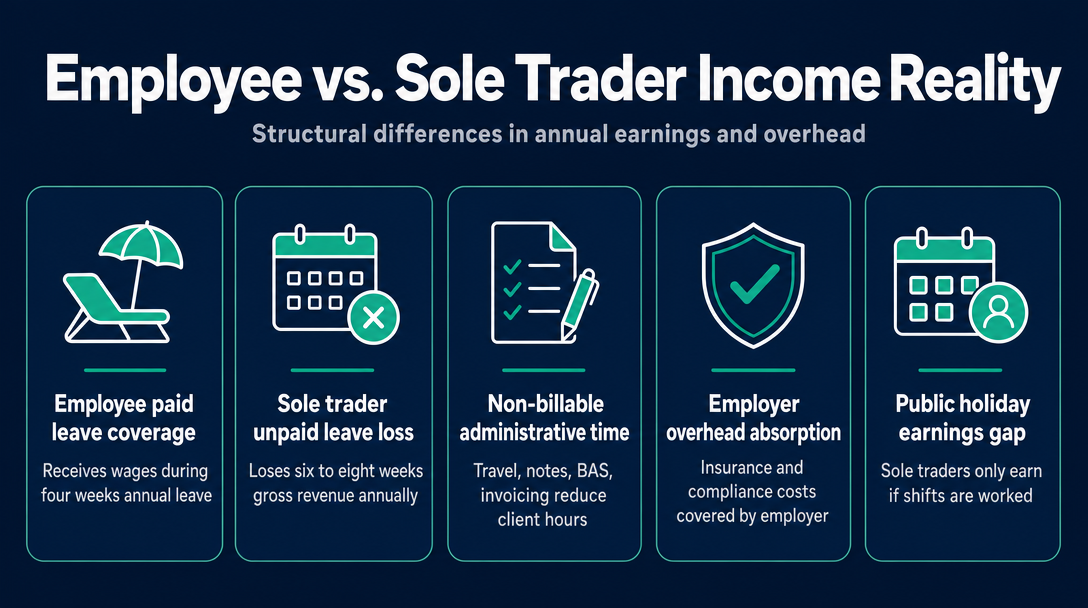
A full-time SCHADS employee working 38 paid hours per week for 52 weeks receives wages for all 52 weeks - including four weeks of annual leave and personal leave days - plus superannuation on top. Their employer absorbs insurance and compliance costs as a business overhead.
A sole trader working a comparable schedule faces a materially different calculation:
- Billable weeks: After four weeks of annual leave (unpaid), ten personal/sick leave days (unpaid), and public holidays (only earns if shifts are worked), a sole trader who mirrors an employee's break pattern loses roughly six to eight weeks of gross revenue annually.
- Billable hours within each week: A 40-hour working week does not produce 40 billable client hours. Travel between clients, shift notes, BAS preparation, invoice reconciliation, and participant communications consume meaningful time. A working week with substantially fewer client-facing hours than total working hours is normal for a self-managing sole trader - the remaining time is real labour with no corresponding invoice.
- The effective hourly rate formula: Divide your actual weekly gross income by the total hours you worked that week - not just the hours you invoiced. If you invoiced 28 hours at $73.58 but spent 40 hours on work-related activity, your effective rate is based on 28 hours of revenue spread across 40 hours of effort. That is the number to compare against an employee's hourly wage.
- After-tax position: Sole traders pay income tax at marginal rates on net business income through their individual tax return. Employees benefit from PAYG withholding and employer-managed tax obligations. A sole trader who does not set aside tax throughout the year faces a potentially large ATO bill at year end.
The bottom line: A sole trader who maintains consistently high billable hours, self-funds superannuation, holds appropriate insurance, and invoices accurately at or near the price limit can achieve a better annual outcome than a base-level SCHADS employee. The key words are "consistently high billable hours" and "invoices accurately." When either condition is missing, the on-cost stack closes the gap quickly - and the sole trader structure can actually produce less net income.
For a complete guide to setting up the foundations before running this comparison yourself, the cornerstone resource for this pillar is the NDIS Sole Trader Support Worker Setup checklist at NDISInvoice.com.au.
Plan Management Type - How It Changes What You Can Actually Charge
Not all NDIS participants are equal from a sole-trader income perspective. The plan management type determines who you can serve and how much flexibility you have on rate.
| Plan management type | Can an unregistered sole trader serve this participant? | Rate flexibility |
|---|---|---|
| Self-managed | Yes | Participant can negotiate directly; you may charge at, below, or (in some circumstances) above the price limit if the participant agrees |
| Plan-managed | Yes | You invoice the plan manager; must stay at or below the price limit; invoice accuracy is critical because plan managers check codes and rates |
| NDIA-managed (Agency-managed) | Generally no, for most supports | Registered providers only; unregistered sole traders are generally excluded |
Can an unregistered sole trader serve NDIA-managed participants?
For most supports, no. The NDIA requires registered providers for NDIA-managed participants. This is a meaningful income ceiling that employees of registered providers do not face - an employee's employer handles registration and can serve any plan management type. A sole trader who is not registered limits their client pool to self-managed and plan-managed participants from the outset.
If growing into NDIA-managed work is part of your plan, NDIS provider registration is a separate process with its own requirements - it is not covered here, but the NDIS pricing arrangements page is the starting point for understanding what registration unlocks.
Where Billing Errors Hit Sole Traders Harder Than Employees
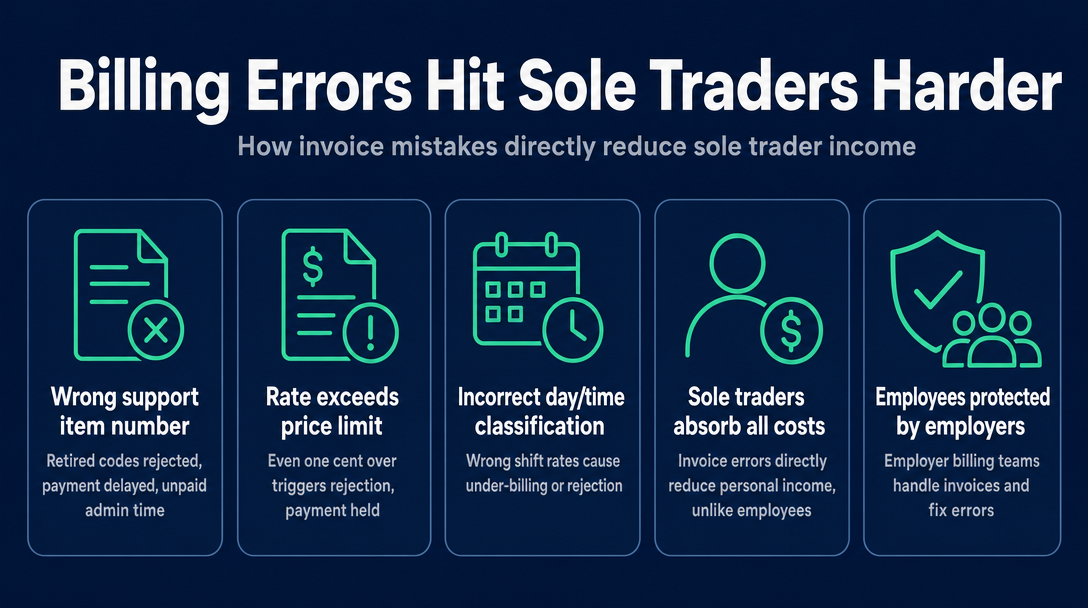
An employee never thinks about support item numbers. Their employer's billing team handles every invoice, and if there is an error, it is the organisation's problem to fix and absorb. As a sole trader, the invoice is your pay cheque. An error on it is a direct reduction in your income.
The most common invoice errors that cost sole traders money:
- Wrong support item number: A code that has been retired or replaced since the last pricing update will be rejected by the plan manager or NDIA system. You re-invoice, the payment is delayed, and the administrative time is unpaid.
- Rate above the price limit: A plan manager is obligated to reject any line item that exceeds the current price cap. If your rate is one cent over - perhaps because you haven't updated to the 2026-27 schedule - the invoice comes back and the shift's payment is held.
- Wrong day/time classification: A Saturday evening shift invoiced at the weekday daytime rate is under-billing. A weekday shift incorrectly claimed at the Saturday rate will be rejected. Both cost you money - one immediately, one through delayed re-invoicing.
- Outdated support codes: The Annual Pricing Review each July does not just change rates - it can retire codes, introduce new ones, and modify item descriptions. An invoice using a code that no longer exists in the current schedule will fail.
For an employed support worker, none of these errors touch their salary. For a sole trader, each one is a deduction from the income they were counting on.
NDISInvoice.com.au is a free, browser-based tool that validates every line item on your invoice against the current NDIS Pricing Schedule before you send it - flagging outdated codes, rates above the price cap, and incorrect day/time classifications in real time. It is the simplest way to close the gap between what you invoice and what you are entitled to.
Frequently Asked Questions
Do sole traders earn more than NDIS employees?
On a gross basis, yes - a sole trader invoicing at the price limit receives more per hour than a SCHADS Award employee earns. On a net basis, it depends. The Sole Trader On-Cost Stack (self-funded super, unpaid leave, insurance, non-billable hours) substantially narrows the gap. Sole traders who maintain high billable hours and manage their on-costs proactively can come out ahead; those with inconsistent work or high admin loads often do not.
Do NDIS sole traders have to pay their own superannuation?
Sole traders are not legally required to pay themselves superannuation the way an employer must pay it for employees. However, by not doing so, they forgo the equivalent of the Superannuation Guarantee - currently 12% from 1 July 2026 - that an employer would contribute on top of a SCHADS wage. Over a working career, the compounding difference is significant. Most financial advisers recommend sole traders treat super contributions as a non-negotiable operating cost.
Is a Mable or Hireup platform worker the same as an independent sole trader?
Not quite. Platform workers typically operate under an ABN and are independent contractors, but they agree to the platform's terms and pay a platform service fee on each booking. That fee comes directly off their effective rate - so the price-limit ceiling is the same, but the amount reaching the worker's account is lower than it would be for a fully independent sole trader arranging their own clients. For a direct income comparison, account for the platform fee as an additional layer of the on-cost stack.
When is it financially better to stay as a SCHADS employee?
Employee status tends to be more financially secure when: your available work hours are inconsistent (unpredictable gaps make sole-trader revenue volatile); you have limited appetite for business administration; paid leave entitlements are important to you (e.g. you have caring responsibilities or health needs); or you cannot access enough self-managed or plan-managed participants to fill a viable schedule. The employed structure also eliminates invoice-error risk entirely.
Does GST affect a sole trader's take-home pay?
NDIS disability supports are GST-free under Australian tax law, meaning you do not charge GST on top of your NDIS invoices. However, once your annual turnover reaches the $75,000 threshold, you are required to register for GST with the ATO and lodge Business Activity Statements, even though the GST collected on NDIS services is $0. The administration burden is real even if the direct GST cost is not. It is worth tracking your turnover against this threshold as your client hours grow.
Is an invoice error really a financial risk for a sole trader?
Yes - directly. A rejected invoice delays payment, requires unpaid time to correct and resubmit, and may create cash flow problems if you rely on that payment within a particular fortnight. Unlike an employed support worker whose salary arrives regardless of billing outcomes, a sole trader's income is contingent on every invoice being accepted on the first submission.
Before your next invoice goes out, check it at NDISInvoice.com.au - a free, browser-based tool that validates every line item against the current NDIS Pricing Schedule before you send. No subscription. Just a clean invoice that matches the rate you are entitled to charge.
More articles
- How to Create Your First NDIS Invoice in Under 5 Minutes (Step-by-Step Video Companion)
- NDIS Plan Manager Turnaround Times: How Long Should You Wait to Be Paid After Submitting an Invoice?
- NDIS Invoice Numbering: Do You Need a Sequential System? (And What Happens If You Don't Have One)
- How to Handle a Rejected NDIS Invoice: Diagnosis, Correction, and Resubmission Step by Step
- NDIS Allied Health Invoicing: How Physiotherapy, Speech Therapy, and OT Codes Work in the Price Guide