Self-Managed NDIS Invoicing: What's Different, What's Flexible, and What Can Still Go Wrong
Written by Cory Nathan, founder of NDIS Invoice · Last reviewed
Self-managed NDIS funding gives participants the most control over how they spend their plan - but it does not give providers a free pass on compliance
13 min read
Self-Managed NDIS Invoicing: What's Different, What's Flexible, and What Can Still Go Wrong
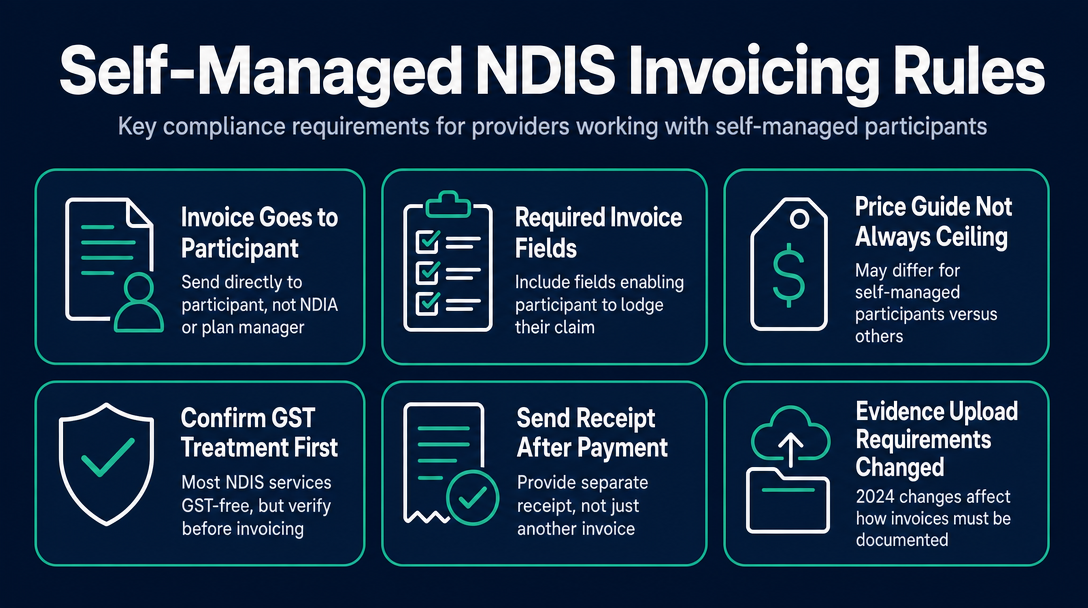
Self-managed NDIS funding gives participants the most control over how they spend their plan - but it does not give providers a free pass on compliance. The invoice rules are genuinely different from plan-managed invoicing in five specific ways, and misreading even one of them can leave you waiting on payment, asked to reissue documents, or exposed during an NDIA payment review.
Here is what every provider and sole trader needs to know before sending an invoice to a self-managed participant.
Quick answer - the five rule-layers for self-managed NDIS invoicing:
- Addressing - Your invoice goes to the participant (or their nominee), not a plan manager or the NDIA
- Fields - The invoice must contain specific information so the participant can lodge their myNDIS claim accurately
- Pricing - The NDIS price guide is not a hard ceiling for self-managed participants, but the flexibility belongs to them - not to you unilaterally
- GST - Most NDIS supports are GST-free under Section 38-38, but confirm before invoicing and use the correct document label
- Post-payment - You must send a receipt after payment, and since 2024, that receipt may need to be uploaded as evidence during NDIA payment reviews
Each layer is explained below.
Rule 1 - Your Invoice Goes to the Participant, Not the NDIA or a Plan Manager
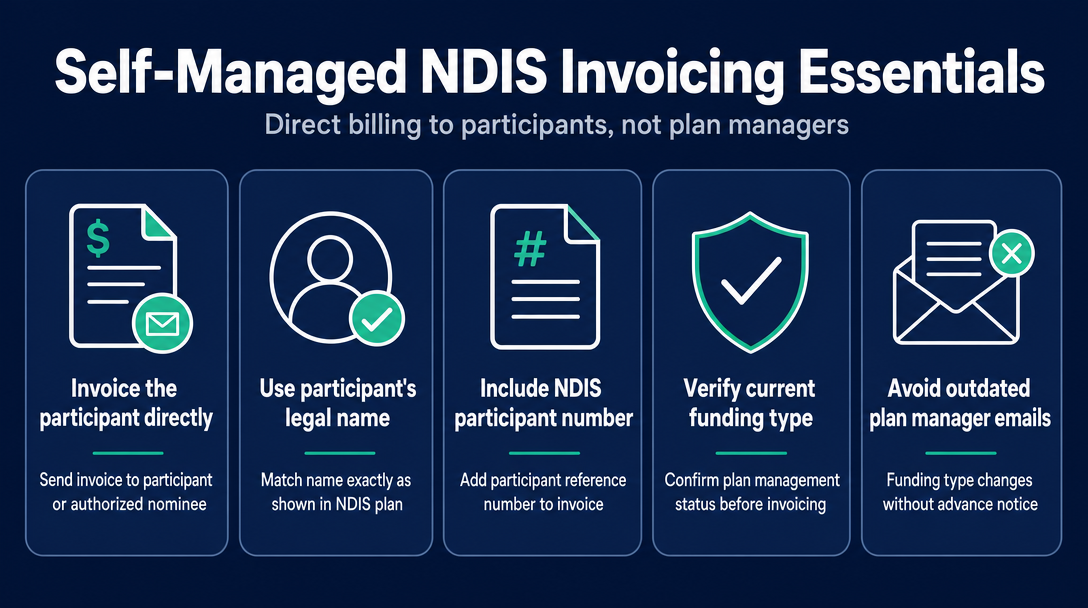
Self-managed invoicing removes the plan manager from the transaction entirely. You send your invoice directly to the participant - or, where applicable, to their plan nominee (a person authorised to manage the plan on their behalf) or a child representative for participants under 18.
Address the invoice to the participant's legal name exactly as it appears in their NDIS plan. Include their NDIS number (also called the participant reference number). If you have previously worked with this person under plan-managed funding and have a plan manager's accounts email on file, do not use it - funding type can change at plan review without notice. Always confirm how the participant's plan is managed before invoicing.
For this article's scope, the structural differences between self-managed and plan-managed payment pathways are the focus. For a full breakdown of how plan-managed invoicing works and who processes those invoices, see the NDIS Plan Management Explained cornerstone guide in this pillar.
Rule 2 - These Fields Must Appear on the Invoice (So the Participant Can Lodge Their Claim)
The reason invoice fields matter for self-managed participants is different from the plan-managed context. Here, the participant (or their nominee) takes your invoice and uses it to enter their payment request in the myNDIS app or myplace portal. A missing or unclear field means they cannot complete their claim accurately - and you do not get paid until they do.
According to the NDIS Guide to Getting Paid, the information required for a compliant payment request includes the participant reference number, dates of support, support item reference number, and support item price. A complete self-managed invoice should include all of the following:
- Your legal business name (or trading name, clearly linked to your ABN)
- Your ABN - required even when services are GST-free; the ABN is not optional
- Invoice number and invoice date
- Participant's full legal name
- Participant's NDIS number (their participant reference number)
- Date(s) of support delivery - each session or delivery date listed separately
- Description of each support - specific enough for the participant to identify the correct support category in the portal
- Support item reference number - technically optional for self-managed participants, but including it prevents the participant from guessing the right category and dramatically reduces claim errors. Always include it.
- Quantity - hours, units, or days; match the unit of measure from the NDIS Support Catalogue
- Unit price and line-item total
- GST treatment - see Rule 4 below
One practical note on support categories: The participant cannot use a single payment request to claim across multiple support categories. If your invoice includes supports from, say, Assistance with Daily Life and Assistance with Social Participation, the participant will need to lodge two separate payment requests in the portal - one per category. Flag this to new self-managed clients early; it causes confusion and delays when discovered at the claiming stage.
Rule 3 - The Price Guide Is a Ceiling for Others, But Not Always for Self-Managed Participants
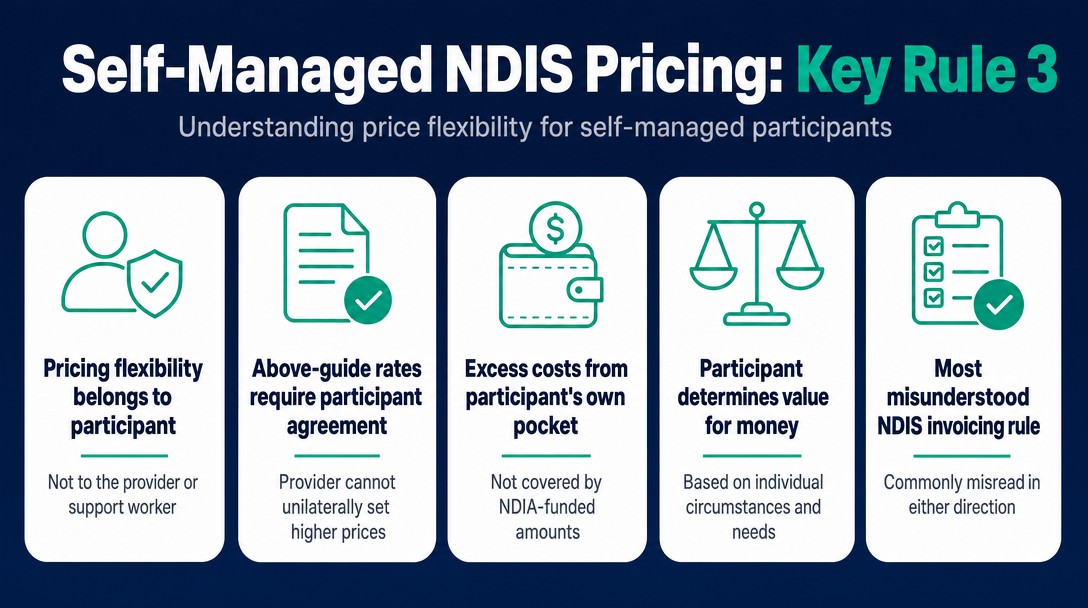
This is the most misunderstood rule in self-managed invoicing - and the one most likely to cause problems if read carelessly in either direction.
The NDIS Pricing Arrangements and Price Limits document states explicitly: "Self-managing participants can use registered or unregistered providers and are not subject to the price limits or other pricing arrangements set out in the NDIS Pricing Arrangements and Price Limits and its associated documents."
That sounds like providers can charge whatever they like. It does not work that way.
The pricing flexibility belongs to the participant, not to the provider. A self-managed participant can agree to pay above the standard price limit if they determine the support represents value for money for their individual circumstances - but the provider cannot unilaterally set an above-guide rate and assume it will be accepted. The key distinction: the excess cost above the standard price limit typically comes from the participant's own pocket, not from NDIA-funded amounts. If a participant is not clearly informed that a rate exceeds the guide, and pays assuming full reimbursement, that creates a dispute.
What this means in practice:
- If you want to charge above the standard rate, document it in a written service agreement before you start supports. Specify the agreed rate, confirm the participant understands it may exceed standard NDIA pricing, and note that any shortfall in reimbursement is their responsibility.
- The NDIS Code of Conduct applies to all providers regardless of the participant's management type - the NDIS Quality and Safeguards Commission can scrutinise providers who systematically charge self-managed participants inflated rates.
- Charging below the price guide is always permissible and needs no special documentation beyond your service agreement.
The myth that "self-managed means anything goes on pricing" is wrong. The flexibility is real, but it requires participant consent, documentation, and genuine value for money.
Rule 4 - GST Treatment: Most NDIS Services Are GST-Free, But Confirm Before Invoicing
Most supports delivered to a self-managed participant are GST-free under Section 38-38 of the A New Tax System (Goods and Services Tax) Act 1999. Four conditions generally need to be met: the supply is a type covered under the NDIS Disability Supports Determination; the recipient has a current NDIS-approved plan; the supply is made under a written agreement (broadly interpreted); and the supplier meets relevant registration or exemption thresholds.
Practical invoicing consequences:
- If your supply is GST-free: do not add 10% GST. Do not head the document "Tax Invoice" - use "Invoice" instead. Your ABN still appears on the document.
- If GST applies (less common in direct NDIS support work): head the document "Tax Invoice," show the GST amount as a separate line item, and show the GST-inclusive total.
- Subcontractor exception: If you are a support worker invoicing another provider (rather than invoicing the participant directly), standard 10% GST typically applies to your invoice to that provider. This is a commonly missed distinction that catches sole traders out.
If you are a sole trader whose annual turnover is below the ATO's GST registration threshold, you are not registered for GST and do not charge it regardless. Once your turnover exceeds that threshold, you must register with the ATO - but NDIS-funded supplies to participants remain GST-free, meaning you do not charge clients GST on those supplies, while still being able to claim input tax credits on your business expenses. Confirm your GST status with your accountant or via ato.gov.au if you are near the threshold.
Rule 5 - After Payment, Send a Receipt (Not Just Another Invoice)
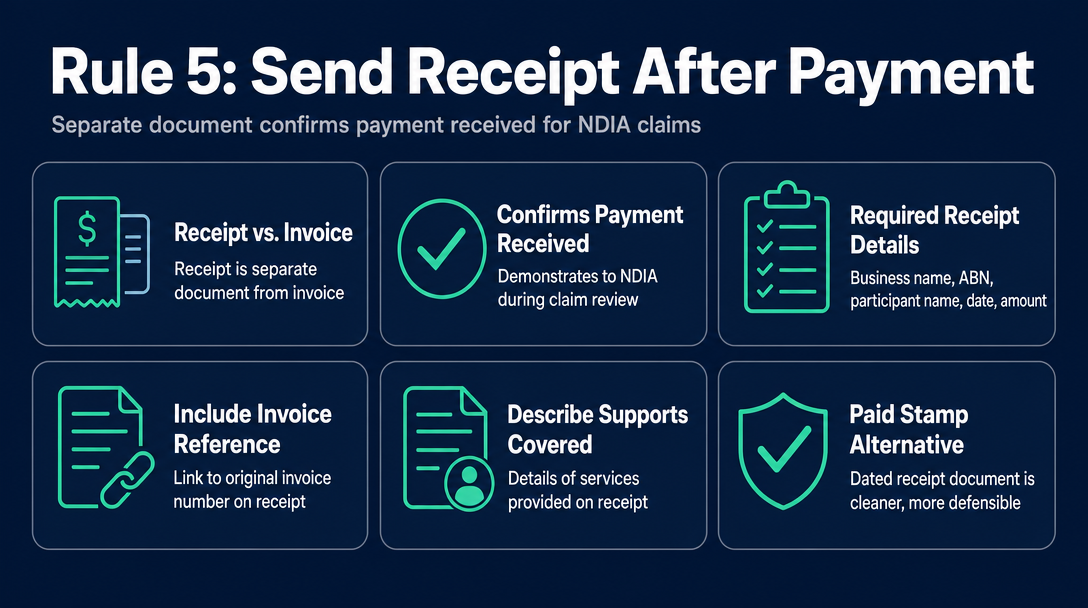
This rule is almost entirely absent from third-party guidance, yet it is clearly stated in the NDIS Guide to Getting Paid: "After they've paid your invoice, send them a receipt to acquit the expense against their plan."
A receipt is a separate document from the invoice. It confirms that payment was actually received - which is what the participant needs to demonstrate to the NDIA if their claim is reviewed. A receipt should include:
- Your business name and ABN
- The participant's name
- Date payment was received
- Amount paid
- Reference to the original invoice number
- Description of the supports covered
Stamping the original invoice "PAID" is a common workaround. It is not strictly prohibited, but a dated receipt document is cleaner and more defensible when a participant needs to upload evidence during a payment review (see Rule 6).
Rule 6 - The Evidence-Upload Requirement: What Changed in 2024 and Why It Affects Your Invoices
In 2024, the NDIA updated its processes for self-managed participants. As the NDIA's official announcement explains, self-managed participants may now be asked to upload supporting evidence - invoices and receipts - when they submit payment requests, rather than only producing records during formal audits.
Participants can upload evidence from a computer file or a photo directly within the myNDIS portal. The practical consequence for providers: your invoice must be detailed enough, correctly formatted, and clean enough to attach as a digital document without requiring revision. An invoice that is handwritten, missing the support item reference number, vague on support descriptions, or lacking delivery dates creates a bottleneck at the participant's claiming stage. They come back to you for a corrected version - and your payment waits.
Participants are required to keep invoices and receipts for five years under NDIS self-management rules. Keeping your own copies for the same period is prudent in case a participant requests a duplicate during an audit. (The full record-keeping framework for sole traders is covered in depth in our NDIS record-keeping article - this article does not repeat that material.)
The take-away for invoice design: treat every invoice you send to a self-managed participant as a document that may be attached to an NDIA portal submission. Clean formatting, complete fields, and a readable PDF output are no longer optional niceties.
Rule 7 - Payment Timing and Cash Flow: Understand the Reimbursement Cycle Before You Invoice
Self-managed invoicing creates a cash flow dynamic that is structurally different from plan-managed arrangements - and almost no provider guidance explains it clearly.
The NDIA typically reimburses self-managed participants within 2 business days of a payment request being submitted. But there are two distinct ways a participant can handle the sequence:
Pathway 1 - Claim first, then pay you: The participant submits their payment request to the NDIA before paying your invoice. Once the NDIA deposits funds into their nominated bank account (usually within 2 business days), they pay you. From your perspective, you may wait several business days from invoice date to receipt of payment.
Pathway 2 - Pay you first, then claim reimbursement: The participant pays you directly from their own funds, then lodges their claim for NDIA reimbursement. You are paid quickly, but the participant carries the short-term cash exposure.
Which pathway a participant uses is their choice. As a provider, you are effectively extending credit for however long the cycle takes. This is materially different from plan-managed invoicing, where the plan manager holds and disburses funds on the participant's behalf.
What to do: Discuss payment timing before you start supports. Include payment terms in your written service agreement (for example, "payment within 7 days of invoice date"). This gives you a documented basis to follow up if payment is delayed.
One thing you cannot do: Submit a payment request in the myplace provider portal for a self-managed participant. The provider portal claiming pathway is for agency-managed (NDIA-managed) participants only. For self-managed participants, your only action is to send the invoice to the participant and wait for their payment.
What if the participant doesn't pay?
Non-payment by a self-managed participant is a commercial dispute between you and the participant - there is no plan manager or NDIA to escalate to. A formal written payment demand is the first step; unresolved disputes may require the relevant state consumer tribunal (such as NCAT in NSW or VCAT in Victoria). A clear service agreement with documented payment terms is the best preventive measure.
Frequently Asked Questions
Do self-managed NDIS participants have to stick to the NDIS price guide?
No. The NDIS Pricing Arrangements and Price Limits document explicitly states that self-managing participants are not subject to the price limits set out in that document. They can agree to pay a provider above the standard rate if they determine the support represents value for money. However, any amount above what the NDIA will reimburse typically comes from the participant's own funds, and the agreement must be documented - providers cannot assume above-guide rates will be accepted without participant consent.
Can I work with a self-managed participant if I am not a registered NDIS provider?
Yes. Unregistered providers can work with self-managed participants. NDIS provider registration is required only to deliver supports to agency-managed (NDIA-managed) participants, or to deliver certain high-intensity or high-risk support types. Your invoicing process is the same whether you are registered or unregistered.
Is there a difference between what I put on an invoice for a self-managed versus a plan-managed participant?
The mandatory fields largely overlap, but the key difference is who receives and processes the invoice. A plan manager checks your invoice strictly against the price guide before approving payment. A self-managed participant uses your invoice to enter their claim in the myNDIS portal, so the fields need to give them enough information to select the right support category and enter accurate figures. Including the support item reference number is best practice for both types, but it is especially valuable for self-managed participants navigating the portal themselves.
How quickly will I be paid after invoicing a self-managed participant?
Once the participant submits their payment request, the NDIA typically reimburses them within 2 business days. If the participant claims before paying you, add that reimbursement window to your wait time. Agree on payment terms in your service agreement (such as "within 7 days of invoice") to give yourself a clear timeline to follow up against.
Do I have to send a receipt after the participant pays me?
Yes. The NDIS Guide to Getting Paid states that after a self-managed participant pays your invoice, you should send them a receipt to acquit the expense against their plan. Since 2024, participants may be asked to upload evidence of payment (including receipts) during NDIA payment reviews. A formal receipt with your ABN, the participant's name, the payment date, and the amount paid is the cleanest form of this evidence.
Ready to Build a Self-Managed-Compliant NDIS Invoice Right Now?
NDISInvoice.com.au is a free, browser-based tool built for Australian support workers and sole traders. Every line item is validated against the current NDIS Pricing Schedule before you send - catching wrong support item codes, outdated rates, and day/time classification errors that would otherwise hold up a self-managed participant's claim. Nothing you enter leaves your device.
Create your free NDIS invoice at NDISInvoice.com.au
More articles
- How to Create Your First NDIS Invoice in Under 5 Minutes (Step-by-Step Video Companion)
- NDIS Plan Manager Turnaround Times: How Long Should You Wait to Be Paid After Submitting an Invoice?
- NDIS Invoice Numbering: Do You Need a Sequential System? (And What Happens If You Don't Have One)
- How to Handle a Rejected NDIS Invoice: Diagnosis, Correction, and Resubmission Step by Step
- NDIS Allied Health Invoicing: How Physiotherapy, Speech Therapy, and OT Codes Work in the Price Guide